Tomistoma
Tomistoma is a genus of gavialid crocodilians. They are noted for their long narrow snouts used to catch fish, similar to the gharial. Tomistoma contains one extant (living) member, the false gharial, as well as potentially several extinct species: T. cairense, T. lusitanicum and T. coppensi. Previously assigned extinct species known from fossils are reclassified as different genera such as Eogavialis, Toyotamaphimeia and Sutekhsuchus.

Junkyardsparkle · CC0 · via Wikipedia/Commons. May be a photograph of a specimen, or an artist’s reconstruction — an interpretation of a skeleton, since colour and soft tissue are almost never preserved.
On record
Recorded, not inferred- Also called
- false gharialPBDB
- Sits inside
- TomistominaePBDB
- Diet
- carnivorePBDB, for Crocodylia
- Motility
- actively mobilePBDB, for Osteichthyes
- Environment
- marinePBDB, for Mesoeucrocodylia
Time the record covers
At least 40 million years on record.
The record covers at least 41.03 Mya to 774 ka. No occurrence read is dated outside 48.07 Mya to 0 Mya.
32 occurrences of Tomistoma on record, most of them in the Miocene. The Paleobiology Database records this as a living group. Bar height is expected occurrences, not a count: each fossil is spread across the span it is dated to, so a tall narrow bar means tight dating and a low wide one means loose.
When
32 occurrences- Eocene16%
- Oligocene7%
- Miocene48%
- Pliocene24%
- Pleistocene5%
These are dates about fossils, not the animal: the record can only begin after it arose and end before it died out, so either end may reach further. Shares are expected occurrences: a fossil dated to a span is counted partly in each period it straddles. More on what this infers.
Found in
15 formations
- Nkondo Formation · Albertine Group4
- Warwire Formation · Albertine Group2
- Lagos-Portimão Formation2
- Harudi Formation1
- Turkana Grit Formation1
- Bakate Formation1
Loading coastlines…
The named rock units Tomistoma has been recovered from, largest first. Drawn where the rock is now, not where it formed. 12 occurrences have no formation on record, which is common for older literature.
Tomistoma and its relatives
MioceneWhere Tomistoma and its relatives were recorded in the Miocene.
Found in the same rock
321 taxa- Carcharias taurus4 sites
- Galeocerdo aduncus4 sites
- Protopterus4 sites
- Alcelaphini3 sites
- Ceratotherium3 sites
- Diplodus jomnitanus3 sites
- Geochelone3 sites
- Hemipristis serra3 sites
- Isurus oxyrinchus3 sites
- Kobus3 sites
- Kolpochoerus afarensis3 sites
- Loxodonta exoptata3 sites
- Myliobatis3 sites
- Otodus megalodon3 sites
- Sivatherium3 sites
- Sparus cinctus3 sites
- Suidae3 sites
- Trionyx3 sites
- Anhinga melanogaster2 sites
- Australopithecus2 sites
- Bovidae2 sites
- Bovini2 sites
- Brachypotherium brachypus2 sites
- Bunocharax sp.2 sites
The Paleobiology Database records 32 sites for Tomistoma, and this reads all of them. The number is how many of those sites it was catalogued from too. The 24 sharing the most are listed.
This is not a list of everything alive at the time. It is only what has come out of the same ground as this animal and been written down.
Entered from
24 references- Late Cenozoic crocodiles (Reptilia: Crocodylidae) from the Western Rift, Uganda5
- The first australopithecine 2500 kilometres west of the Rift Valley (Chad)3
- Vertébrés (crocodiliens, poissons) du Miocène marin de l'Argarve occidentale2
- Ergebnisse der Forschungsreiten Prof. E. Stromers in den Wüsten Ägyptens. V. Tertiäre Wirbeltiere. 1. Beiträge zur Kenntnis der Krokodilier des ägyptischen Tertiärs.2
- An overview of the crocodylian fossil record from Sardinia (Italy)1
- Le site paléontologique du Grand Morier (Pont-Boutard, Indre-et-Loire, France): contexte géologique et détail biostratigraphique des formations cénozoïques à partir des assemblages de vertébrés fossiles1
- Presència de Tomistoma cf. lusitanica (Vianna i Moraes, 1945) (Reptilia: Crocodylia) al Burdigalià inferior de Mallorca (Illes Balears, Mediterrània occidental). Implicacions paleoambientals1
- Crocodilian faunal renewal in the Upper Oligocene of Western Europe1
- personal communication1
- Carnivora from Nkondo and Kisegi-Nyabusosi,Western Rift, Uganda1
- Palaeobiology of the Albertine rift valley,Uganda-Zaire1
- Late Cenozoic crocodilian fossils from Jiangsu1
Each of the 32 occurrences read was entered from one of these publications, ordered by how many each accounts for. This is not a search for papers mentioning the name. 12 further references are not listed. Entries link to doi.org where the Paleobiology Database holds an identifier, and to its own record where it does not. Relayed as the Paleobiology Database holds them, not checked against what they resolve to.
Media and terms
Media content2

Picture of Tomistoma
- Source
- Wikipedia/Commons
- Credit
- Junkyardsparkle
- Licence
- CC0
- Commercial use
- the licence allows it
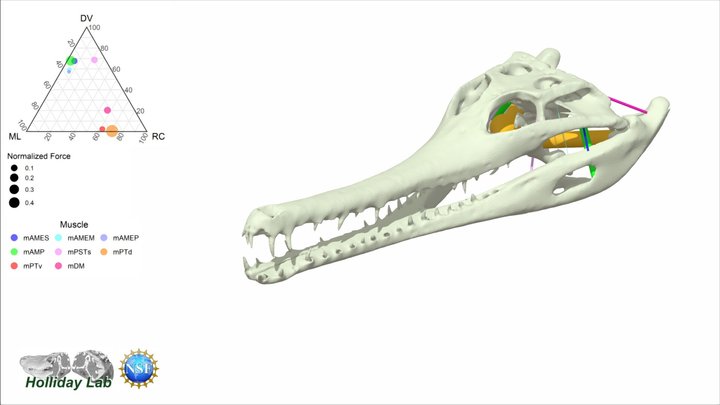
3D model
- Source
- Sketchfab
- Credit
- Holliday Lab
- Licence
- CC Attribution
- Commercial use
- cannot be read from the licence given — check the record
Smithsonian Open Access and MorphoSource were not reached for this taxon, so this list is what the others held rather than everything there is.
The description on this site
- Source
- Wikipedia, “Tomistoma”
- Licence
- CC BY-SA 4.0
This is what the site found, which is not the same as what exists.
Keep going
What may have been alongside itTomistominae through timeFormations of the MioceneThe world it lived on
Occurrence data from the Paleobiology Database, CC BY 4.0. Müller 1846