Trionychinae
The Trionychinae are a subfamily of turtles in the family Trionychidae.

Bastet78 · CC BY-SA 3.0 · via Wikipedia/Commons. May be a photograph of a specimen, or an artist’s reconstruction — an interpretation of a skeleton, since colour and soft tissue are almost never preserved.
On record
Recorded, not inferred- Also called
- softshell turtlePBDB
- Sits inside
- TrionychidaePBDB
- Diet
- piscivore, carnivorePBDB, for Trionychidae
- Life habit
- aquatic, solitaryPBDB, for Trionychidae
- Motility
- actively mobilePBDB, for Trionychidae
- Environment
- brackish,freshwaterPBDB, for Trionychidae
Time the record covers
At least 121 million years on record.
The record covers at least 121.4 Mya to 11.7 ka. No occurrence read is dated outside 125.77 Mya to 0 Mya.
625 occurrences of Trionychinae on record, most of them in the Miocene. The Paleobiology Database records this as a living group. Bar height is expected occurrences, not a count: each fossil is spread across the span it is dated to, so a tall narrow bar means tight dating and a low wide one means loose.
When
625 occurrences- Early Cretaceousunder 1%
- Late Cretaceous26%
- Paleocene8%
- Eocene24%
- Oligocene5%
- Miocene26%
- Pliocene3%
- Pleistocene7%
- Holocene1%
These are dates about fossils, not the animal: the record can only begin after it arose and end before it died out, so either end may reach further. Shares are expected occurrences: a fossil dated to a span is counted partly in each period it straddles. More on what this infers.
Found in
149 formations
- Kirtland Formation26
- Koobi Fora Formation · Omo Group23
- Denver Formation22
- Dinosaur Park Formation · Belly River Group18
- Bridger Formation14
- Hell Creek Formation · Montana Group14
Loading coastlines…
The named rock units Trionychinae has been recovered from, largest first. Drawn where the rock is now, not where it formed. 125 further formations hold fewer occurrences each and are not listed. 214 occurrences have no formation on record, which is common for older literature.
Trionychinae and its relatives
MioceneWhere Trionychinae and its relatives were recorded in the Miocene.
Found in the same rock
2,629 taxa- Trionyx111 sites
- Osteichthyes37 sites
- Hadrosauridae36 sites
- Lepisosteus36 sites
- Geochelone32 sites
- Crocodylus31 sites
- Teleostei31 sites
- Mammalia30 sites
- Theropoda29 sites
- Clarias28 sites
- Baenidae27 sites
- Anura26 sites
- Myledaphus bipartitus26 sites
- Lacertilia25 sites
- Aves24 sites
- Ceratopsidae24 sites
- Scapherpeton tectum24 sites
- Crocodylia23 sites
- Opisthotriton kayi23 sites
- Saurornitholestes langstoni23 sites
- Ankylosauria22 sites
- Champsosaurus natator22 sites
- Cyclurus22 sites
- Chelydridae21 sites
The Paleobiology Database records 557 sites for Trionychinae, and this reads 240 of them. The number is how many of those sites it was catalogued from too. The 24 sharing the most are listed.
This is not a list of everything alive at the time. It is only what has come out of the same ground as this animal and been written down.
Entered from
241 references- Contribution a l'etude des Cheloniens. Cheloniens continentaux due Cretace et du Tertiare de France70
- Synonymies and reidentifications of North American fossil vertebrates and so forth46
- Re-assessment of Late Campanian (Kirtlandian) turtles from the Upper Cretaceous Fruitland and Kirtland formations, San Juan Basin, New Mexico, USA30
- The fossil turtles of North America19
- Exceptional continental record of biotic recovery after the Cretaceous–Paleogene mass extinction14
- Fossile Schildkroten aus der Turkei12
- A preliminary report on southeast Asia's oldest Cenozoic turtle fauna from the late middle Eocene Pondaung Formation, Myanmar11
- Late Cretaceous and early Paleocene turtles of the Denver Basin, Colorado10
- Amphibians and reptiles from the Early Miocene of the Bardenas Reales of Navarre (Ebro Basin, Iberian Peninsula)10
- Koobi Fora Research Project The Fossil Ungulates: Proboscidea, Perissodactyla, Suidae10
- A new species of trionychid turtle, Axestemys infernalis sp. nov., from the Late Cretaceous (Maastrichtian) Hell Creek and Lance formations of the Northern Great Plains, USA9
- Soft-shelled turtles (Trionychidae) from the Cenomanian of Uzbekistan9
Each of the 625 occurrences read was entered from one of these publications, ordered by how many each accounts for. This is not a search for papers mentioning the name. 229 further references are not listed. Entries link to doi.org where the Paleobiology Database holds an identifier, and to its own record where it does not. Relayed as the Paleobiology Database holds them, not checked against what they resolve to.
Media and terms
Media content1
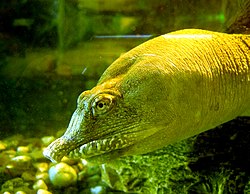
Picture of Trionychinae
- Source
- Wikipedia/Commons
- Credit
- Bastet78
- Licence
- CC BY-SA 3.0
- Commercial use
- the licence allows it
No 3D scan was found. Smithsonian Open Access, MorphoSource and Sketchfab were all searched.
The description on this site
- Licence
- CC BY-SA 4.0
This is what the site found, which is not the same as what exists.
Keep going
What may have been alongside itTrionychidae through timeFormations of the MioceneThe world it lived on
Occurrence data from the Paleobiology Database, CC BY 4.0. (Gray 1825)