Channa
Channa is a genus of predatory fish in the family Channidae, commonly known as snakeheads, native to freshwater habitats in Asia. This genus contains about 50 scientifically described species. The genus has a wide natural distribution extending from Iraq in the west, to Indonesia and China in the east, and parts of Siberia in the Far East. A particularly high richness of species exists in Myanmar (Burma), Bangladesh and northeastern India, and many Channa species live nowhere else. In contrast, a few widespread species have been introduced to several regions outside their natural range, where they often become invasive. The large and medium-sized Channa species are among the most common staple food fish in several Asian countries, and they are extensively cultured. Apart from their importance as a food fish, snakeheads are consumed in some regions as a traditional medicine for wound healing and reducing postoperative pain and discomfort, and collected for the international aquarium pet trade.

George Chernilevsky · Public Domain · via Wikipedia/Commons. May be a photograph of a specimen, or an artist’s reconstruction — an interpretation of a skeleton, since colour and soft tissue are almost never preserved.
On record
Recorded, not inferred- Sits inside
- ChannidaePBDB
- Motility
- actively mobilePBDB, for Osteichthyes
Time the record covers
At least 12 million years on record.
The record covers at least 15.98 Mya to 3.6 Mya. No occurrence read is dated outside 20.45 Mya to 2.58 Mya.
14 occurrences of Channa on record, most of them in the Miocene. The Paleobiology Database records this as a living group, and the chart stops with its fossils rather than at the present. Bar height is expected occurrences, not a count: each fossil is spread across the span it is dated to, so a tall narrow bar means tight dating and a low wide one means loose.
When
14 occurrencesThese are dates about fossils, not the animal: the record can only begin after it arose and end before it died out, so either end may reach further. Shares are expected occurrences: a fossil dated to a span is counted partly in each period it straddles. More on what this infers.
Found in
2 formations
- Upper Freshwater Molasse Formation · Molasse Group5
- Brackwater Molasse Formation · Molasse Group2
Loading coastlines…
The named rock units Channa has been recovered from, largest first. Drawn where the rock is now, not where it formed. 7 occurrences have no formation on record, which is common for older literature.
Channa and its relatives
MioceneWhere Channa and its relatives were recorded in the Miocene.
Found in the same rock
283 taxa- Lacerta6 sites
- Ophisaurus6 sites
- Testudo6 sites
- Palaeocarassius5 sites
- Prolagus oeningensis5 sites
- Trionyx5 sites
- Chamaeleo4 sites
- Chelotriton4 sites
- Colubrinae4 sites
- Diplocynodon ungeri4 sites
- Geochelone4 sites
- Latonia gigantea4 sites
- Mauremys4 sites
- Palaeoleuciscus4 sites
- Acrochordus dehmi3 sites
- Anguidae3 sites
- Barbus3 sites
- Batagur3 sites
- Brachypotherium3 sites
- Claridae indet.3 sites
- Coluber caspioides3 sites
- Democricetodon minor gracilis3 sites
- Democricetodon mutilus3 sites
- Diplocynodon3 sites
The Paleobiology Database records 13 sites for Channa, and this reads all of them. The number is how many of those sites it was catalogued from too. The 24 sharing the most are listed.
This is not a list of everything alive at the time. It is only what has come out of the same ground as this animal and been written down.
Entered from
8 references- Vertebrate microfossils from the Upper Freshwater Molasse in the Swiss Molasse Basin: Implications for the evolution of the North Alpine Foreland Basin during the Miocene Climate Optimum3
- Miocene vertebrates from the Siwalik Group, Western Nepal3
- Snakes from Griesbeckerzell (Langhian, Early Badenian), North Alpine Foreland Basin (Germany), with comments on the evolution of snake faunas in Central Europe during the Miocene Climatic Optimum2
- Stratigraphy and mammal faunas of the Brackwassermolasse in the surroundings of Ulm (Southwest Germany)2
- Pliocene otoliths from NW India reveal first fossil osphronemid and structure of a Himalayan freshwater ecosystem1
- Ectothermic vertebrates (Actinopterygii, Allocaudata, Urodela, Anura, Crocodylia, Squamata) from the Miocene of Sandelzhausen (Germany, Bavaria) and their implications for environment reconstruction and palaeoclimate1
- Biostratigraphy and palaeoecology of a Middle Miocene (Karpathian, MN 5) fauna from the northern margin of the North Alpine Foreland Basin (Oggenhausen 2, SW' Germany)1
- Biostratigraphy and sedimentology of the Fluviatile Untere Serie (Early and Middle Miocene) in the central part of the North Alpine Foreland Basin: implications for palaeoenvironment and climate1
Each of the 14 occurrences read was entered from one of these publications, ordered by how many each accounts for. This is not a search for papers mentioning the name. Entries link to doi.org where the Paleobiology Database holds an identifier, and to its own record where it does not. Relayed as the Paleobiology Database holds them, not checked against what they resolve to.
Media and terms
Media content2
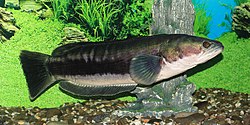
Picture of Channa
- Source
- Wikipedia/Commons
- Credit
- George Chernilevsky
- Licence
- Public Domain
- Commercial use
- the licence allows it
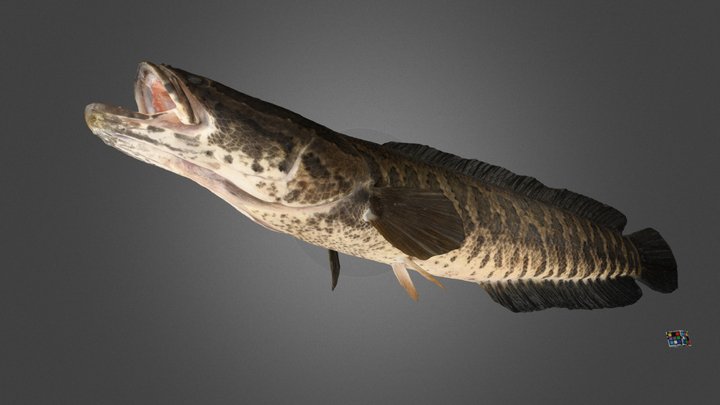
3D model
- Source
- Sketchfab
- Licence
- CC0 Public Domain
- Commercial use
- the licence allows it
Smithsonian Open Access and MorphoSource were not reached for this taxon, so this list is what the others held rather than everything there is.
The description on this site
- Source
- Wikipedia, “Channa”
- Licence
- CC BY-SA 4.0
This is what the site found, which is not the same as what exists.
Keep going
What may have been alongside itChannidae through timeFormations of the MioceneThe world it lived on
Occurrence data from the Paleobiology Database, CC BY 4.0. Scopoli 1770