Chironomoidea
The Chironomoidea are a superfamily within the order Diptera, suborder Nematocera, infraorder Culicomorpha. This superfamily contains the families Chironomidae, Ceratopogonidae, Simuliidae, and Thaumaleidae.

Uncredited · Attribution · via Wikipedia/Commons. May be a photograph of a specimen, or an artist’s reconstruction — an interpretation of a skeleton, since colour and soft tissue are almost never preserved.
On record
Recorded, not inferred- Sits inside
- CulicomorphaPBDB
- Motility
- actively mobilePBDB, for Arthropoda
- Environment
- terrestrialPBDB, for Insecta
Time the record covers
At least 245 million years on record.
The record covers at least 245.19 Mya to 11.7 ka. No occurrence read is dated outside 247 Mya to 0 Mya.
1,553 occurrences of Chironomoidea on record, most of them in the Eocene. The Paleobiology Database records this as a living group. Bar height is expected occurrences, not a count: each fossil is spread across the span it is dated to, so a tall narrow bar means tight dating and a low wide one means loose.
When
1,553 occurrences- Middle Triassicunder 1%
- Late Triassicunder 1%
- Early Jurassicunder 1%
- Middle Jurassicunder 1%
- Late Jurassic4%
- Early Cretaceous11%
- Late Cretaceous13%
- Paleoceneunder 1%
- Eocene46%
- Oligocene5%
- Miocene16%
- Plioceneunder 1%
- Pleistocene4%
- Holocene1%
These are dates about fossils, not the animal: the record can only begin after it arose and end before it died out, so either end may reach further. Shares are expected occurrences: a fossil dated to a span is counted partly in each period it straddles. More on what this infers.
Found in
74 formations
- Barstow Formation119
- Rott Formation62
- Foremost Formation · Belly River Group57
- Argiles d'lignite du Soissonnais Formation38
- Kheta Formation27
- Raritan Formation · Potomac Group20
Loading coastlines…
The named rock units Chironomoidea has been recovered from, largest first. Drawn where the rock is now, not where it formed. 50 further formations hold fewer occurrences each and are not listed. 964 occurrences have no formation on record, which is common for older literature.
Chironomoidea and its relatives
EoceneWhere Chironomoidea and its relatives were recorded in the Eocene.
Found in the same rock
7,275 taxa- Dasyhelea antiqua33 sites
- Anostraca22 sites
- Forcipomyia22 sites
- Schistomerus californense20 sites
- Ceratopogoninae18 sites
- Ceratopogon16 sites
- Culicoides14 sites
- Forcipomyia (Forcipomyia)13 sites
- Monogedania clunipes13 sites
- Culicoides filipalpis12 sites
- Dasyhelea12 sites
- Dasyhelea stenoceras12 sites
- Eohelea sinuosa12 sites
- Coleoptera11 sites
- Curculionidae11 sites
- Diptera11 sites
- Tetraponera simplex11 sites
- Thripidae11 sites
- Ulaia communis11 sites
- Yantaromyrmex geinitzi11 sites
- Atriculicoides globosus10 sites
- Brachypogon (Isohelea)10 sites
- Brachypogon (Isohelea) prominulus10 sites
- Dasyhelea dara10 sites
The Paleobiology Database records 306 sites for Chironomoidea, and this reads 240 of them. Of that, one read hit the database's own return limit, so every count below is a floor rather than a total. The number is how many of those sites it was catalogued from too. The 24 sharing the most are listed.
This is not a list of everything alive at the time. It is only what has come out of the same ground as this animal and been written down.
Entered from
212 references- Biting midges (Diptera, Ceratopogonidae) from Baltic amber224
- Fossil arthropods of California 29. Silicified Miocene pupae of ceratopogonid flies86
- Monographie des Cecidomyidae, des Sciaridae, des Mycetophilidae et des Chironomidae de l'ambre de la Baltique79
- Biting midges (Diptera: Ceratopogonidae) in Eocene Baltic amber from the Rovno region (Ukraine)71
- Borkent, 199563
- Biting midges (Diptera, Ceratopogonidae) from Miocene Saxonian amber58
- Biting midges from Dominican amber. IV. Species of the tribes Dasyheleini and Forcipomyiini (Diptera: Ceratopogonidae)49
- Neue Dipteren (Nematocera) aus dem Oberoligocan von Rott. 1. Teil 6. Familie: Tendipedidae (Zuck- oder Schwarmmucken). 2. Teil 7. Familie: Heleidae (Gnitzen) 3. Teil 8. Familie: Lycoriidae (Trauermucken)48
- Biting midges (Ceratopogonidae: Diptera) from Lower Cretaceous Lebanese amber with a discussion of the diversity and patterns found in other ambers33
- Miocene arthropods from the Mojave desert, California31
- Chironomid midges from early Eocene amber of France (Diptera: Chironomidae)30
- Biting midges from Lower Cretaceous amber of Lebanon and Upper Cretaceous Siberian amber of Taimyr (Dipera, Ceratopogonidae)29
Each of the 1,553 occurrences read was entered from one of these publications, ordered by how many each accounts for. This is not a search for papers mentioning the name. 200 further references are not listed. Entries link to doi.org where the Paleobiology Database holds an identifier, and to its own record where it does not. Relayed as the Paleobiology Database holds them, not checked against what they resolve to.
Media and terms
Media content1
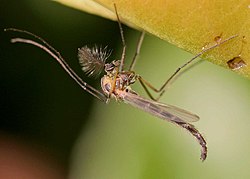
Picture of Chironomoidea
- Source
- Wikipedia/Commons
- Credit
- nobody named on the record
- Licence
- Attribution
- Commercial use
- cannot be read from the licence given — check the record
No 3D scan of Chironomoidea was found in MorphoSource and Sketchfab.
Smithsonian Open Access was not reached for this taxon, so this list is what the others held rather than everything there is.
The description on this site
- Licence
- CC BY-SA 4.0
This is what the site found, which is not the same as what exists.
Keep going
What may have been alongside itCulicomorpha through timeFormations of the EoceneThe world it lived on
Occurrence data from the Paleobiology Database, CC BY 4.0. Macquart 1838