Centrocercus urophasianus
The greater sage-grouse, also known as the sagehen, is the largest grouse in North America. Its range is sagebrush country in the western United States and southern Alberta and Saskatchewan, Canada. It was known as simply the sage grouse until the Gunnison sage-grouse was recognized as a separate species in 2000. The Mono Basin population of sage grouse may also be distinct.

Pacific Southwest Region U.S. Fish and Wildlife Service from Sacramento, US · Public Domain · via Wikipedia/Commons. May be a photograph of a specimen, or an artist’s reconstruction — an interpretation of a skeleton, since colour and soft tissue are almost never preserved.
On record
Recorded, not inferred- Also called
- greater sage-grousePBDB
- Sits inside
- CentrocercusPBDB
- Diet
- granivorePBDB, for Phasianidae
- Life habit
- volantPBDB, for Phasianidae
- Motility
- actively mobilePBDB, for Theropoda
- Environment
- terrestrialPBDB, for Phasianidae
- Mass
- 1.7 kgWikidata
Time the record covers
At least 81 thousand years on record.
The record covers at least 210 ka to 129 ka. No occurrence read is dated outside 1.4 Mya to 0 Mya.
4 occurrences of Centrocercus urophasianus on record, most of them in the Pleistocene. The Paleobiology Database records this as a living group. Bar height is expected occurrences, not a count: each fossil is spread across the span it is dated to, so a tall narrow bar means tight dating and a low wide one means loose.
When
4 occurrences- Pleistocene98%
- Holocene2%
These are dates about fossils, not the animal: the record can only begin after it arose and end before it died out, so either end may reach further. Shares are expected occurrences: a fossil dated to a span is counted partly in each period it straddles. More on what this infers.
Centrocercus urophasianus and its relatives
PleistoceneWhere Centrocercus urophasianus and its relatives were recorded in the Pleistocene.
Found in the same rock
248 taxa- Aquila chrysaetos4 sites
- Bubo virginianus4 sites
- Anas acuta3 sites
- Anas crecca3 sites
- Anas platyrhynchos3 sites
- Buteo3 sites
- Camelops hesternus3 sites
- Canis latrans3 sites
- Canis lupus3 sites
- Corvus corax3 sites
- Dendragapus obscurus3 sites
- Ovis canadensis3 sites
- Podiceps nigricollis3 sites
- Accipiter gentilis2 sites
- Accipiter striatus2 sites
- Agelaius phoeniceus2 sites
- Anas2 sites
- Antigone canadensis2 sites
- Antilocapra americana2 sites
- Asio otus2 sites
- Aythya americana2 sites
- Aythya collaris2 sites
- Branta canadensis2 sites
- Bubo scandiacus2 sites
The Paleobiology Database records 4 sites for Centrocercus urophasianus, and this reads all of them. The number is how many of those sites it was catalogued from too. The 24 sharing the most are listed.
This is not a list of everything alive at the time. It is only what has come out of the same ground as this animal and been written down.
Entered from
4 references- The early and middle Pleistocene avifauna from Porcupine Cave1
- The late Pleistocene avifauna of Crystal Ball Cave, Utah1
- The late Pleistocene (Rancholabrean) avifauna of Little Box Elder Cave, Wyoming1
- A review of the Pleistocene birds of Fossil Lake, Oregon1
Each of the 4 occurrences read was entered from one of these publications, ordered by how many each accounts for. This is not a search for papers mentioning the name. Entries link to doi.org where the Paleobiology Database holds an identifier, and to its own record where it does not. Relayed as the Paleobiology Database holds them, not checked against what they resolve to.
Media and terms
Media content2
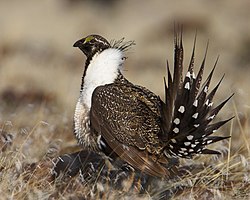
Picture of Centrocercus urophasianus
- Source
- Wikipedia/Commons
- Credit
- Pacific Southwest Region U.S. Fish and Wildlife Service from Sacramento, US
- Licence
- Public Domain
- Commercial use
- the licence allows it
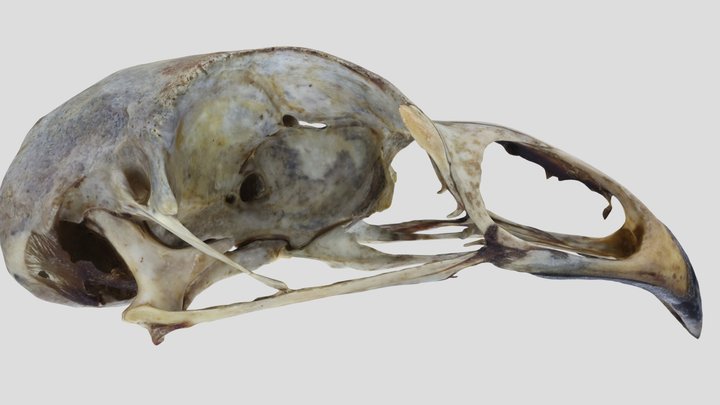
3D model
- Source
- Sketchfab
- Licence
- CC Attribution
- Commercial use
- cannot be read from the licence given — check the record
MorphoSource was not reached for this taxon, so this list is what the others held rather than everything there is.
The description on this site
- Licence
- CC BY-SA 4.0
This is what the site found, which is not the same as what exists.
Keep going
What may have been alongside itCentrocercus through timeFormations of the PleistoceneThe world it lived on
Occurrence data from the Paleobiology Database, CC BY 4.0. (Bonaparte 1827)