Anas acuta
The pintail or northern pintail is a duck species with wide geographic distribution that breeds in the northern areas of Europe and across the Palearctic and North America. It is migratory and winters south of its breeding range as far as the equator. Unusually for a bird with such a large range, it has no geographical subspecies, although the possibly conspecific duck Eaton's pintail is considered to be a separate species.

J.M.Garg · CC BY-SA 3.0 · via Wikipedia/Commons. May be a photograph of a specimen, or an artist’s reconstruction — an interpretation of a skeleton, since colour and soft tissue are almost never preserved.
On record
Recorded, not inferred- Also called
- northern pintailPBDB
- Sits inside
- AnasPBDB
- Diet
- herbivorePBDB, for Anatinae
- Life habit
- volantPBDB, for Anatinae
- Motility
- actively mobilePBDB, for Theropoda
- Environment
- freshwaterPBDB, for Anatinae
- Mass
- 1.02 kgWikidata
Time the record covers
At least 3.5 million years on record.
The record covers at least 3.6 Mya to 11.7 ka. No occurrence read is dated outside 5.333 Mya to 0 Mya.
29 occurrences of Anas acuta on record, most of them in the Pleistocene. The Paleobiology Database records this as a living group. Bar height is expected occurrences, not a count: each fossil is spread across the span it is dated to, so a tall narrow bar means tight dating and a low wide one means loose.
When
29 occurrences- Pliocene3%
- Pleistocene86%
- Holocene11%
These are dates about fossils, not the animal: the record can only begin after it arose and end before it died out, so either end may reach further. Shares are expected occurrences: a fossil dated to a span is counted partly in each period it straddles. More on what this infers.
Found in
4 formations
- Gabal Silsila Formation2
- Gebel Silsila-YCS Formation2
- Yorktown Formation · Chesapeake Group1
- Becerra Formation1
Loading coastlines…
The named rock units Anas acuta has been recovered from, largest first. Drawn where the rock is now, not where it formed. 23 occurrences have no formation on record, which is common for older literature.
Anas acuta and its relatives
PleistoceneWhere Anas acuta and its relatives were recorded in the Pleistocene.
Found in the same rock
1,146 taxa- Anas platyrhynchos18 sites
- Anas crecca14 sites
- Spatula clypeata12 sites
- Aythya collaris9 sites
- Podilymbus podiceps9 sites
- Branta canadensis8 sites
- Ectopistes migratorius8 sites
- Aix sponsa7 sites
- Buteo jamaicensis7 sites
- Mareca penelope7 sites
- Podiceps nigricollis7 sites
- Spatula discors7 sites
- Alcelaphus buselaphus6 sites
- Anas crecca carolinensis6 sites
- Aquila chrysaetos6 sites
- Ardea cinerea6 sites
- Ardea herodias6 sites
- Branta bernicla6 sites
- Bubo virginianus6 sites
- Corvus corax6 sites
- Falco sparverius6 sites
- Hippopotamus amphibius6 sites
- Mareca americana6 sites
- Mergus merganser6 sites
The Paleobiology Database records 29 sites for Anas acuta, and this reads all of them. The number is how many of those sites it was catalogued from too. The 24 sharing the most are listed.
This is not a list of everything alive at the time. It is only what has come out of the same ground as this animal and been written down.
Entered from
24 references- Kom Ombo: Preliminary Report on the Fauna of Late Paleolithic Sites in Upper Egypt4
- The ornithological remains from Marathousa 1 (Middle Pleistocene; Megalopolis Basin, Greece)2
- Avian fossils from three Pleistocene sites in central Mexico2
- Terminal Pleistocene–Holocene Avifauna of San Miguel and Santa Rosa Islands: Identifications of Previously Unidentified Avian Remains Recovered from Fossil Sites and Prehistoric Cave Deposits1
- Late Pleistocene birds from Binagada (Azerbaijan) in collection of the National Museum of Natural History (Kyiv, Ukraine)1
- After Hopewell in Southern Québec1
- Birds of the Late Pleistocene and Holocene from the Palaeolithic Djuktai cave site of Yakutia, eastern Siberia1
- Tropical marsh and savanna of the late Pleistocene in northeastern Sonora, Mexico1
- Late Pleistocene birds from Kingston Saltpeter Cave, southern Appalachian Mountains, Georgia1
- Miocene and Pliocene birds from the Lee Creek Mine, North Carolina1
- The Late Pleistocene fossil birds of the central and southern Ryukyu Islands, and their zoogeographical implications for the Recent avifauna of the archipelago1
- The birds of the late Quaternary of the Altai Mts1
Each of the 29 occurrences read was entered from one of these publications, ordered by how many each accounts for. This is not a search for papers mentioning the name. 12 further references are not listed. Entries link to doi.org where the Paleobiology Database holds an identifier, and to its own record where it does not. Relayed as the Paleobiology Database holds them, not checked against what they resolve to.
Media and terms
Media content3

Picture of Anas acuta
- Source
- Wikipedia/Commons
- Credit
- J.M.Garg
- Licence
- CC BY-SA 3.0
- Commercial use
- the licence allows it
CT scan
- Source
- MorphoSource
- Credit
- ISM Zoology Collection
- Licence
- In Copyright
- Commercial use
- cannot be read from the licence given — check the record
- Specimen
- Anas acuta · ISM:ISM-Aves:692511
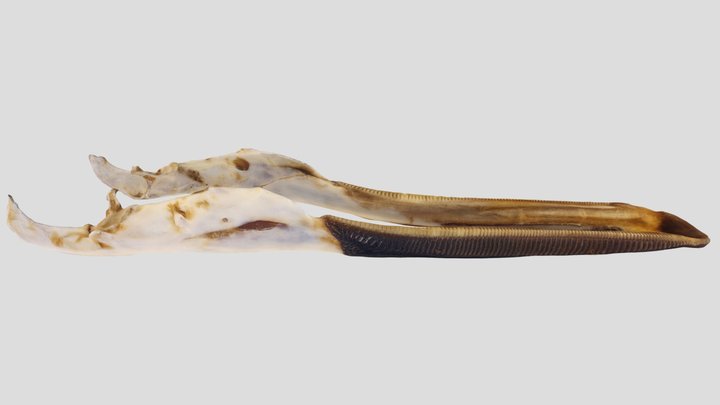
3D model
- Source
- Sketchfab
- Licence
- CC Attribution
- Commercial use
- cannot be read from the licence given — check the record
The description on this site
- Licence
- CC BY-SA 4.0
This is what the site found, which is not the same as what exists.
Keep going
What may have been alongside itAnas through timeFormations of the PleistoceneThe world it lived on
Occurrence data from the Paleobiology Database, CC BY 4.0. (Linnaeus 1758)