Castor
Beavers are large semiaquatic rodents of the Northern Hemisphere. There are two extant species: the North American beaver and the Eurasian beaver. Beavers are the second-largest living rodents, after capybaras, weighing up to 50 kg (110 lb). They have stout bodies with large heads, long chisel-like incisors, brown or gray fur, hand-like front feet, webbed back feet, and tails that are flat and scaly. The two species differ in skull and tail shape and fur color. Beavers can be found in a number of freshwater habitats, such as rivers, streams, lakes and ponds. They are herbivorous, consuming tree bark, aquatic plants, grasses and sedges.

Steve from Washington, DC, USA · CC BY-SA 2.0 · via Wikipedia/Commons. May be a photograph of a specimen, or an artist’s reconstruction — an interpretation of a skeleton, since colour and soft tissue are almost never preserved.
On record
Recorded, not inferred- Also called
- beaverPBDB
- Sits inside
- CastorinaePBDB
- Diet
- browserPBDB, for Castoridae
- Life habit
- amphibiousPBDB
- Motility
- actively mobilePBDB, for Osteichthyes
- Environment
- terrestrialPBDB, for Eutheria
Time the record covers
At least 7.2 million years on record.
The record covers at least 7.246 Mya to 11.7 ka. No occurrence read is dated outside 66 Mya to 0 Mya.
209 occurrences of Castor on record, most of them in the Pleistocene. The Paleobiology Database records this as a living group. Bar height is expected occurrences, not a count: each fossil is spread across the span it is dated to, so a tall narrow bar means tight dating and a low wide one means loose.
When
209 occurrencesThese are dates about fossils, not the animal: the record can only begin after it arose and end before it died out, so either end may reach further. Shares are expected occurrences: a fossil dated to a span is counted partly in each period it straddles. More on what this infers.
Found in
34 formations
- San Joaquin Formation7
- Alkali Canyon Formation4
- Glenns Ferry Formation4
- Cromer Forest Bed Formation4
- Unterer Travertin Formation3
- Choremi Formation3
Loading coastlines…
The named rock units Castor has been recovered from, largest first. Drawn where the rock is now, not where it formed. 10 further formations hold fewer occurrences each and are not listed. 152 occurrences have no formation on record, which is common for older literature.
Castor and its relatives
PleistoceneWhere Castor and its relatives were recorded in the Pleistocene.
Found in the same rock
2,013 taxa- Equus64 sites
- Odocoileus virginianus37 sites
- Procyon lotor33 sites
- Microtus32 sites
- Ondatra zibethicus32 sites
- Mimomys30 sites
- Canis lupus29 sites
- Cervidae29 sites
- Bison28 sites
- Ursus americanus28 sites
- Marmota monax27 sites
- Lepus26 sites
- Apodemus24 sites
- Cervus24 sites
- Cervus elaphus24 sites
- Sorex24 sites
- Stephanorhinus etruscus24 sites
- Canis21 sites
- Ochotona21 sites
- Microtus pennsylvanicus20 sites
- Sus scrofa20 sites
- Erethizon dorsatum19 sites
- Neotoma floridana19 sites
- Platygonus19 sites
The Paleobiology Database records 201 sites for Castor, and this reads all of them. The number is how many of those sites it was catalogued from too. The 24 sharing the most are listed.
This is not a list of everything alive at the time. It is only what has come out of the same ground as this animal and been written down.
Entered from
134 references- Mittelpleistozane Saugetierfaunen aus Mitteleuropa - der Versuch einer biostratigraphischen Zuordnung9
- Quaternary vertebrate localities of Virginia and their avian and mammalian fauna8
- Catalogue of Tertiary Fossil Sites of the Land Mammals in the U.S.S.R.7
- Geology of the Kettleman Hills Oil Field, California, Stratigraphy, Paleontology and Structure7
- Hemphillian rodents from northern Oregon and their biostratigraphic implications4
- Paleontology and historic field trip of the John Guilday Cave Preserve (Trout Rock)4
- Geology and Paleontology of the Early Pleistocene (Late Blancan) White Rock Fauna from North-Central Kansas4
- Animal remains from Ohio rock shelters4
- Synonymies and reidentifications of North American fossil mammals3
- Magneto- and cyclostratigraphy and mammal-fauna’s of the Pleistocene lacustrine Megalopolis Basin, Peloponnesos, Greece3
- Biochronological implications of the Arvicolidae (Rodentia, Mammalia) from the Lower Pleistocene hominid-bearing level of Trinchera Dolina 6 (TD6, Atapuerca, Spain)3
- Neues aus dem Villafranchium von Hajnacka bei Filakovo (Slowakei, cssr)3
Each of the 209 occurrences read was entered from one of these publications, ordered by how many each accounts for. This is not a search for papers mentioning the name. 122 further references are not listed. Entries link to doi.org where the Paleobiology Database holds an identifier, and to its own record where it does not. Relayed as the Paleobiology Database holds them, not checked against what they resolve to.
Media and terms
Media content3
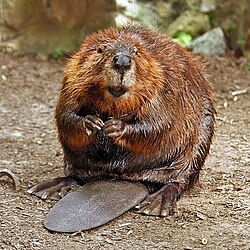
Picture of Castor
- Source
- Wikipedia/Commons
- Credit
- Steve from Washington, DC, USA
- Licence
- CC BY-SA 2.0
- Commercial use
- the licence allows it
CT scan
- Source
- MorphoSource
- Licence
- not stated by the source
- Commercial use
- cannot be read from the licence given — check the record
- Specimen
- Castor canadensis · ibm:gpp:CNMA 4037
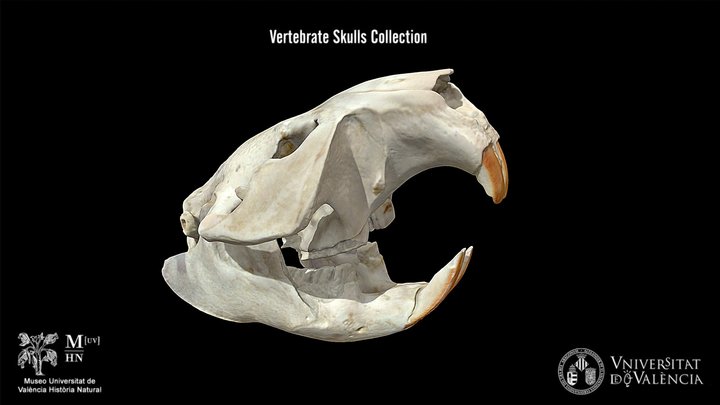
3D model
- Source
- Sketchfab
- Licence
- CC Attribution
- Commercial use
- cannot be read from the licence given — check the record
The description on this site
- Source
- Wikipedia, “Beaver”
- Licence
- CC BY-SA 4.0
This is what the site found, which is not the same as what exists.
Keep going
What may have been alongside itCastorinae through timeFormations of the PleistoceneThe world it lived on
Occurrence data from the Paleobiology Database, CC BY 4.0. Linnaeus 1758