Calliphoridae
The Calliphoridae are a family of insects in the order Diptera, with almost 1,900 known species. The maggot larvae, often used as fishing bait, are known as gentles. The family is known to be polyphyletic, but much remains disputed regarding proper treatment of the constituent taxa, some of which are occasionally accorded family status.

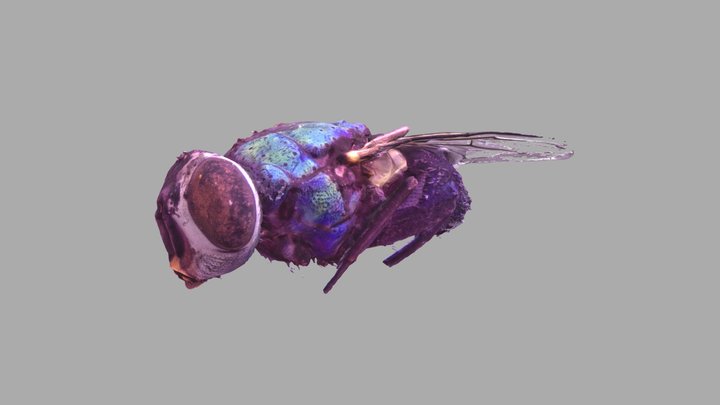
Muhammad Mahdi Karim · GFDL 1.2 · via Wikipedia/Commons. May be a photograph of a specimen, or an artist’s reconstruction — an interpretation of a skeleton, since colour and soft tissue are almost never preserved.
On record
Recorded, not inferred- Also called
- blow flyPBDB
- Sits inside
- OestroideaPBDB
- Motility
- actively mobilePBDB, for Arthropoda
- Environment
- terrestrialPBDB, for Insecta
Time the record covers
At least 2.5 million years on record.
The record covers at least 2.58 Mya to 11.7 ka. No occurrence read is dated outside 5.333 Mya to 0 Mya.
11 occurrences of Calliphoridae on record, most of them in the Pleistocene. The Paleobiology Database records this as a living group. Bar height is expected occurrences, not a count: each fossil is spread across the span it is dated to, so a tall narrow bar means tight dating and a low wide one means loose.
When
11 occurrences- Pliocene9%
- Pleistocene73%
- Holocene18%
These are dates about fossils, not the animal: the record can only begin after it arose and end before it died out, so either end may reach further. Shares are expected occurrences: a fossil dated to a span is counted partly in each period it straddles. More on what this infers.
Found in
3 formations
Loading coastlines…
The named rock units Calliphoridae has been recovered from, largest first. Drawn where the rock is now, not where it formed. 7 occurrences have no formation on record, which is common for older literature.
Calliphoridae and its relatives
PleistoceneWhere Calliphoridae and its relatives were recorded in the Pleistocene.
Found in the same rock
446 taxa- Carabidae3 sites
- Protophormia terraenovae3 sites
- Aegialia (Psammoporus) terminalis2 sites
- Agabini2 sites
- Agabus (Acatodes) anthracinus2 sites
- Agabus (Gaurodytes) affinis2 sites
- Agonum2 sites
- Aleocharinae2 sites
- Amara2 sites
- Anoplus plantaris2 sites
- Apatania crymophila2 sites
- Apatania nigra2 sites
- Arctobyrrhus subcanus2 sites
- Arctopsyche ladogensis2 sites
- Atheta2 sites
- Bembidion2 sites
- Bembidion (Asioperyphus) bimaculatum2 sites
- Bembidion (Asioperyphus) sordidum2 sites
- Bembidion (Bracteon)2 sites
- Bembidion (Bracteon) levettei2 sites
- Bembidion (Melomalus) planatum2 sites
- Bembidion (Metallina) dyschirinum2 sites
- Bembidion (Peryphanes) yukonum2 sites
- Bembidion (Plataphus) fellmanni2 sites
The Paleobiology Database records 11 sites for Calliphoridae, and this reads all of them. The number is how many of those sites it was catalogued from too. The 24 sharing the most are listed.
This is not a list of everything alive at the time. It is only what has come out of the same ground as this animal and been written down.
Entered from
9 references- Palaeoentomology of the Kap København Formation, a Plio-Pleistocene sequence in Peary Land, North Greenland2
- Bovenpleistocene zoogdieren van Oudenaarde Donk (België), fossiele vliegepoppen uit de Vlaamse Valleien elders en nog een en ander over de Vlaamse Vallei2
- Over aasvliegen en een mammoetkalf uit de Eurogeul1
- Massive death of pinnipeds 1200 years ago: Taphonomic history of the “Lobos site” (Golfo Nuevo, Patagonia, Argentina)1
- The Clark's Cave bone deposit and the Late Pleistocene paleoecology of the central Appalachian Mountains of Virginia1
- Puparia of the subarctic or black blowfly Protophormia terraenovae (Robineau-Desvoidy, 1830) in a skull of late Eemian(?) bison at Zemst, Brabant (Belgium)1
- Notes on some chalicothere remains from Makapansgat1
- Insektenreste aus der Hallstattzeit1
- Fossil arthropods of California 8. A case of Pleistocene myiasis from the La Brea pits1
Each of the 11 occurrences read was entered from one of these publications, ordered by how many each accounts for. This is not a search for papers mentioning the name. Entries link to doi.org where the Paleobiology Database holds an identifier, and to its own record where it does not. Relayed as the Paleobiology Database holds them, not checked against what they resolve to.
Media and terms
Media content2

Picture of Calliphoridae
- Source
- Wikipedia/Commons
- Credit
- Muhammad Mahdi Karim
- Licence
- GFDL 1.2
- Commercial use
- the licence allows it
Smithsonian Open Access and MorphoSource were not reached for this taxon, so this list is what the others held rather than everything there is.
The description on this site
- Licence
- CC BY-SA 4.0
This is what the site found, which is not the same as what exists.
Keep going
What may have been alongside itOestroidea through timeFormations of the PleistoceneThe world it lived on
Occurrence data from the Paleobiology Database, CC BY 4.0. (Brauer and von Bergenstamm 1889)