Blastoidea
Blastoids are an extinct type of stemmed echinoderm, often referred to as sea buds. They first appear, along with many other echinoderm classes, in the Ordovician period, and reached their greatest diversity in the Mississippian subperiod of the Carboniferous period. However, blastoids may have originated in the Cambrian. Blastoids persisted until their extinction at the end of Permian, about 250 million years ago. Although never as diverse as their contemporary relatives, the crinoids, blastoids are common fossils, especially in many Mississippian-age rocks.

Diego Delso · CC BY-SA 4.0 · via Wikipedia/Commons. May be a photograph of a specimen, or an artist’s reconstruction — an interpretation of a skeleton, since colour and soft tissue are almost never preserved.
On record
Recorded, not inferred- Also called
- blastoidPBDB
- Sits inside
- BlastozoaPBDB
- Diet
- suspension feederPBDB
- Life habit
- intermediate-level epifaunalPBDB
- Motility
- stationary, attachedPBDB
- Vision
- blindPBDB
- Environment
- marinePBDB, for Echinodermata
Time the record covers
At least 209 million years on record.
The record covers at least 461 Mya to 251.902 Mya. No occurrence read is dated outside 471.3 Mya to 251.1 Mya.
760 occurrences of Blastoidea on record, most of them in the Carboniferous. Bar height is expected occurrences, not a count: each fossil is spread across the span it is dated to, so a tall narrow bar means tight dating and a low wide one means loose.
When
760 occurrences- Ordovician5%
- Silurian11%
- Devonian19%
- Carboniferous57%
- Permian8%
- Early Triassicunder 1%
These are dates about fossils, not the animal: the record can only begin after it arose and end before it died out, so either end may reach further. Shares are expected occurrences: a fossil dated to a span is counted partly in each period it straddles. More on what this infers.
Found in
180 formations
- Bangor Limestone Formation72
- Glen Dean Limestone Formation62
- Golconda Formation48
- Fort Payne Formation27
- Burlington Formation17
- Hongguleleng Formation16
Loading coastlines…
The named rock units Blastoidea has been recovered from, largest first. Drawn where the rock is now, not where it formed. 156 further formations hold fewer occurrences each and are not listed. 44 occurrences have no formation on record, which is common for older literature.
Blastoidea and its relatives
CarboniferousWhere Blastoidea and its relatives were recorded in the Carboniferous.
Found in the same rock
2,427 taxa- Pentremites103 sites
- Fenestella78 sites
- Fistulipora70 sites
- Echinoidea59 sites
- Eumetria59 sites
- Archimedes58 sites
- Anthracospirifer leidyi51 sites
- Orthotetes50 sites
- Cleiothyridina49 sites
- Dichocrinus49 sites
- Tabulipora48 sites
- Composita47 sites
- Bryozoa44 sites
- Rhabdomeson44 sites
- Torynifer44 sites
- Cornulites42 sites
- Polypora41 sites
- Camptocrinus40 sites
- Reticulariina40 sites
- Paladin39 sites
- Crinoidea38 sites
- Aphelacrinus sp.37 sites
- Phanocrinus37 sites
- Platyceras37 sites
The Paleobiology Database records 447 sites for Blastoidea, and this reads 240 of them. The number is how many of those sites it was catalogued from too. The 24 sharing the most are listed.
This is not a list of everything alive at the time. It is only what has come out of the same ground as this animal and been written down.
Entered from
173 references- The Paleontology and Paleoecology of the Lower Bangor Limestone (Chesterian, Mississippian)in northwestern Alabama70
- Invertebrate Fauna of the Golconda Formation (Middle Chester) of Indiana, Western Kentucky, and Southern Illinois68
- Caradocian-Gedinnian echinoderm associations of Central and Eastern North America61
- Fauna of Glen Dean Limestone (Chester) in Indiana and Northern Kentucky60
- Crinoid assemblages from the Fort Payne Formation (late Osagean, early Viséan, Mississippian) from Kentucky, Tennessee, and Alabama26
- A critical interval in blastoid evolution: the respiratory transition and palaeogeographic dispersion of the spiraculate blastoids in the Devonian25
- Bibliographic and faunal index of Paleozoic pelmatozoan echinoderms16
- Permian echinoderms from Western Australia15
- Echinodermata. Article 3. Blastoid Studies13
- Facies Faunas of the Salem Limestone (Mississippian) in Southern Indiana and Central Kentucky12
- Systematics of the Fissiculate Blastoidea12
- Coronate echinoderms from the lower Palaeozoic of Britain10
Each of the 760 occurrences read was entered from one of these publications, ordered by how many each accounts for. This is not a search for papers mentioning the name. 161 further references are not listed. Entries link to doi.org where the Paleobiology Database holds an identifier, and to its own record where it does not. Relayed as the Paleobiology Database holds them, not checked against what they resolve to.
Media and terms
Media content2

Picture of Blastoidea
- Source
- Wikipedia/Commons
- Credit
- Diego Delso
- Licence
- CC BY-SA 4.0
- Commercial use
- the licence allows it
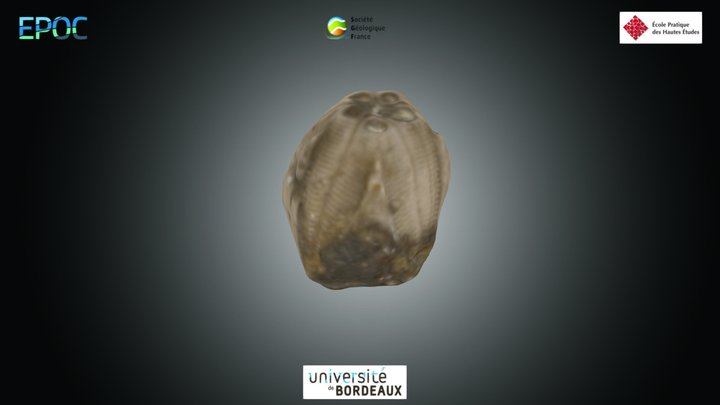
3D model
- Source
- Sketchfab
- Licence
- CC Attribution-NonCommercial-ShareAlike
- Commercial use
- the licence does not allow it
Smithsonian Open Access was not reached for this taxon, so this list is what the others held rather than everything there is.
The description on this site
- Source
- Wikipedia, “Blastoid”
- Licence
- CC BY-SA 4.0
This is what the site found, which is not the same as what exists.
Keep going
What may have been alongside itBlastozoa through timeFormations of the CarboniferousThe world it lived on
Occurrence data from the Paleobiology Database, CC BY 4.0. Say 1825