Balanocidaris

Vassil · Public Domain · via Wikidata/Commons. May be a photograph of a specimen, or an artist’s reconstruction — an interpretation of a skeleton, since colour and soft tissue are almost never preserved.
On record
Recorded, not inferred- Sits inside
- StylocidarinaePBDB
- Diet
- grazer, omnivorePBDB, for Cidaroida
- Life habit
- low-level epifaunalPBDB, for Cidaroida
- Motility
- slow-movingPBDB, for Cidaroida
- Vision
- limitedPBDB, for Echinoidea
- Environment
- marinePBDB, for Cidaroida
Time the record covers
At least 150 million years on record.
The record covers at least 233.6 Mya to 83.6 Mya. No occurrence read is dated outside 237 Mya to 72.2 Mya.
32 occurrences of Balanocidaris on record, most of them in the Late Triassic. Bar height is expected occurrences, not a count: each fossil is spread across the span it is dated to, so a tall narrow bar means tight dating and a low wide one means loose.
When
32 occurrencesThese are dates about fossils, not the animal: the record can only begin after it arose and end before it died out, so either end may reach further. Shares are expected occurrences: a fossil dated to a span is counted partly in each period it straddles. More on what this infers.
Found in
7 formations
- Cassian Formation11
- Abadia Formation1
- Sant Corneli Formation1
- Vallcarga Formation1
- Torinosu Formation1
- Torinosu Limestone Formation1
Loading coastlines…
The named rock units Balanocidaris has been recovered from, largest first. Drawn where the rock is now, not where it formed. 15 occurrences have no formation on record, which is common for older literature.
Balanocidaris and its relatives
Late TriassicWhere Balanocidaris and its relatives were recorded in the Late Triassic.
Found in the same rock
490 taxa- Bivalvia8 sites
- Cidaris7 sites
- Coelostylina conica7 sites
- Echinoidea7 sites
- Isocrinus7 sites
- Plicatula7 sites
- Cultriopsis6 sites
- Eucycloscala6 sites
- Gastropoda6 sites
- Gervillia (Cultriopsis) angusta6 sites
- Naticopsis6 sites
- Palaeonucula strigilata6 sites
- Terebratula6 sites
- Trypanostylus6 sites
- Brachiopoda5 sites
- Cassianella beyrichii5 sites
- Cassianella decussata5 sites
- Chelocrinus cassianus5 sites
- Diplospirella5 sites
- Palaeonucula5 sites
- Parallelodon5 sites
- Porifera5 sites
- Pteria5 sites
- Zygopleura tenuis5 sites
The Paleobiology Database records 28 sites for Balanocidaris, and this reads all of them. The number is how many of those sites it was catalogued from too. The 24 sharing the most are listed.
This is not a list of everything alive at the time. It is only what has come out of the same ground as this animal and been written down.
Entered from
16 references- Primary collection data of Cassian Formation used for publication of Fürsich and Wendt (1977) (ref. 9188)10
- Echinides du Crétacé inférieur de la Hongrie4
- Holothurien (Echinodermata) aus Kelloway-Geschieben (Dogger: Callovium)2
- Die oberjurassische Korallenfazies von Algarve (Südportugal) [The Upper Jurassic coral facies of Algarve (Southern Portugal)]2
- Coniacian-Maastrichtian of the Tremp Area (South Central Pyrenees)2
- Bioconstructions bajociennes à madréporaires et faciès associés dans l'Ile Crémieu (Jura du Sud; France)2
- Aptian-Cenomanian echinoids from northern Sinai, Egypt1
- Position of the Middle Triassic Tyros Beds in the Gavrovo-Tripolis Unit (Rhodes Island, Dodecanese, Greece)1
- Urgonian (Early Cretaceous) echinoids of the Mirdita zone (Southern Albania)1
- Paléoécologie et paléobiogéographie des faunes d'échinides du Cénomanien nord-aquitain (Charente-Maritime, France)1
- Les echinides du Kimméridgien inférieur des Monts de Chellala (ouest Algérien); révision, paléoenvironnement, et eustatisme1
- Biostratinomy and palaeoecology of the Cassian Formation (Triassic) of the Southern Alps1
Each of the 32 occurrences read was entered from one of these publications, ordered by how many each accounts for. This is not a search for papers mentioning the name. 4 further references are not listed. Entries link to doi.org where the Paleobiology Database holds an identifier, and to its own record where it does not. Relayed as the Paleobiology Database holds them, not checked against what they resolve to.
Media and terms
Media content2
Picture of Balanocidaris
- Source
- Wikidata/Commons
- Credit
- Vassil
- Licence
- Public Domain
- Commercial use
- the licence allows it
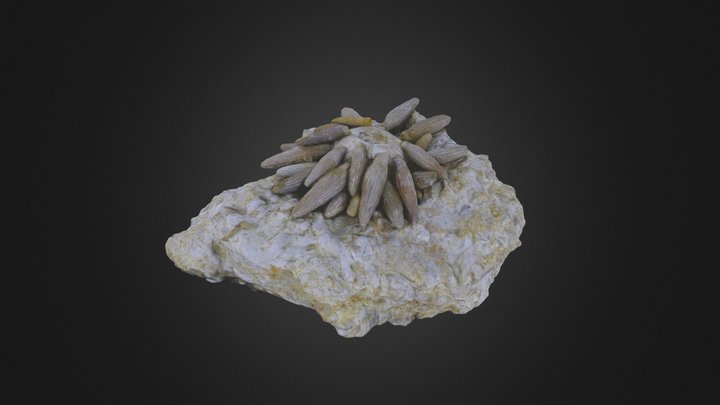
3D model
- Source
- Sketchfab
- Licence
- CC0 Public Domain
- Commercial use
- the licence allows it
This is what the site found, which is not the same as what exists.
Keep going
What may have been alongside itStylocidarinae through timeFormations of the Late TriassicThe world it lived on
Occurrence data from the Paleobiology Database, CC BY 4.0.