Archaeocidaris
Archaeocidaris is an extinct genus of echinoid that lived from the Late Devonian to the Late Permian. Its remains have been found in Africa, Europe, and North America.

Didier Descouens · CC BY-SA 4.0 · via Wikipedia/Commons. May be a photograph of a specimen, or an artist’s reconstruction — an interpretation of a skeleton, since colour and soft tissue are almost never preserved.
On record
Recorded, not inferred- Sits inside
- ArchaeocidaridaePBDB
- Diet
- grazer, deposit feederPBDB, for Echinoidea
- Life habit
- epifaunalPBDB, for Echinoidea
- Motility
- actively mobilePBDB, for Echinoidea
- Vision
- limitedPBDB, for Echinoidea
- Environment
- marinePBDB, for Echinodermata
Time the record covers
At least 136 million years on record.
The record covers at least 387.95 Mya to 251.902 Mya. No occurrence read is dated outside 393.47 Mya to 201.4 Mya.
111 occurrences of Archaeocidaris on record, most of them in the Carboniferous. Bar height is expected occurrences, not a count: each fossil is spread across the span it is dated to, so a tall narrow bar means tight dating and a low wide one means loose.
When
111 occurrences- Devonian8%
- Carboniferous57%
- Permian33%
- Early Triassicunder 1%
- Middle Triassicunder 1%
- Late Triassic1%
These are dates about fossils, not the animal: the record can only begin after it arose and end before it died out, so either end may reach further. Shares are expected occurrences: a fossil dated to a span is counted partly in each period it straddles. More on what this infers.
Found in
35 formations
- Kaibab Formation13
- Second Abden Shale Formation11
- Honaker Trail Formation10
- Pottawatomie Formation6
- Minturn Formation5
- Supai Formation5
Loading coastlines…
The named rock units Archaeocidaris has been recovered from, largest first. Drawn where the rock is now, not where it formed. 11 further formations hold fewer occurrences each and are not listed. 17 occurrences have no formation on record, which is common for older literature.
Archaeocidaris and its relatives
CarboniferousWhere Archaeocidaris and its relatives were recorded in the Carboniferous.
Found in the same rock
1,085 taxa- Crinoidea40 sites
- Bryozoa18 sites
- Ostracoda16 sites
- Eomarginifera longispinus15 sites
- Crurithyris urei13 sites
- Fenestella13 sites
- Composita subtilita12 sites
- Gastropoda11 sites
- Peniculauris bassi11 sites
- Penniretepora11 sites
- Punctospirifer11 sites
- Composita10 sites
- Kirkbya10 sites
- Lophophyllidium profundum10 sites
- Aviculopecten9 sites
- Chonetes9 sites
- Crurithyris planoconvexa9 sites
- Derbyia9 sites
- Parajuresania nebrascensis9 sites
- Paraparchites9 sites
- Pseudorthoceras knoxense9 sites
- Rugosa9 sites
- Strobeus brevis9 sites
- Bairdia8 sites
The Paleobiology Database records 107 sites for Archaeocidaris, and this reads all of them. The number is how many of those sites it was catalogued from too. The 24 sharing the most are listed.
This is not a list of everything alive at the time. It is only what has come out of the same ground as this animal and been written down.
Entered from
41 references- The environment and history of the Toroweap and Kaibab Formations of northern Arizona and southern Utah16
- The paleoecology of a Lower Carboniferous marine transgression11
- Paleoecology and paleoenvironment of the upper Honaker Trail Formation near Moab, Utah10
- Coal Measures faunal studies. I.8
- Oekologie und Fazies des juengsten Ober-Devon von Velbert (Rheinisches Schiefergebirge)7
- The first Pennsylvanian batocrinid and other new echinoderms from the Minturn Formation of central Colorado5
- Supai Formation (Permian) of eastern Arizona5
- Brachiopods of the suborder Strophomenidina from the Shumway Cyclothem, Mattoon Formation, Virgilian of Illinois.3
- Upper Paleozoic of Peru3
- The fauna of the Wewoka Formation of Oklahoma3
- PENNSYLVANIAN (LATE CARBONIFEROUS) ECHINOIDS FROM THE WINCHELL FORMATION, NORTH-CENTRAL TEXAS, USA2
- Monographie paleontologique des affleurements permiens du Djebel Tebaga (Sud Tunisien)2
Each of the 111 occurrences read was entered from one of these publications, ordered by how many each accounts for. This is not a search for papers mentioning the name. 29 further references are not listed. Entries link to doi.org where the Paleobiology Database holds an identifier, and to its own record where it does not. Relayed as the Paleobiology Database holds them, not checked against what they resolve to.
Media and terms
Media content2

Picture of Archaeocidaris
- Source
- Wikipedia/Commons
- Credit
- Didier Descouens
- Licence
- CC BY-SA 4.0
- Commercial use
- the licence allows it
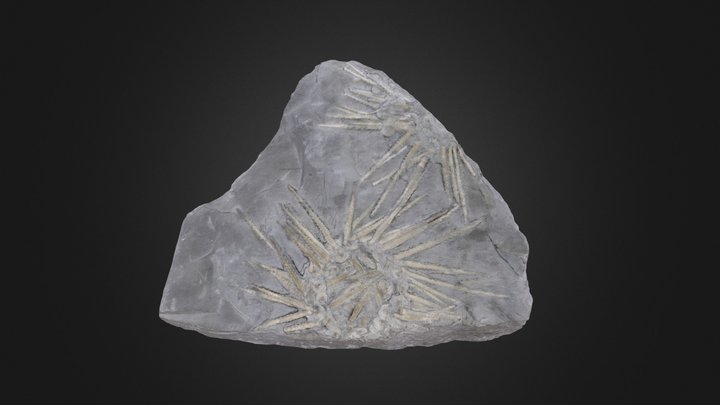
3D model
- Source
- Sketchfab
- Licence
- CC0 Public Domain
- Commercial use
- the licence allows it
Smithsonian Open Access and MorphoSource were not reached for this taxon, so this list is what the others held rather than everything there is.
The description on this site
- Licence
- CC BY-SA 4.0
This is what the site found, which is not the same as what exists.
Keep going
What may have been alongside itArchaeocidaridae through timeFormations of the CarboniferousThe world it lived on
Occurrence data from the Paleobiology Database, CC BY 4.0. M'Coy 1844