Venericardia
Searched as Venericardia iheringi. The Paleobiology Database treats Venericardia as the accepted name.
Venericardia is a widely distributed genus of marine bivalve molluscs, in the family Carditidae.

H. Zell · CC BY-SA 3.0 · via Wikipedia/Commons. May be a photograph of a specimen, or an artist’s reconstruction — an interpretation of a skeleton, since colour and soft tissue are almost never preserved.
On record
Recorded, not inferred- Sits inside
- VenericardiinaePBDB
- Diet
- suspension feederPBDB, for Carditidae
- Life habit
- shallow infaunalPBDB
- Motility
- facultatively mobilePBDB, for Carditidae
- Vision
- blindPBDB, for Crassatelloidea
- Environment
- marinePBDB, for Crassatelloidea
Time the record covers
At most 11 million years on record.
Every occurrence read is dated to somewhere between 72.2 Mya and 61.66 Mya, and nothing in the dating separates them, so that window is what the record shows rather than a span.
89 occurrences of Venericardia on record, most of them in the Paleocene. The Paleobiology Database records this as a living group, and the chart stops with its fossils rather than at the present. Bar height is expected occurrences, not a count: each fossil is spread across the span it is dated to, so a tall narrow bar means tight dating and a low wide one means loose.
When
89 occurrences- Late Cretaceous28%
- Paleocene72%
These are dates about fossils, not the animal: the record can only begin after it arose and end before it died out, so either end may reach further. Shares are expected occurrences: a fossil dated to a span is counted partly in each period it straddles. More on what this infers.
Found in
3 formations
- Jagüel Formation · Malargüe Group42
- Lefipán Formation27
- Roca Formation · Malargüe Group20
Loading coastlines…
The named rock units Venericardia has been recovered from, largest first. Drawn where the rock is now, not where it formed.
Venericardia and its relatives
PaleoceneWhere Venericardia and its relatives were recorded in the Paleocene.
Found in the same rock
2,371 taxa- Turritella68 sites
- Dentalium50 sites
- Eburneopecten scintillatus50 sites
- Gastropoda47 sites
- Bivalvia45 sites
- Nuculana45 sites
- Cadulus44 sites
- Corbula densata38 sites
- Hipponix38 sites
- Calyptraea (Trochita) aperta37 sites
- Caestocorbula wailesiana36 sites
- Tellinidae36 sites
- Myrtaea (Myrtaea) curta35 sites
- Ostrea35 sites
- Pitar34 sites
- Ficus32 sites
- Bathytormus flexurus31 sites
- Nucula (Nucula) sphenopsis31 sites
- Pseudoliva vetusta31 sites
- Retusa galba31 sites
- Corbula30 sites
- Athleta petrosa29 sites
- Barbatia (Plagiarca) rhomboidella29 sites
- Bullata semen29 sites
The Paleobiology Database records 976 sites for Venericardia, and this reads 240 of them. Of that, one read hit the database's own return limit, so every count below is a floor rather than a total. The number is how many of those sites it was catalogued from too. The 24 sharing the most are listed.
This is not a list of everything alive at the time. It is only what has come out of the same ground as this animal and been written down.
Entered from
5 references- Molluscs at the K/Pg boundary in Argentina: Extinction and recovery patterns. unpublished Ph.D. thesis77
- Estratigrafía y Paleontología del grupo Malargüe (Límite Cretácico-Paleógeno), en la provincia de Mendoza9
- Maastrichtian and Danian species of Turkostreini (Ostreidae, Crassostreinae) from the Neuquén Basin, Argentina1
- First shallow water scleractinian coral reef from the Danian, northern Patagonia, Argentina1
- Sedimentología, Paleontología y Estratigrafía del Límite Cretácico-Paleógeno en Liu Malal, Departamento Malargüe, Provincia de Mendoza1
Each of the 89 occurrences read was entered from one of these publications, ordered by how many each accounts for. This is not a search for papers mentioning the name. Each entry links to the Paleobiology Database's own record for the work.
Media and terms
Media content2

Picture of Venericardia
- Source
- Wikipedia/Commons
- Credit
- H. Zell
- Licence
- CC BY-SA 3.0
- Commercial use
- the licence allows it
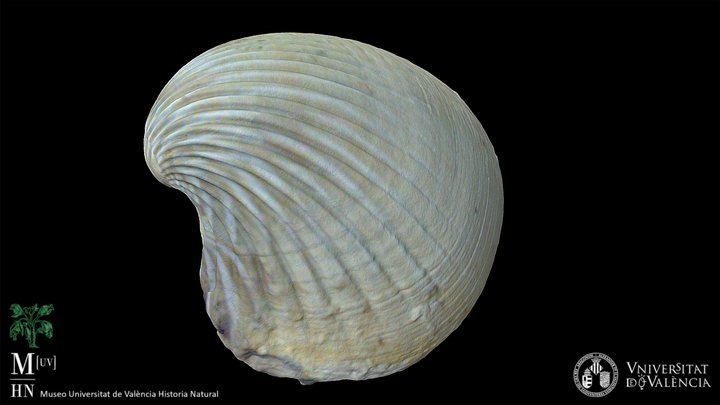
3D model
- Source
- Sketchfab
- Licence
- CC Attribution
- Commercial use
- cannot be read from the licence given — check the record
The description on this site
- Licence
- CC BY-SA 4.0
This is what the site found, which is not the same as what exists.
Keep going
What may have been alongside itVenericardiinae through timeFormations of the PaleoceneThe world it lived on
Occurrence data from the Paleobiology Database, CC BY 4.0. (Lamarck 1801)