Thryonomys
The genus Thryonomys, also known as cane rats or grasscutters, is a genus of rodent found throughout Sub-Saharan Africa. It is the only extant genus in the family Thryonomyidae. They are eaten in some African countries and are a pest species on many crops. The family name comes from the Greek word thryon, meaning a "rush" or "reed" and mys meaning "mouse".

Aurélia Zizo · Attribution · via Wikipedia/Commons. May be a photograph of a specimen, or an artist’s reconstruction — an interpretation of a skeleton, since colour and soft tissue are almost never preserved.
On record
Recorded, not inferred- Sits inside
- ThryonomyidaePBDB
- Diet
- grazerPBDB, for Thryonomyidae
- Life habit
- ground dwellingPBDB, for Thryonomyidae
- Motility
- actively mobilePBDB, for Osteichthyes
- Environment
- terrestrialPBDB, for Eutheria
Time the record covers
At least 7.2 million years on record.
The record covers at least 7.246 Mya to 11.7 ka. No occurrence read is dated outside 11.63 Mya to 0 Mya.
47 occurrences of Thryonomys on record, most of them in the Pleistocene. The Paleobiology Database records this as a living group. Bar height is expected occurrences, not a count: each fossil is spread across the span it is dated to, so a tall narrow bar means tight dating and a low wide one means loose.
When
47 occurrences- Miocene7%
- Pliocene13%
- Pleistocene54%
- Holocene26%
These are dates about fossils, not the animal: the record can only begin after it arose and end before it died out, so either end may reach further. Shares are expected occurrences: a fossil dated to a span is counted partly in each period it straddles. More on what this infers.
Found in
15 formations
- Koobi Fora Formation · Omo Group6
- Wehaietu Formation · Awash Group3
- Shungura Formation · Omo Group3
- Nachukui Formation · Omo Group2
- Kapthurin Formation2
- Vogel River Series Formation2
Loading coastlines…
The named rock units Thryonomys has been recovered from, largest first. Drawn where the rock is now, not where it formed. 20 occurrences have no formation on record, which is common for older literature.
Thryonomys and its relatives
PleistoceneWhere Thryonomys and its relatives were recorded in the Pleistocene.
Found in the same rock
629 taxa- Alcelaphini15 sites
- Mammalia14 sites
- Phacochoerus aethiopicus14 sites
- Bovidae13 sites
- Hystrix13 sites
- Tragelaphus scriptus13 sites
- Reduncini12 sites
- Aepyceros melampus11 sites
- Clarias11 sites
- Equus11 sites
- Suidae11 sites
- Gazella10 sites
- Hipparion10 sites
- Hippopotamus amphibius10 sites
- Kobus ellipsiprymnus10 sites
- Potamochoerus porcus10 sites
- Redunca redunca10 sites
- Rhinocerotidae10 sites
- Syncerus caffer10 sites
- Tatera10 sites
- Tragelaphus strepsiceros10 sites
- Crocodylus9 sites
- Tragelaphus9 sites
- Kobus kob8 sites
The Paleobiology Database records 43 sites for Thryonomys, and this reads all of them. The number is how many of those sites it was catalogued from too. The 24 sharing the most are listed.
This is not a list of everything alive at the time. It is only what has come out of the same ground as this animal and been written down.
Entered from
35 references- Les faunes de vertebres quaternaires en Afrique centrale3
- The use of fish remains in African archaeozoology3
- Lakeside cemeteries in the Sahara: 5000 years of Holocene population and environmental change2
- Lothagam: the dawn of humanity in eastern Africa2
- The bone assemblages from the excavated sites2
- Late Pleistocene hunter-gatherers at Ishango (eastern Zaire): the faunal evidence2
- Laetoli: a Pliocene Site in Northern Tanzania2
- Later Stone Age Faunal Samples from Heuningneskrans Shelter (Transvaal) and Leopard's Hill Cave (Zambia)2
- Systematics and Paleoecology of small vertebrates from the Plio-Pleistocene deposits east of Lake Turkana, Kenya2
- Fossil Mammals and Artifacts from the Middle Awash Valley, Ethiopia2
- Intoduction: Paleontological and Geological Research in the Manonga Valley, Tanzania1
- Fossil elephantoids, Awash paleolake basins, and the Afar triple junction, Ethiopia1
Each of the 47 occurrences read was entered from one of these publications, ordered by how many each accounts for. This is not a search for papers mentioning the name. 23 further references are not listed. Entries link to doi.org where the Paleobiology Database holds an identifier, and to its own record where it does not. Relayed as the Paleobiology Database holds them, not checked against what they resolve to.
Media and terms
Media content2
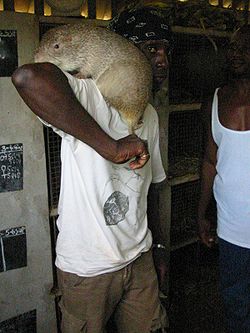
Picture of Thryonomys
- Source
- Wikipedia/Commons
- Credit
- Aurélia Zizo
- Licence
- Attribution
- Commercial use
- cannot be read from the licence given — check the record
CT scan
- Source
- MorphoSource
- Licence
- In Copyright
- Commercial use
- cannot be read from the licence given — check the record
- Specimen
- Thryonomys sp. · YPM:VZ:YPM MAM 014532
The description on this site
- Source
- Wikipedia, “Cane rat”
- Licence
- CC BY-SA 4.0
This is what the site found, which is not the same as what exists.
Keep going
What may have been alongside itThryonomyidae through timeFormations of the PleistoceneThe world it lived on
Occurrence data from the Paleobiology Database, CC BY 4.0. Fitzinger 1867