Kobus kob
The kob is an antelope found across Central Africa and parts of West Africa and East Africa. Together with the closely related reedbucks, waterbucks, lechwe, Nile lechwe, and puku, it forms the Reduncinae tribe. Found along the northern savanna, it is often seen in Murchison Falls and Queen Elizabeth National Park, Uganda; Garamba and Virunga National Park, and the Democratic Republic of the Congo, as well as grassy floodplains of South Sudan. Kob are found in wet areas, where they eat grasses. Kob are diurnal, but inactive during the heat of the day. They live in groups of either females and calves or just males. These groups generally range from five to forty animals.

Fanny Schertzer · CC BY 3.0 · via Wikipedia/Commons. May be a photograph of a specimen, or an artist’s reconstruction — an interpretation of a skeleton, since colour and soft tissue are almost never preserved.
On record
Recorded, not inferred- Also called
- kobPBDB
- Sits inside
- KobusPBDB
- Diet
- grazer, browserPBDB, for Bovidae
- Life habit
- ground dwellingPBDB, for Bovidae
- Motility
- actively mobilePBDB, for Osteichthyes
- Environment
- terrestrialPBDB, for Artiodactyla
Time the record covers
At least 2.5 million years on record.
The record covers at least 2.58 Mya to 11.7 ka. No occurrence read is dated outside 5.333 Mya to 0 Mya.
49 occurrences of Kobus kob on record, most of them in the Pleistocene. The Paleobiology Database records this as a living group. Bar height is expected occurrences, not a count: each fossil is spread across the span it is dated to, so a tall narrow bar means tight dating and a low wide one means loose.
When
49 occurrences- Pliocene17%
- Pleistocene70%
- Holocene12%
These are dates about fossils, not the animal: the record can only begin after it arose and end before it died out, so either end may reach further. Shares are expected occurrences: a fossil dated to a span is counted partly in each period it straddles. More on what this infers.
Found in
6 formations
- Koobi Fora Formation24
- Shungura Formation · Omo Group6
- Nachukui Formation · Omo Group3
- Olduvai Formation2
- Matabaietu Formation · Awash Group1
- 2 Formation1
Loading coastlines…
The named rock units Kobus kob has been recovered from, largest first. Drawn where the rock is now, not where it formed. 12 occurrences have no formation on record, which is common for older literature.
Kobus kob and its relatives
PleistoceneWhere Kobus kob and its relatives were recorded in the Pleistocene.
Found in the same rock
369 taxa- Alcelaphini24 sites
- Reduncini24 sites
- Equus22 sites
- Hipparion20 sites
- Palaeoloxodon recki20 sites
- Giraffa19 sites
- Kobus sigmoidalis19 sites
- Kolpochoerus limnetes19 sites
- Adenota recki17 sites
- Tragelaphus strepsiceros17 sites
- Libytherium maurusium16 sites
- Aepyceros melampus15 sites
- Hippopotamus gorgops15 sites
- Hominidae15 sites
- Menelikia lyrocera15 sites
- Parmularius eppsi15 sites
- Pelorovis turkanensis15 sites
- Tragelaphini15 sites
- Metridiochoerus andrewsi14 sites
- Giraffa stillei13 sites
- Megalotragus isaaci13 sites
- Metridiochoerus compactus13 sites
- Ceratotherium simum12 sites
- Gazella12 sites
The Paleobiology Database records 49 sites for Kobus kob, and this reads all of them. The number is how many of those sites it was catalogued from too. The 24 sharing the most are listed.
This is not a list of everything alive at the time. It is only what has come out of the same ground as this animal and been written down.
Entered from
23 references- Family Bovidae23
- Stratigraphy and Paleontology of pliocene and Pleistocene Localities West of Lake Turkana, Kenya3
- The Omo Group: Archives of the International Omo Research Expedition3
- Lakeside cemeteries in the Sahara: 5000 years of Holocene population and environmental change1
- The fauna and associated artefacts from the Lower Pleistocene site of Mansourah (Constantine, Algeria)1
- Environment and Behavior of 2.5-Million-Year-Old Bouri Hominids1
- New antelope fossils from Awash, Ethiopia, and phylogenetic analysis of Hippotragini (Bovidae, Mammalia)1
- Koobi Fora Research Project, Vol III, The Fossil Ungulates: Geology, Fossil Artiodactyls and Paleoenvironments1
- Climatic environment and air quality in the farrowing units of a pig house1
- Olduvai Gorge; a case study in the interpretation of hominid paleoenvironments in East Africa1
- Plio-Pleistocene Hippopotamidae from the Upper Semliki1
- Late Pleistocene hunter-gatherers at Ishango (eastern Zaire): the faunal evidence1
Each of the 49 occurrences read was entered from one of these publications, ordered by how many each accounts for. This is not a search for papers mentioning the name. 11 further references are not listed. Entries link to doi.org where the Paleobiology Database holds an identifier, and to its own record where it does not. Relayed as the Paleobiology Database holds them, not checked against what they resolve to.
Media and terms
Media content2
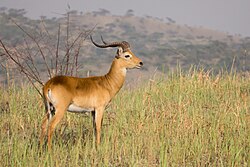
Picture of Kobus kob
- Source
- Wikipedia/Commons
- Credit
- Fanny Schertzer
- Licence
- CC BY 3.0
- Commercial use
- the licence allows it
Structured light scan
- Source
- MorphoSource
- Licence
- In Copyright
- Commercial use
- cannot be read from the licence given — check the record
- Specimen
- Kobus kob · FMNH:Mammals:51368
Smithsonian Open Access was not reached for this taxon, so this list is what the others held rather than everything there is.
The description on this site
- Source
- Wikipedia, “Kob”
- Licence
- CC BY-SA 4.0
This is what the site found, which is not the same as what exists.
Keep going
What may have been alongside itKobus through timeFormations of the PleistoceneThe world it lived on
Occurrence data from the Paleobiology Database, CC BY 4.0. (Erxleben 1777)