Thalassinoides suevicus
No picture of Thalassinoides suevicus was found. Wikidata was searched and had none. iDigBio and GBIF were not searched: the Paleobiology Database does not place Thalassinoides suevicus firmly enough to tell it from something else bearing the same name, and a search on the name alone returns whichever of them was photographed. Wikipedia and Smithsonian Open Access did not answer, so this is what the others held rather than everything there is.
On record
Recorded, not inferred- Sits inside
- ThalassinoidesPBDB
Time the record covers
At least 151 million years on record.
The record covers at least 192.9 Mya to 41.03 Mya. No occurrence read is dated outside 201.4 Mya to 37.71 Mya.
19 occurrences of Thalassinoides suevicus on record, most of them in the Late Jurassic. Bar height is expected occurrences, not a count: each fossil is spread across the span it is dated to, so a tall narrow bar means tight dating and a low wide one means loose.
When
19 occurrencesThese are dates about fossils, not the animal: the record can only begin after it arose and end before it died out, so either end may reach further. Shares are expected occurrences: a fossil dated to a span is counted partly in each period it straddles. More on what this infers.
Found in
7 formations
- Kap Leslie Formation12
- Areia do Mastro Formation2
- Calcari Grigi Formation1
- Shemshak Formation1
- Blue Lias Formation · Lias Group1
- Margas de Pamplona Formation1
Loading coastlines…
The named rock units Thalassinoides suevicus has been recovered from, largest first. Drawn where the rock is now, not where it formed.
Thalassinoides suevicus and its relatives
Late JurassicWhere Thalassinoides suevicus and its relatives were recorded in the Late Jurassic.
Found in the same rock
130 taxa- Ammonoidea11 sites
- Entolium orbiculare10 sites
- Pleuromya9 sites
- Belemnitida8 sites
- Buchia mosquensis8 sites
- Camptonectes8 sites
- Pleuromya uniformis8 sites
- Protocardia striatula8 sites
- Grammatodon7 sites
- Chondrites6 sites
- Isognomon6 sites
- Pinna6 sites
- Taimyrothyris6 sites
- Thracia depressa6 sites
- Astarte5 sites
- Eriphyla5 sites
- Hartwellia5 sites
- Isocyprina5 sites
- Mesosaccella5 sites
- Modiolus5 sites
- Liostrea4 sites
- Serpula intestinalis4 sites
- Angaria3 sites
- Corbicellopsis3 sites
The Paleobiology Database records 19 sites for Thalassinoides suevicus, and this reads all of them. The number is how many of those sites it was catalogued from too. The 24 sharing the most are listed.
This is not a list of everything alive at the time. It is only what has come out of the same ground as this animal and been written down.
Entered from
9 references- Genesis and environmental significance of Upper Cretaceous shell concentrations from the Cauvery Basin, southern India8
- Unpublished data4
- The dinosaur tracksite from the lower Barremian of Areia do Mastro Formation (Cabo Espichel, Portugal): implications for dinosaur behavior1
- New dinosaur tracks from the lower Barremian of Portugal (Areia do Mastro Formation, Cape Espichel)1
- Dinosaur eggs associated with crustacean trace fossils from the Upper Cretaceous of Jiangxi, China: evidence for foraging behavior?1
- Fossil associations from the middle and upper Eocene strata of the Pamplona Basin and surrounding areas (Navarre, western Pyrenees)1
- The upper Shemshak Formation (Toarcian–Aalenian) of the Eastern Alborz (Iran): Biota and palaeoenvironments during a transgressive–regressive cycle1
- Burrows and body fossil of decapod crustaceans in the Calcari Grigi, lower Jurassic, Trento platform (Italy)1
- Trace fossils of the Jurassic, Blue Lias, Lyme Regis, Southern England1
Each of the 19 occurrences read was entered from one of these publications, ordered by how many each accounts for. This is not a search for papers mentioning the name. Entries link to doi.org where the Paleobiology Database holds an identifier, and to its own record where it does not. Relayed as the Paleobiology Database holds them, not checked against what they resolve to.
Media and terms
Media content1
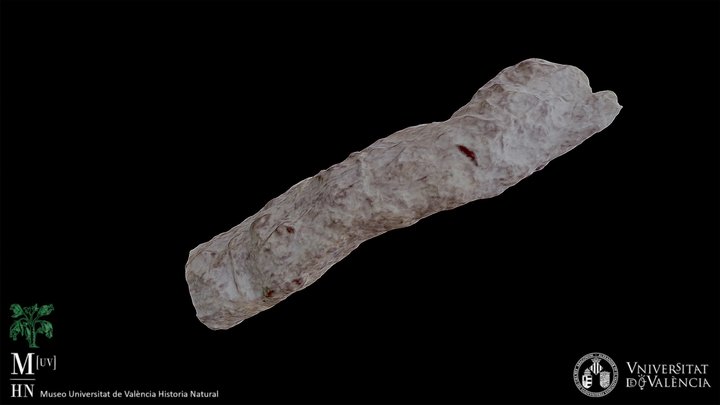
3D model
- Source
- Sketchfab
- Licence
- CC Attribution
- Commercial use
- cannot be read from the licence given — check the record
No picture of Thalassinoides suevicus was found. Wikidata was searched and had none.
iDigBio and GBIF were not searched: the Paleobiology Database does not place Thalassinoides suevicus firmly enough to tell it from something else bearing the same name, and a search on the name alone returns whichever of them was photographed.
Wikipedia and Smithsonian Open Access did not answer, so this is what the others held rather than everything there is.
Smithsonian Open Access and MorphoSource were not reached for this taxon, so this list is what the others held rather than everything there is.
This is what the site found, which is not the same as what exists.
Keep going
What may have been alongside itThalassinoides through timeFormations of the Late JurassicThe world it lived on
Occurrence data from the Paleobiology Database, CC BY 4.0. (Rieth 1932)