Taioma

via iDigBio · CC0 · via iDigBio. May be a photograph of a specimen, or an artist’s reconstruction — an interpretation of a skeleton, since colour and soft tissue are almost never preserved.
On record
Recorded, not inferred- Sits inside
- FusininaePBDB
- Diet
- carnivorePBDB, for Fasciolariidae
- Life habit
- epifaunalPBDB, for Fasciolariidae
- Motility
- actively mobilePBDB, for Fasciolariidae
- Vision
- limitedPBDB, for Gastropoda
Time the record covers
At least 49 million years on record.
The record covers at least 72.2 Mya to 23.04 Mya. No occurrence read is dated outside 83.6 Mya to 15.98 Mya.
43 occurrences of Taioma on record, most of them in the Paleocene. Bar height is expected occurrences, not a count: each fossil is spread across the span it is dated to, so a tall narrow bar means tight dating and a low wide one means loose.
When
43 occurrences- Late Cretaceous28%
- Paleocene42%
- Eocene28%
- Miocene2%
These are dates about fossils, not the animal: the record can only begin after it arose and end before it died out, so either end may reach further. Shares are expected occurrences: a fossil dated to a span is counted partly in each period it straddles. More on what this infers.
Found in
11 formations
- La Meseta Formation12
- Lopez de Bertodano Formation9
- Jagüel Formation · Malargüe Group9
- Sobral Formation4
- Kauru Formation · Fuchsia Group2
- Santa Marta Formation2
Loading coastlines…
The named rock units Taioma has been recovered from, largest first. Drawn where the rock is now, not where it formed.
Taioma and its relatives
PaleoceneWhere Taioma and its relatives were recorded in the Paleocene.
Found in the same rock
429 taxa- Polinices (Polinices) subtenuis10 sites
- Eunaticina9 sites
- Struthioptera camachoi9 sites
- Eoscaphella fordycei8 sites
- Saxolucina sharmani8 sites
- Zelandiella verrucosa8 sites
- Austrotoma oliveroi7 sites
- Galeodea7 sites
- Rotularia7 sites
- Antarctodarwinella ellioti6 sites
- Austroficopsis seymourensis6 sites
- Lahillia wilckensi6 sites
- Panopea clausa6 sites
- Reptilia6 sites
- Amberleya5 sites
- Anthozoa5 sites
- Austrobuccinum tuberosum5 sites
- Austroficopsis wimani5 sites
- Colposigma euthenia5 sites
- Cryptorhytis5 sites
- Cucullaea5 sites
- Cucullaea antarctica5 sites
- Cucullaea raea5 sites
- Eucrassatella wilckensi5 sites
The Paleobiology Database records 26 sites for Taioma, and this reads all of them. The number is how many of those sites it was catalogued from too. The 24 sharing the most are listed.
This is not a list of everything alive at the time. It is only what has come out of the same ground as this animal and been written down.
Entered from
13 references- Molluscan Systematics and Biostratigraphy12
- Molluscs at the K/Pg boundary in Argentina: Extinction and recovery patterns. unpublished Ph.D. thesis9
- Stratigraphy, sedimentology, and paleoecology of Upper Cretaceous/Paleocene shelf-deltaic sediments of Seymour Island6
- Early Paleocene Mollusks of Antarctica: Systematics, Paleoecology and Paleobiogeographic Significance4
- Nuevos afloramientos de la Formacion Santa Marta (Cretacio Tardio), en las Isla James Ross, Antartida. Estratigrafia e implcancias estructurales2
- Latest Cretaceous/Earliest Tertiary Transition on Seymour Island, Antarctica2
- The Geology of the Waitaki Subdivision2
- Resilience of marine invertebrate communities during the early Cenozoic hyperthermals1
- Invertibrados fósiles marinos de la Formación Guadal (Oligoceno superio-Mioceno inferior) en Pampa, Castillo region, región de Aisén, Chile1
- Late Cretaceous-Early Tertiary Gastropods from Southwestern Patagonia, Argentina1
- Upper Cretaceous sedimentology and biostratigraphy of western Cape Lamb (Vega Island, Antarctica). Implications of sedimentary cycles and evolution of the basin1
- Marine Upper Cretaceous and lowermost Tertiary deposits in West Greenland1
Each of the 43 occurrences read was entered from one of these publications, ordered by how many each accounts for. This is not a search for papers mentioning the name. 1 further reference is not listed. Entries link to doi.org where the Paleobiology Database holds an identifier, and to its own record where it does not. Relayed as the Paleobiology Database holds them, not checked against what they resolve to.
Media and terms
Media content2
Picture of Taioma
- Source
- iDigBio
- Credit
- via iDigBio
- Licence
- CC0
- Commercial use
- the licence allows it
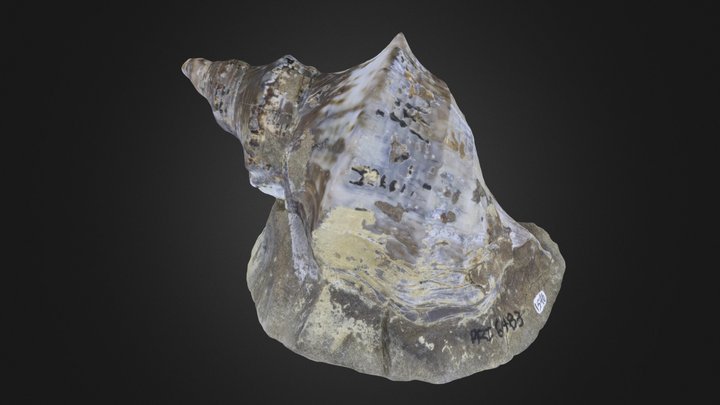
3D model
- Source
- Sketchfab
- Licence
- CC0 Public Domain
- Commercial use
- the licence allows it
Smithsonian Open Access and MorphoSource were not reached for this taxon, so this list is what the others held rather than everything there is.
This is what the site found, which is not the same as what exists.
Keep going
What may have been alongside itFusininae through timeFormations of the PaleoceneThe world it lived on
Occurrence data from the Paleobiology Database, CC BY 4.0. Finlay and Marwick 1937