Annularia
Searched as Rotularia. The Paleobiology Database treats Annularia as the accepted name.
No picture of Annularia was found. iDigBio was searched and had none. Wikipedia and Wikidata have a picture filed under this name, but nothing tied it to Annularia itself, so it was not used. Smithsonian Open Access did not answer, so this is what the others held rather than everything there is. GBIF was asked, and what came back is not recorded: nothing, or a picture this site could not tie to Annularia, or no answer at all. This entry cannot say which.
On record
Recorded, not inferred- Sits inside
- EquisetalesPBDB
- Diet
- "photoautotroph"PBDB, for Streptophyta
Time the record covers
At least 285 million years on record.
The record covers at least 323.4 Mya to 37.71 Mya. No occurrence read is dated outside 358.86 Mya to 33.9 Mya.
591 occurrences of Annularia on record, most of them in the Permian. Bar height is expected occurrences, not a count: each fossil is spread across the span it is dated to, so a tall narrow bar means tight dating and a low wide one means loose.
When
591 occurrences- Carboniferous21%
- Permian46%
- Early Triassicunder 1%
- Early Jurassicunder 1%
- Middle Jurassicunder 1%
- Late Jurassicunder 1%
- Early Cretaceous7%
- Late Cretaceous16%
- Paleocene4%
- Eocene5%
These are dates about fossils, not the animal: the record can only begin after it arose and end before it died out, so either end may reach further. Shares are expected occurrences: a fossil dated to a span is counted partly in each period it straddles. More on what this infers.
Found in
152 formations
- Lopez de Bertodano Formation23
- Pottsville Formation22
- Shanxi Formation18
- Okarahia Sandstone Formation · Mata Group18
- Kahuitara Tuff Formation · Pitt Island Group16
- Manebacher Formation10
Loading coastlines…
The named rock units Annularia has been recovered from, largest first. Drawn where the rock is now, not where it formed. 128 further formations hold fewer occurrences each and are not listed. 194 occurrences have no formation on record, which is common for older literature.
Annularia and its relatives
PermianWhere Annularia and its relatives were recorded in the Permian.
Found in the same rock
595 taxa- Pecopteris177 sites
- Sphenophyllum133 sites
- Cordaites110 sites
- Neuropteris102 sites
- Sphenopteris98 sites
- Taeniopteris92 sites
- Odontopteris78 sites
- Pecopteris (Alethopteris)74 sites
- Calamites73 sites
- Asterophyllites64 sites
- Lobatannularia56 sites
- Callipteris54 sites
- Lepidodendron48 sites
- Samaropsis47 sites
- Callipteridium43 sites
- Paracalamites39 sites
- Phyllotheca37 sites
- Noeggerathiopsis36 sites
- Walchia33 sites
- Callipteris conferta30 sites
- Sigillaria30 sites
- Lebachia29 sites
- Compsopteris27 sites
- Crassinervia27 sites
The Paleobiology Database records 246 sites for Annularia, and this reads 240 of them. The number is how many of those sites it was catalogued from too. The 24 sharing the most are listed.
This is not a list of everything alive at the time. It is only what has come out of the same ground as this animal and been written down.
Entered from
161 references- Stratigraphische Grundlagen des Stefan C und Rotliegenden im Thuringer Wald31
- Kompleksy rasteniy; sporovo-pyl'tsevyye kompleksy31
- Cretaceous stratigraphy of Raukumara Peninsula29
- Contribution a l'etude des flores Autuno-Stephaniennes19
- Stratigraphy, sedimentology, and paleoecology of Upper Cretaceous/Paleocene shelf-deltaic sediments of Seymour Island17
- Upper Cretaceous Decapoda and Serpulidae from James Ross Island, Graham Land16
- Regional Geology of Hebei Province, Beijing Municipality and Tianjing Municipality14
- The Piripauan and Haumurian stratotypes (Mata Series, Upper Cretaceous) and correlative sequences in the Haumuri Bluff district, South Marlborough (S56)14
- The Piripauan and Haumurian stratotypes (Mata Series, Upper Cretaceous) and correlative sequences in the Haumuri Bluff District, South Marlborough13
- A paleontological study of an Early Pennsylvanian forest preserved above the Blue Creek Coal seam, Pottsville, Formation, Northwestern Alabama12
- Flora of Pennsylvanian Pictou Group of New Brunswick12
- A paleoecological study of an in situ peat-forming Carboniferous forest in the Black Warrior Basin, Alabama10
Each of the 591 occurrences read was entered from one of these publications, ordered by how many each accounts for. This is not a search for papers mentioning the name. 149 further references are not listed. Entries link to doi.org where the Paleobiology Database holds an identifier, and to its own record where it does not. Relayed as the Paleobiology Database holds them, not checked against what they resolve to.
Media and terms
Media content1
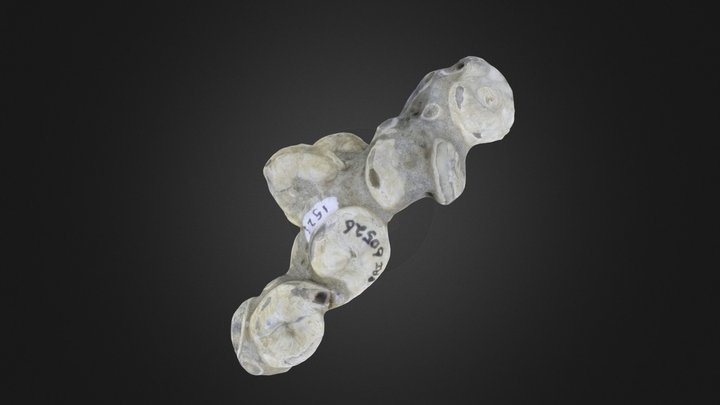
3D model
- Source
- Sketchfab
- Licence
- CC0 Public Domain
- Commercial use
- the licence allows it
No picture of Annularia was found. iDigBio was searched and had none.
Wikipedia and Wikidata have a picture filed under this name, but nothing tied it to Annularia itself, so it was not used.
Smithsonian Open Access did not answer, so this is what the others held rather than everything there is.
GBIF was asked, and what came back is not recorded: nothing, or a picture this site could not tie to Annularia, or no answer at all. This entry cannot say which.
Smithsonian Open Access was not reached for this taxon, so this list is what the others held rather than everything there is.
This is what the site found, which is not the same as what exists.
Keep going
What may have been alongside itEquisetales through timeFormations of the PermianThe world it lived on
Occurrence data from the Paleobiology Database, CC BY 4.0. Sternberg 1825