Sylvilagus nuttallii
The mountain cottontail or Nuttall's cottontail is a species of rabbit found in western Canada and the United States. It is a medium- to small-sized rabbit with pale brown fur, white undersides, a two-colored tail, and black-tipped, rounded ears with densely furred insides. It has notably rusty-colored legs and an orange nape. The mountain cottontail appears largely among coniferous forests in mountainous regions, including the slopes of the Rocky Mountains and the Cascade-Sierra Nevada mountain ranges, and adapts to a variety of elevations and vegetation. Its diet is made up of various grasses, shrubs, and sagebrush, as well as twigs, bark, or fungi in lesser amounts or when foliage is scarce.

Justin Wilde · Public Domain · via Wikipedia/Commons. May be a photograph of a specimen, or an artist’s reconstruction — an interpretation of a skeleton, since colour and soft tissue are almost never preserved.
On record
Recorded, not inferred- Also called
- mountain cottontailPBDB
- Sits inside
- SylvilagusPBDB
- Diet
- grazer, browserPBDB, for Leporidae
- Life habit
- ground dwellingPBDB, for Leporidae
- Motility
- actively mobilePBDB, for Osteichthyes
- Environment
- terrestrialPBDB, for Eutheria
- Mass
- 720 gWikidata
Time the record covers
At most 129 thousand years on record.
Every occurrence read is dated to somewhere between 129 ka and 0 Mya, and nothing in the dating separates them, so that window is what the record shows rather than a span.
5 occurrences of Sylvilagus nuttallii on record, most of them in the Pleistocene. The Paleobiology Database records this as a living group. Bar height is expected occurrences, not a count: each fossil is spread across the span it is dated to, so a tall narrow bar means tight dating and a low wide one means loose.
When
5 occurrences- Pleistocene78%
- Holocene22%
These are dates about fossils, not the animal: the record can only begin after it arose and end before it died out, so either end may reach further. Shares are expected occurrences: a fossil dated to a span is counted partly in each period it straddles. More on what this infers.
Sylvilagus nuttallii and its relatives
PleistoceneWhere Sylvilagus nuttallii and its relatives were recorded in the Pleistocene.
Found in the same rock
201 taxa- Lynx rufus4 sites
- Antilocapra americana3 sites
- Antrozous pallidus3 sites
- Aquila chrysaetos3 sites
- Canis latrans3 sites
- Equus mexicanus3 sites
- Lemmiscus curtatus3 sites
- Marmota flaviventris3 sites
- Neotoma cinerea3 sites
- Peromyscus maniculatus3 sites
- Puma concolor3 sites
- Accipiter striatus2 sites
- Anas platyrhynchos2 sites
- Aztlanolagus agilis2 sites
- Bos bison2 sites
- Bubo virginianus2 sites
- Camelops hesternus2 sites
- Capromeryx2 sites
- Cervus canadensis2 sites
- Colaptes auratus2 sites
- Colinus virginianus2 sites
- Corvus2 sites
- Crotalus2 sites
- Crotaphytus collaris2 sites
The Paleobiology Database records 5 sites for Sylvilagus nuttallii, and this reads all of them. The number is how many of those sites it was catalogued from too. The 24 sharing the most are listed.
This is not a list of everything alive at the time. It is only what has come out of the same ground as this animal and been written down.
Entered from
3 references- Reconstruction of mid Wisconsinan environments in southern New Mexico2
- New Quaternary mammal localities in the upper Clark Fork River valley, western Montana2
- Quaternary paleontology and paleocology of Crystal Ball Cave, Millard County, Utah: with emphasis on mammals and description of a new species of fossil skunk1
Each of the 5 occurrences read was entered from one of these publications, ordered by how many each accounts for. This is not a search for papers mentioning the name. Each entry links to the Paleobiology Database's own record for the work.
Media and terms
Media content2
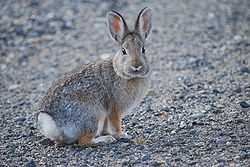
Picture of Sylvilagus nuttallii
- Source
- Wikipedia/Commons
- Credit
- Justin Wilde
- Licence
- Public Domain
- Commercial use
- the licence allows it
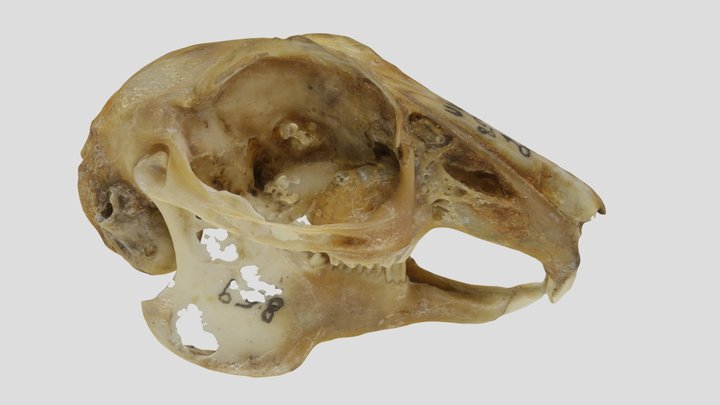
3D model
- Source
- Sketchfab
- Licence
- CC Attribution
- Commercial use
- cannot be read from the licence given — check the record
The description on this site
- Licence
- CC BY-SA 4.0
This is what the site found, which is not the same as what exists.
Keep going
What may have been alongside itSylvilagus through timeFormations of the PleistoceneThe world it lived on
Occurrence data from the Paleobiology Database, CC BY 4.0. (Bachman 1837)