Strumigenys
Strumigenys is a genus of ants in the subfamily Myrmicinae. It is a widespread, speciose genus of small ants with cryptic lifestyles that are predators of small arthropod prey.

April Nobile · CC BY 4.0 · via Wikipedia/Commons. May be a photograph of a specimen, or an artist’s reconstruction — an interpretation of a skeleton, since colour and soft tissue are almost never preserved.
On record
Recorded, not inferred- Sits inside
- AttiniPBDB
- Motility
- actively mobilePBDB, for Arthropoda
- Environment
- terrestrialPBDB, for Insecta
Time the record covers
At least 13 million years on record.
The record covers at least 13.82 Mya to 11.7 ka. No occurrence read is dated outside 20.45 Mya to 0 Mya.
7 occurrences of Strumigenys on record, most of them in the Miocene. The Paleobiology Database records this as a living group. Bar height is expected occurrences, not a count: each fossil is spread across the span it is dated to, so a tall narrow bar means tight dating and a low wide one means loose.
When
7 occurrencesThese are dates about fossils, not the animal: the record can only begin after it arose and end before it died out, so either end may reach further. Shares are expected occurrences: a fossil dated to a span is counted partly in each period it straddles. More on what this infers.
Strumigenys and its relatives
MioceneWhere Strumigenys and its relatives were recorded in the Miocene.
Found in the same rock
619 taxa- Pheidole3 sites
- Camponotus2 sites
- Cephalotes caribicus2 sites
- Cephalotes serratus2 sites
- Cephalotes squamosus2 sites
- Chimarra (Chimarrita) palaenova2 sites
- Crematogaster2 sites
- Dolichoderus2 sites
- Gnamptogenys2 sites
- Harpactosphecion sucinum2 sites
- Hypoponera2 sites
- Linepithema2 sites
- Micromalthus debilis2 sites
- Neomachilellus (Praeneomachilellus) dominicanus2 sites
- Odontomachus2 sites
- Paratrechina2 sites
- Platythyrea2 sites
- Proceratium dominicanum2 sites
- Tapinoma2 sites
- Thaumatodryinus miocenicus2 sites
- Ablabesmyia electrohispaniolana1 site
- Acanthognathus poinari1 site
- Acanthostichus hispaniolicus1 site
- Acaricoris robertae1 site
The Paleobiology Database records 4 sites for Strumigenys, and this reads all of them. The number is how many of those sites it was catalogued from too. The 24 sharing the most are listed.
This is not a list of everything alive at the time. It is only what has come out of the same ground as this animal and been written down.
Entered from
4 references- The ant tribe Dacetini: limits and constituent genera, with descriptions of new species (Hymenoptera, Formicidae)2
- A preliminary review of Colombia ants (Hymenoptera: Formicidae) preserved in copal2
- First description of fossil Dacetini ants with a critical analysis of the current classification of the tribe (amber collection Stuttgart: Hymenoptera, Formicidae. VI: Dacetini)2
- The mid-Miocene Zhangpu biota reveals an outstandingly rich rainforest biome in East Asia1
Each of the 7 occurrences read was entered from one of these publications, ordered by how many each accounts for. This is not a search for papers mentioning the name. Entries link to doi.org where the Paleobiology Database holds an identifier, and to its own record where it does not. Relayed as the Paleobiology Database holds them, not checked against what they resolve to.
Media and terms
Media content3

Picture of Strumigenys
- Source
- Wikipedia/Commons
- Credit
- April Nobile
- Licence
- CC BY 4.0
- Commercial use
- the licence allows it
CT scan
- Source
- MorphoSource
- Credit
- UTEP Insects (Arctos)
- Licence
- not stated by the source
- Commercial use
- cannot be read from the licence given — check the record
- Specimen
- Strumigenys longispinosa · UTEP:Ento:UTEP:Ento:11024
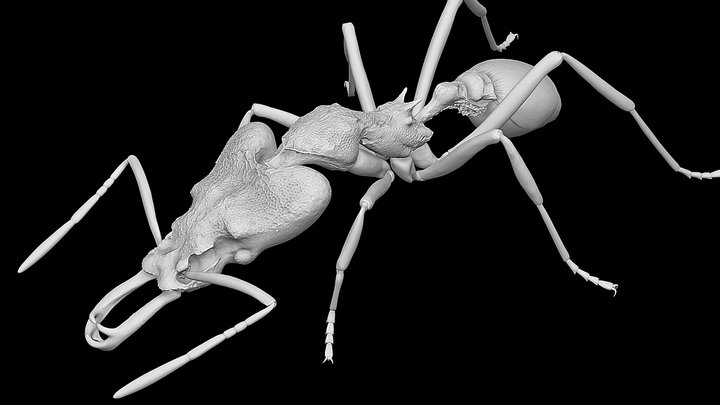
The description on this site
- Source
- Wikipedia, “Strumigenys”
- Licence
- CC BY-SA 4.0
This is what the site found, which is not the same as what exists.
Keep going
What may have been alongside itAttini through timeFormations of the MioceneThe world it lived on
Occurrence data from the Paleobiology Database, CC BY 4.0. Smith 1860