Somateria mollissima
The common eider, also called St. Cuthbert's duck or Cuddy's duck, is a large sea-duck that is distributed over the northern coasts of Europe, North America and eastern Siberia. It breeds in Arctic and some northern temperate regions, but winters somewhat farther south in temperate zones, when it can form large flocks on coastal waters. It can fly at speeds up to 113 km/h (70 mph).

Ryzhkov Sergey · CC BY-SA 4.0 · via Wikipedia/Commons. May be a photograph of a specimen, or an artist’s reconstruction — an interpretation of a skeleton, since colour and soft tissue are almost never preserved.
On record
Recorded, not inferred- Also called
- common eiderPBDB
- Sits inside
- SomateriaPBDB
- Diet
- herbivorePBDB, for Anatinae
- Life habit
- volantPBDB, for Anatinae
- Motility
- actively mobilePBDB, for Theropoda
- Environment
- freshwaterPBDB, for Anatinae
- Mass
- 2.22 kgWikidata
Time the record covers
At least 3.5 million years on record.
The record covers at least 3.6 Mya to 11.7 ka. No occurrence read is dated outside 5.333 Mya to 0 Mya.
23 occurrences of Somateria mollissima on record. The Paleobiology Database records this as a living group. Bar height is expected occurrences, not a count: each fossil is spread across the span it is dated to, so a tall narrow bar means tight dating and a low wide one means loose.
When
23 occurrences- Pliocene4%
- Pleistocene22%
- Holocene74%
These are dates about fossils, not the animal: the record can only begin after it arose and end before it died out, so either end may reach further. Shares are expected occurrences: a fossil dated to a span is counted partly in each period it straddles. More on what this infers.
Found in
1 formation
- Yorktown Formation · Chesapeake Group1
Loading coastlines…
The named rock units Somateria mollissima has been recovered from, largest first. Drawn where the rock is now, not where it formed. 22 occurrences have no formation on record, which is common for older literature.
Found in the same rock
628 taxa- Cepphus grylle9 sites
- Erignathus barbatus9 sites
- Larus9 sites
- Rangifer tarandus9 sites
- Odobenus rosmarus8 sites
- Phoca hispida8 sites
- Ursus maritimus8 sites
- Balaena mysticetus6 sites
- Branta6 sites
- Ovibos moschatus6 sites
- Vulpes lagopus6 sites
- Aves5 sites
- Gadus5 sites
- Lepus arcticus5 sites
- Melanitta nigra5 sites
- Mergus serrator5 sites
- Phocidae5 sites
- Uria lomvia5 sites
- Anas4 sites
- Anatidae4 sites
- Canis4 sites
- Canis familiaris4 sites
- Fulmarus glacialis4 sites
- Larus hyperboreus4 sites
The Paleobiology Database records 21 sites for Somateria mollissima, and this reads all of them. The number is how many of those sites it was catalogued from too. The 24 sharing the most are listed.
This is not a list of everything alive at the time. It is only what has come out of the same ground as this animal and been written down.
Entered from
14 references- Polar bear fossil and archaeological records from the Pleistocene and Holocene in relation to sea ice extent and open water polynyas6
- Humans and marine resource interaction reappraised: Archaeofauna remains during the late Pleistocene and Holocene in Cantabrian Spain2
- Birds in Finnish prehistory2
- Bird bones from Jettböle I, a site in the Neolithic Åland archipelago in the northern Baltic2
- Seabirds and Late Pleistocene marine environments in the Northeast Atlantic and the Mediterranean2
- Hunting technologies and archaeofaunas: societal differences between hunter-gatherers of the Eastern Arctic1
- Pleistocene birds of Gruta da Furninha (Peniche-Portugal): a paleontological and paleoenvironmental aproach1
- Brown bear (Ursus arctos) (9880 ± 35 BP) from late-glacial Champlain Sea deposits at Saint-Nicolas, Quebec, Canada, and the dispersal history of brown bears1
- Animals and the precontact Inuit of Labrador: an examination using faunal remains, space and myth1
- Dynamics of sea mammal and bird populations of the Bearing Sea region over the last several millennia1
- Miocene and Pliocene birds from the Lee Creek Mine, North Carolina1
- Coastal adaptation and marine exploitation of the island Hiiumaa, Estonia, during the stone age with special emphasis on the Kõpu I site1
Each of the 23 occurrences read was entered from one of these publications, ordered by how many each accounts for. This is not a search for papers mentioning the name. 2 further references are not listed. Entries link to doi.org where the Paleobiology Database holds an identifier, and to its own record where it does not. Relayed as the Paleobiology Database holds them, not checked against what they resolve to.
Media and terms
Media content1
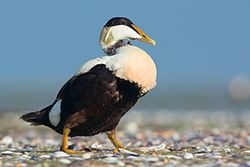
Picture of Somateria mollissima
- Source
- Wikipedia/Commons
- Credit
- Ryzhkov Sergey
- Licence
- CC BY-SA 4.0
- Commercial use
- the licence allows it
No 3D scan of Somateria mollissima was found in Sketchfab.
Smithsonian Open Access and MorphoSource were not reached for this taxon, so this list is what the others held rather than everything there is.
The description on this site
- Licence
- CC BY-SA 4.0
This is what the site found, which is not the same as what exists.
Keep going
What may have been alongside itSomateria through timeThe world it lived on
Occurrence data from the Paleobiology Database, CC BY 4.0. (Linnaeus 1758)