Simbirskites
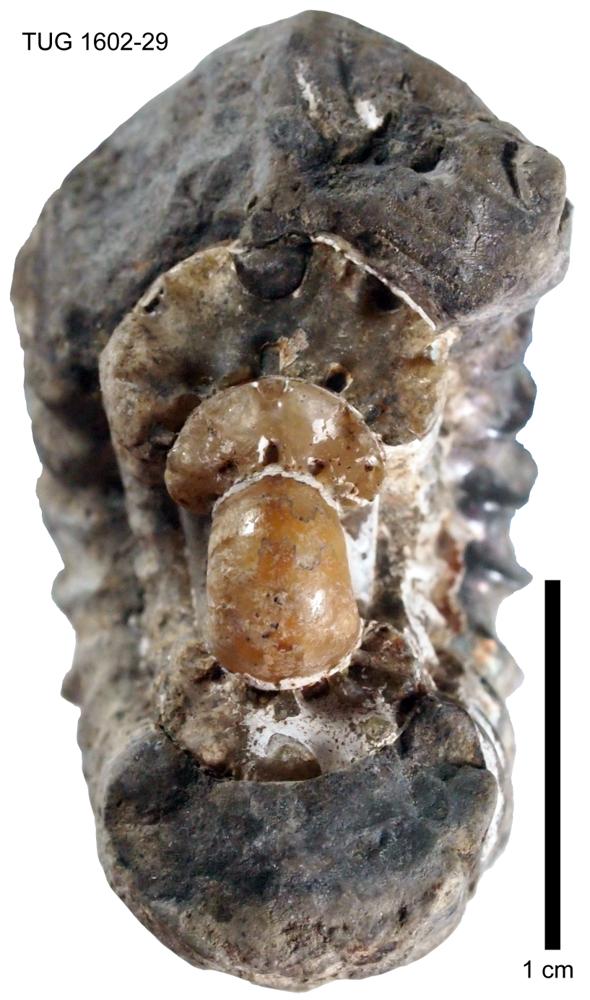
via GBIF · CC BY-NC 4.0 · via GBIF. May be a photograph of a specimen, or an artist’s reconstruction — an interpretation of a skeleton, since colour and soft tissue are almost never preserved.
On record
Recorded, not inferred- Sits inside
- SimbirskitinaePBDB
- Diet
- carnivorePBDB, for Ammonoidea
- Life habit
- nektonicPBDB, for Ammonoidea
- Motility
- fast-movingPBDB, for Ammonoidea
- Vision
- well-developedPBDB, for Cephalopoda
- Environment
- marinePBDB, for Cephalopoda
Time the record covers
At most 12 million years on record.
Every occurrence read is dated to somewhere between 137.05 Mya and 125.77 Mya, and nothing in the dating separates them, so that window is what the record shows rather than a span.
48 occurrences of Simbirskites on record, most of them in the Early Cretaceous. Bar height is expected occurrences, not a count: each fossil is spread across the span it is dated to, so a tall narrow bar means tight dating and a low wide one means loose.
When
48 occurrences- Early Cretaceous100%
These are dates about fossils, not the animal: the record can only begin after it arose and end before it died out, so either end may reach further. Shares are expected occurrences: a fossil dated to a span is counted partly in each period it straddles. More on what this infers.
Found in
12 formations
- Upper Shale-Siltstone Division Formation6
- Budden Canyon Formation6
- Palnatokes Bjerg Formation · Wollaston Forland Group5
- Paskenta Formation3
- Wloclawek Formation2
- Days Creek Formation2
Loading coastlines…
The named rock units Simbirskites has been recovered from, largest first. Drawn where the rock is now, not where it formed. 16 occurrences have no formation on record, which is common for older literature.
Simbirskites and its relatives
Early CretaceousWhere Simbirskites and its relatives were recorded in the Early Cretaceous.
Found in the same rock
68 taxa- Hibolithes4 sites
- Lytoceras aulaeum4 sites
- Bivalvia3 sites
- Phyllopachyceras infundibulum3 sites
- Hollisites lucasi2 sites
- Hoploparia riddlensis2 sites
- Inoceramus2 sites
- Venus collinium2 sites
- Acrioceras (Paraspinoceras) pulcherrimum1 site
- Acrioceras hamlini1 site
- Acrioceras vespertinum1 site
- Acroteuthis1 site
- Acroteuthis impressa1 site
- Acroteuthis shastensis1 site
- Anahamulina wilcoxensis1 site
- Aucella nuciformia1 site
- Balearites balearis1 site
- Belemnoteuthis (Conoteuthis) pacifica1 site
- Bochianites neocomiensis1 site
- Crioceratites1 site
- Crioceratites duvalii1 site
- Crioceratites latus1 site
- Crioceratites tehamaensis1 site
- Dentalium1 site
The Paleobiology Database records 36 sites for Simbirskites, and this reads all of them. The number is how many of those sites it was catalogued from too. The 24 sharing the most are listed.
This is not a list of everything alive at the time. It is only what has come out of the same ground as this animal and been written down.
Entered from
20 references- Jurassic and Lower Cretaceous paleogeographgy and depositional tectonics of Porcupine Plateau. adjacent areas of Northern Yukon and those of MacKensie District6
- Lower Cretaceous deposits in California and Oregon6
- Mesozoic and ? Tertiary rocks of Quatsino Sound, Vancouver Island, Bristish Columbia5
- Ammonites of Early Cretaceous age (Valanginian and Hauterivian) from the Pacific Coast states5
- The Early Cretaceous (Late Ryazanian-Early Hauterivian) ammonite fauna of North-East Greenland: taxonomy, biostratigraphy, and biogeography4
- Correlation of the Barremian belemnite successions of northwest Europe and the Ulyanovsk Saratov area (Russian Platform)3
- Biofacies Characteristics of Lower Cretaceous Deposits of Georgia2
- Sedimentaere und palaeotektonische Entwicklung der epikontinentalen Unterkreide Polens2
- The Jurassic-Cretaceous Boundary and the Berriasian Stage in the Boreal Realm2
- Hoploparia riddlensis, a new species of lobster (Decapoda: Nephropidae) from the Days Creek Formation (Hauterivian, Lower Cretaceous) of Oregon2
- New genera of Early Cretaceous ammonites from California and Oregon2
- A new elasmosaurid plesiosaurian from the Early Cretaceous of Russia marks an early attempt at neck elongation1
Each of the 48 occurrences read was entered from one of these publications, ordered by how many each accounts for. This is not a search for papers mentioning the name. 8 further references are not listed. Entries link to doi.org where the Paleobiology Database holds an identifier, and to its own record where it does not. Relayed as the Paleobiology Database holds them, not checked against what they resolve to.
Media and terms
Media content2
Picture of Simbirskites
- Source
- GBIF
- Credit
- via GBIF
- Licence
- CC BY-NC 4.0
- Commercial use
- the licence does not allow it
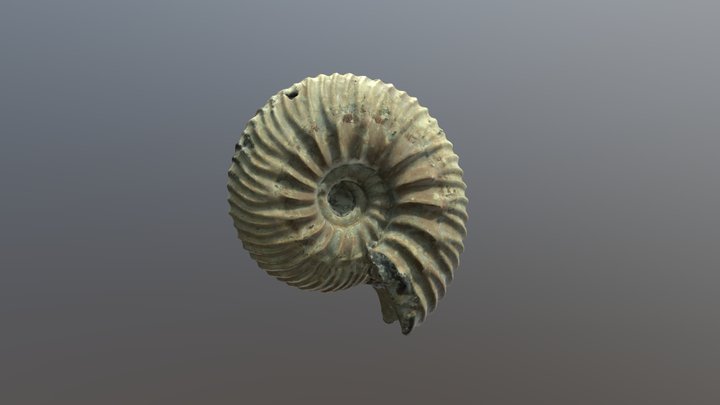
3D model
- Source
- Sketchfab
- Credit
- Shellie Luallin
- Licence
- CC Attribution
- Commercial use
- cannot be read from the licence given — check the record
Smithsonian Open Access was not reached for this taxon, so this list is what the others held rather than everything there is.
This is what the site found, which is not the same as what exists.
Keep going
What may have been alongside itSimbirskitinae through timeFormations of the Early CretaceousThe world it lived on
Occurrence data from the Paleobiology Database, CC BY 4.0. (Pavlow 1891)