Selachimorpha
Sharks are a group of elasmobranch cartilaginous fishes characterized by a ribless endoskeleton, dermal denticles, five to seven gill slits on each side, and pectoral fins that are not fused to the head. Modern sharks are classified within the division Selachii and are the sister group to the Batomorphi. Some sources extend the term "shark" as an informal category including extinct members of Chondrichthyes with a shark-like morphology, such as hybodonts. Shark-like chondrichthyans such as Cladoselache and Doliodus first appeared in the Devonian Period, though some fossilized chondrichthyan-like scales are as old as the Late Ordovician. The earliest confirmed modern sharks (Selachii) are known from the Early Jurassic around 200 million years ago, with the oldest known member being Agaleus, though records of true sharks may extend back as far as the Permian.

NOAA Photo Library · CC BY 2.0 · via Wikipedia/Commons. May be a photograph of a specimen, or an artist’s reconstruction — an interpretation of a skeleton, since colour and soft tissue are almost never preserved.
On record
Recorded, not inferred- Sits inside
- EuselachiiPBDB
- Diet
- carnivorePBDB, for Chondrichthyes
- Life habit
- nektonicPBDB, for Chondrichthyes
- Motility
- actively mobilePBDB, for Chondrichthyes
Time the record covers
At least 86 million years on record.
The record covers at least 89.8 Mya to 3.6 Mya. No occurrence read is dated outside 93.9 Mya to 2.58 Mya.
6 occurrences of Selachimorpha on record, most of them in the Late Cretaceous. The Paleobiology Database records this as a living group, and the chart stops with its fossils rather than at the present. Bar height is expected occurrences, not a count: each fossil is spread across the span it is dated to, so a tall narrow bar means tight dating and a low wide one means loose.
When
6 occurrences- Late Cretaceous50%
- Miocene33%
- Pliocene17%
These are dates about fossils, not the animal: the record can only begin after it arose and end before it died out, so either end may reach further. Shares are expected occurrences: a fossil dated to a span is counted partly in each period it straddles. More on what this infers.
Found in
6 formations
- Taime Formation1
- Foremost Formation1
- Double Corner Shell Beds Formation1
- Chhasra Formation1
- Mata Amarilla Formation1
- Schönleiten Formation · Gosau Group1
Loading coastlines…
The named rock units Selachimorpha has been recovered from, largest first. Drawn where the rock is now, not where it formed.
Selachimorpha and its relatives
Late CretaceousWhere Selachimorpha and its relatives were recorded in the Late Cretaceous.
Found in the same rock
73 taxa- Actinopterygii2 sites
- Anura2 sites
- Aves2 sites
- Lepisosteus2 sites
- Trionychidae2 sites
- Acrochordus1 site
- Adocus1 site
- Ankylosauria1 site
- Ankylosauridae1 site
- Antozoa indet.1 site
- Archaeolamna1 site
- Atlantoceratodus iheringi1 site
- Baenidae1 site
- Basilemys1 site
- Bovidae1 site
- Brachypotherium1 site
- Carcharhinus1 site
- Ceratopsidae1 site
- Cetacea1 site
- Champsosaurus1 site
- Chelydridae1 site
- Chondrichthyes1 site
- Cirripedia indet.1 site
- Crocodylia1 site
The Paleobiology Database records 5 sites for Selachimorpha, and this reads all of them. The number is how many of those sites it was catalogued from too. The 24 sharing the most are listed.
This is not a list of everything alive at the time. It is only what has come out of the same ground as this animal and been written down.
Entered from
6 references- A Middle Miocene (~14 Ma) vertebrate assemblage from Palasava, Rapar Taluka, Kutch (Kachchh) District, Gujarat State, western India1
- Vertebrate remains from the Turonian (Upper Cretaceous) Gosau Group of Gams, Austria1
- A vertebrate microsite from a marine-terrestrial transition in the Foremost Formation (Campanian) of Alberta, Canada, and the use of faunal assemblage data as a paleoenvironmental indicator1
- Atlantoceratodus, a new genus of lungfish from the upper Cretaceous of South America and Africa1
- A fossil diving petrel (Aves: Pelecanoididae) from the mid-Miocene of North Canterbury, New Zealand1
- The geology of late Cenozoic marine terraces (tablazos) in northwestern Peru1
Each of the 6 occurrences read was entered from one of these publications, ordered by how many each accounts for. This is not a search for papers mentioning the name. Entries link to doi.org where the Paleobiology Database holds an identifier, and to its own record where it does not. Relayed as the Paleobiology Database holds them, not checked against what they resolve to.
Media and terms
Media content2

Picture of Selachimorpha
- Source
- Wikipedia/Commons
- Credit
- NOAA Photo Library
- Licence
- CC BY 2.0
- Commercial use
- the licence allows it
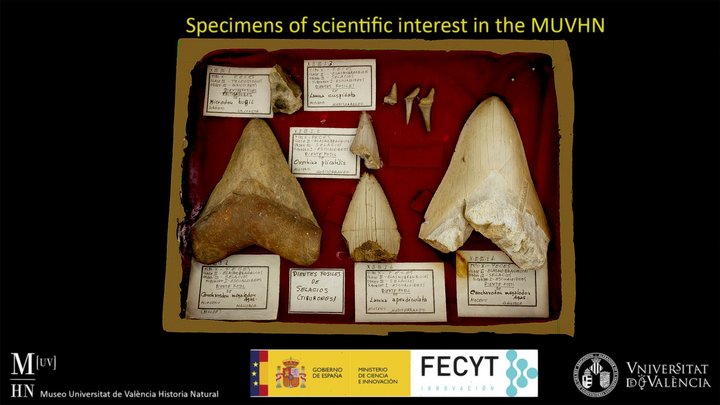
3D model
- Source
- Sketchfab
- Licence
- CC Attribution
- Commercial use
- cannot be read from the licence given — check the record
The description on this site
- Source
- Wikipedia, “Shark”
- Licence
- CC BY-SA 4.0
This is what the site found, which is not the same as what exists.
Keep going
What may have been alongside itEuselachii through timeFormations of the Late CretaceousThe world it lived on
Occurrence data from the Paleobiology Database, CC BY 4.0. Nelson 1984