Scaphites ventricosus

via iDigBio · CC0 · via iDigBio. May be a photograph of a specimen, or an artist’s reconstruction — an interpretation of a skeleton, since colour and soft tissue are almost never preserved.
On record
Recorded, not inferred- Sits inside
- ScaphitesPBDB
- Diet
- carnivorePBDB, for Ammonoidea
- Life habit
- nektonicPBDB, for Ammonoidea
- Motility
- fast-movingPBDB, for Ammonoidea
- Vision
- well-developedPBDB, for Cephalopoda
- Environment
- marinePBDB, for Cephalopoda
Time the record covers
At most 6.2 million years on record.
Every occurrence read is dated to somewhere between 89.8 Mya and 83.6 Mya, and nothing in the dating separates them, so that window is what the record shows rather than a span.
13 occurrences of Scaphites ventricosus on record, most of them in the Late Cretaceous. Bar height is expected occurrences, not a count: each fossil is spread across the span it is dated to, so a tall narrow bar means tight dating and a low wide one means loose.
When
13 occurrences- Late Cretaceous100%
These are dates about fossils, not the animal: the record can only begin after it arose and end before it died out, so either end may reach further. Shares are expected occurrences: a fossil dated to a span is counted partly in each period it straddles. More on what this infers.
Found in
4 formations
- Frontier Formation3
- Wapiabi Formation · Alberta Group1
- Bad Heart Formation · Smoky Group1
- Marias River Shale Formation1
Loading coastlines…
The named rock units Scaphites ventricosus has been recovered from, largest first. Drawn where the rock is now, not where it formed. 7 occurrences have no formation on record, which is common for older literature.
Scaphites ventricosus and its relatives
Late CretaceousWhere Scaphites ventricosus and its relatives were recorded in the Late Cretaceous.
Found in the same rock
33 taxa- Baculites asper8 sites
- Oxytoma (Hypoxytoma) nebrascana8 sites
- Inoceramus coulthardi4 sites
- Clioscaphites vermiformis3 sites
- Baculites anceps2 sites
- Cremnoceramus deformis erectus2 sites
- Inoceramus2 sites
- Inoceramus pontoni2 sites
- Mytiloides stantoni2 sites
- Anatina1 site
- Anomia1 site
- Baculites1 site
- Baculites codyensis1 site
- Forresteria stantoni1 site
- Gervillia1 site
- Goniomya americana1 site
- Inoceramus corpulentus1 site
- Inoceramus fragilis1 site
- Inoceramus selwyni1 site
- Inoceramus undabundus1 site
- Martesia mcevoyi1 site
- Nucula1 site
- Ostrea congesta1 site
- Pecten silentiensis1 site
The Paleobiology Database records 13 sites for Scaphites ventricosus, and this reads all of them. The number is how many of those sites it was catalogued from too. The 24 sharing the most are listed.
This is not a list of everything alive at the time. It is only what has come out of the same ground as this animal and been written down.
Entered from
6 references- Mesozoic Palaeontology of Blairmore Region: Stratigraphic Palaeontology6
- The Upper Cretaceous ammonite genus Barroisiceras in the United States3
- Paleontology and stratigraphy of upper Coniacian–middle Santonian ammonite zones and application to erosion surfaces and marine transgressive strata in Montana and Alberta1
- Ammonites from the Upper Cretaceous of West Greenland1
- American Journal of Science1
- Contributions to Canadian Palaeontology: New species from the Coloradoan of Lower Smokey and Lower Peace Rivers, Alberta1
Each of the 13 occurrences read was entered from one of these publications, ordered by how many each accounts for. This is not a search for papers mentioning the name. Entries link to doi.org where the Paleobiology Database holds an identifier, and to its own record where it does not. Relayed as the Paleobiology Database holds them, not checked against what they resolve to.
Media and terms
Media content2
Picture of Scaphites ventricosus
- Source
- iDigBio
- Credit
- via iDigBio
- Licence
- CC0
- Commercial use
- the licence allows it
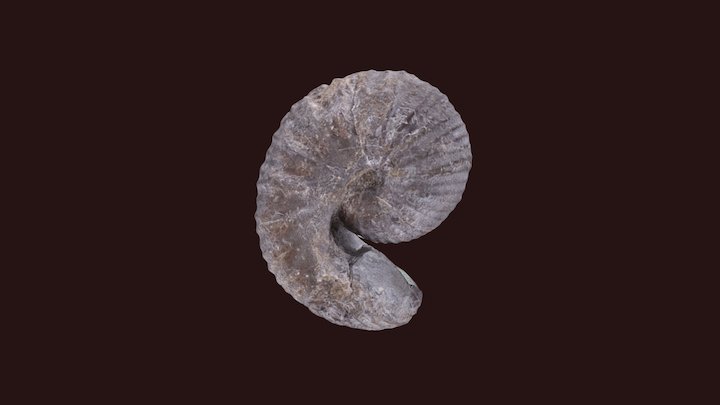
3D model
- Source
- Sketchfab
- Credit
- Shellie Luallin
- Licence
- CC Attribution
- Commercial use
- cannot be read from the licence given — check the record
Smithsonian Open Access and MorphoSource were not reached for this taxon, so this list is what the others held rather than everything there is.
This is what the site found, which is not the same as what exists.
Keep going
What may have been alongside itScaphites through timeFormations of the Late CretaceousThe world it lived on
Occurrence data from the Paleobiology Database, CC BY 4.0. (Meek and Hayden 1862)