Ranina
Ranina is a genus of crabs belonging to the family Raninidae. It has two extant species.

Hectonichus · CC BY-SA 3.0 · via Wikipedia/Commons. May be a photograph of a specimen, or an artist’s reconstruction — an interpretation of a skeleton, since colour and soft tissue are almost never preserved.
On record
Recorded, not inferred- Sits inside
- RanininaePBDB
- Diet
- carnivorePBDB, for Decapoda
- Life habit
- semi-infaunalPBDB, for Raninoidia
- Motility
- actively mobilePBDB, for Malacostraca
- Vision
- well-developedPBDB, for Malacostraca
Time the record covers
At least 56 million years on record.
The record covers at least 61.66 Mya to 5.333 Mya. No occurrence read is dated outside 66 Mya to 2.58 Mya.
40 occurrences of Ranina on record, most of them in the Eocene. The Paleobiology Database records this as a living group, and the chart stops with its fossils rather than at the present. Bar height is expected occurrences, not a count: each fossil is spread across the span it is dated to, so a tall narrow bar means tight dating and a low wide one means loose.
When
40 occurrencesThese are dates about fossils, not the animal: the record can only begin after it arose and end before it died out, so either end may reach further. Shares are expected occurrences: a fossil dated to a span is counted partly in each period it straddles. More on what this infers.
Found in
15 formations
- Santee Limestone Formation3
- Bateque Formation3
- Glendon Formation · Vicksburg Group3
- Ndalithoni Limestone Formation2
- Futuna Limestone Formation2
- Ndalithoni Formation2
Loading coastlines…
The named rock units Ranina has been recovered from, largest first. Drawn where the rock is now, not where it formed. 15 occurrences have no formation on record, which is common for older literature.
Ranina and its relatives
EoceneWhere Ranina and its relatives were recorded in the Eocene.
Found in the same rock
325 taxa- Chlamys6 sites
- Conus5 sites
- Cardiidae4 sites
- Chama4 sites
- Cidaris pratti4 sites
- Cubitostrea4 sites
- Eburneopecten scintillatus4 sites
- Ostrea4 sites
- Pitar4 sites
- Plicatula filamentosa4 sites
- Recurvaster4 sites
- Solena4 sites
- Strombus4 sites
- Turritella4 sites
- Venericardia4 sites
- Agaronia3 sites
- Aturia alabamensis3 sites
- Barbatia (Cucullaearca) cuculloides3 sites
- Barbatia (Plagiarca) rhomboidella3 sites
- Cladocora3 sites
- Coelopleurus infulatus3 sites
- Crassatella3 sites
- Crassatella texalta3 sites
- Cypraea3 sites
The Paleobiology Database records 24 sites for Ranina, and this reads all of them. The number is how many of those sites it was catalogued from too. The 24 sharing the most are listed.
This is not a list of everything alive at the time. It is only what has come out of the same ground as this animal and been written down.
Entered from
20 references- I’ll genere Ranina Lamarck, 1801 (Crustacea, Decapoda, Raninidae) nel Terziario del Vicentino, con descrizione di due nuove specie4
- Eocene biostratigraphy of South Carolina and its relationship to Gulf Coastal Plain zonations and global changes of coastal onlap4
- Geology of Lau, Fiji4
- Decapod Crustacea4
- Beiträge zur Decapodenfauna des ungarischen Tertiärs. Über die Brachyuren der palaeontologischen sammlung des bayerischen Staates4
- Invertebrate Macropaleontolgy of the Clarke County Mississippi Area3
- Geologische Forschungen in den Kaukasusländern. II3
- New Decapoda (Anomura, Brachyura) from the Eocene Bateque and Tepetate Formations, Baja California Sur, Mexico2
- Crustacea (Anomura, Brachyura) from the Miocene of Veracruz and Chiapas, Mexico: New records and new species1
- Review and additions to the Eocene decapod Crustacea from Chiapas, Mexico1
- Mesozoic and Tertiary Decapod Crustacea from Mexico1
- The Middle Eocene siliceous sponges from Val di Chiampo (Lessini Mountains, northern Italy)1
Each of the 40 occurrences read was entered from one of these publications, ordered by how many each accounts for. This is not a search for papers mentioning the name. 8 further references are not listed. Entries link to doi.org where the Paleobiology Database holds an identifier, and to its own record where it does not. Relayed as the Paleobiology Database holds them, not checked against what they resolve to.
Media and terms
Media content2

Picture of Ranina
- Source
- Wikipedia/Commons
- Credit
- Hectonichus
- Licence
- CC BY-SA 3.0
- Commercial use
- the licence allows it
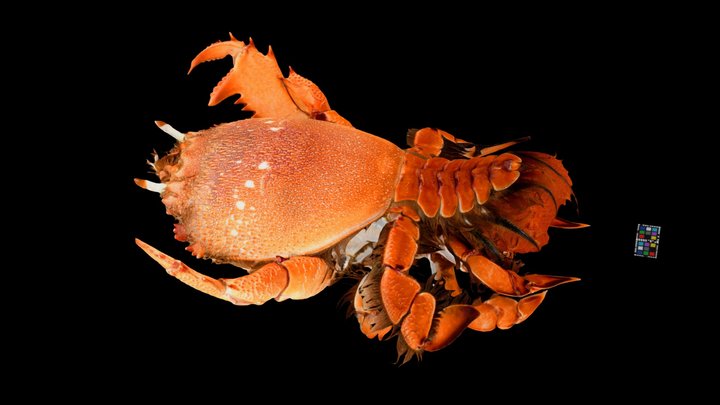
3D model
- Source
- Sketchfab
- Licence
- CC0 Public Domain
- Commercial use
- the licence allows it
Smithsonian Open Access and MorphoSource were not reached for this taxon, so this list is what the others held rather than everything there is.
The description on this site
- Source
- Wikipedia, “Ranina”
- Licence
- CC BY-SA 4.0
This is what the site found, which is not the same as what exists.
Keep going
What may have been alongside itRanininae through timeFormations of the EoceneThe world it lived on
Occurrence data from the Paleobiology Database, CC BY 4.0. Feldmann et al. 1996