Plioplatecarpus
Plioplatecarpus is a genus of mosasaur lizard. Like all mosasaurs, it lived in the late Cretaceous period, about 82-68 million years ago.

User:Ballista · CC BY-SA 3.0 · via Wikipedia/Commons. May be a photograph of a specimen, or an artist’s reconstruction — an interpretation of a skeleton, since colour and soft tissue are almost never preserved.
On record
Recorded, not inferred- Sits inside
- PlioplatecarpiniPBDB
- Diet
- carnivorePBDB, for Mosasauridae
- Life habit
- aquaticPBDB, for Mosasauridae
- Motility
- actively mobilePBDB, for Osteichthyes
- Vision
- well-developedPBDB, for Mosasauridae
- Environment
- terrestrialPBDB, for Amniota
Time the record covers
At least 21 million years on record.
The record covers at least 93.9 Mya to 72.2 Mya. No occurrence read is dated outside 100.5 Mya to 61.66 Mya.
28 occurrences of Plioplatecarpus on record, most of them in the Late Cretaceous. Bar height is expected occurrences, not a count: each fossil is spread across the span it is dated to, so a tall narrow bar means tight dating and a low wide one means loose.
When
28 occurrencesThese are dates about fossils, not the animal: the record can only begin after it arose and end before it died out, so either end may reach further. Shares are expected occurrences: a fossil dated to a span is counted partly in each period it straddles. More on what this infers.
Found in
15 formations
- Pierre Shale Formation · Montana Group3
- Fox Hills Formation · Montana Group3
- Bearpaw Shale Formation2
- St. Mary River Formation2
- Danish White Chalk Formation2
- López de Bertodano Formation2
Loading coastlines…
The named rock units Plioplatecarpus has been recovered from, largest first. Drawn where the rock is now, not where it formed. 5 occurrences have no formation on record, which is common for older literature.
Plioplatecarpus and its relatives
Late CretaceousWhere Plioplatecarpus and its relatives were recorded in the Late Cretaceous.
Found in the same rock
218 taxa- Mosasaurus5 sites
- Mosasaurus hoffmannii5 sites
- Baculites4 sites
- Mosasauridae4 sites
- Prognathodon3 sites
- Aves2 sites
- Bivalvia2 sites
- Cretalamna2 sites
- Cretalamna appendiculata2 sites
- Elasmosauridae2 sites
- Gastropoda2 sites
- Glycymeris2 sites
- Ischyrhiza mira2 sites
- Opisthotriton kayi2 sites
- Paralbula casei2 sites
- Platecarpus2 sites
- Squalicorax pristodontus2 sites
- Squatina2 sites
- Testudines2 sites
- Acipenser albertensis1 site
- Acteon1 site
- Actinocamax1 site
- Actinocamax primus1 site
- Adocus beatus1 site
The Paleobiology Database records 28 sites for Plioplatecarpus, and this reads all of them. The number is how many of those sites it was catalogued from too. The 24 sharing the most are listed.
This is not a list of everything alive at the time. It is only what has come out of the same ground as this animal and been written down.
Entered from
23 references- Amphibian, reptilian, and avian remains from the Fox Hills Formation (Maastrichtian): shoreline and estuarine deposits of the Pierre Sea in south-central North Dakota3
- Campanian and Maastrichtian mosasaurs from Antarctic Peninsula and Patagonia, Argentina2
- Danish mosasaurs2
- The ceratopsian dinosaurs and associated lower vertebrates from the St. Mary River Formation (Maestrichtian) at Scabby Butte, southern Alberta2
- New mosasaur remains from the Upper Cretaceous of Mississippi1
- Asmodochelys parhami, a new fossil marine turtle from the Campanian Demopolis Chalk and the stratigraphic congruence of competing marine turtle phylogenies1
- A new species of Plioplatecarpus (Mosasauridae, Plioplatecarpinae) from the Bearpaw Formation (Campanian, Upper Cretaceous) of Montana, USA1
- The mosasaur collections of the Museum National d'Histoire Naturelle of Paris1
- Mosasaurs (Reptilia) from the late Maastrichtian (Late Cretaceous) of northern Patagonia (Río Negro, Argentina)1
- Latest Cretaceous mosasaurs and lamniform sharks from Labirinta cave, Vratsa district (northwest Bulgaria): a preliminary note1
- Palaeobiological significance of high-latitude Late Cretaceous vertebrate fossils from the James Ross Basin, Antarctica1
- Carnivorous dinosaurs (Saurischia, Theropoda) from the Maastrichtian of the Volga-Don interfluve, Russia1
Each of the 28 occurrences read was entered from one of these publications, ordered by how many each accounts for. This is not a search for papers mentioning the name. 11 further references are not listed. Entries link to doi.org where the Paleobiology Database holds an identifier, and to its own record where it does not. Relayed as the Paleobiology Database holds them, not checked against what they resolve to.
Media and terms
Media content2
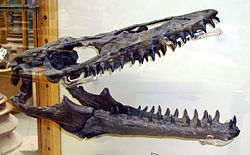
Picture of Plioplatecarpus
- Source
- Wikipedia/Commons
- Credit
- User:Ballista
- Licence
- CC BY-SA 3.0
- Commercial use
- the licence allows it
Structured light scan
- Source
- MorphoSource
- Licence
- In Copyright
- Commercial use
- cannot be read from the licence given — check the record
- Specimen
- Plioplatecarpus houzeaui · RBINS-Scientific Heritage:R:0035
Smithsonian Open Access was not reached for this taxon, so this list is what the others held rather than everything there is.
The description on this site
- Licence
- CC BY-SA 4.0
This is what the site found, which is not the same as what exists.
Keep going
What may have been alongside itPlioplatecarpini through timeFormations of the Late CretaceousThe world it lived on
Occurrence data from the Paleobiology Database, CC BY 4.0. Dollo 1882