Mosasaurus
Mosasaurus is the type genus of the Mosasauridae, an extinct group of aquatic squamate reptiles. It lived from about 82 to 66 million years ago during the Campanian and Maastrichtian stages of the Late Cretaceous. The genus was one of the first Mesozoic marine reptiles known to science—the first fossils of Mosasaurus were found as skulls in a chalk quarry near the Dutch city of Maastricht in the late 18th century, and were initially thought to be crocodiles or whales. One skull discovered in 1778 was famously nicknamed the "great animal of Maastricht". In 1808, naturalist Georges Cuvier concluded that it belonged to a giant marine lizard with similarities to monitor lizards but otherwise unlike any known living animal. This concept was revolutionary at the time and helped support the then-developing ideas of extinction. Cuvier did not designate a scientific name for the animal; this was done by William Daniel Conybeare in 1822 when he named it Mosasaurus in reference to its origin in fossil deposits near the Meuse River. The exact affinities of Mosasaurus as a squamate remain controversial, and scientists continue to debate whether its closest living relatives are monitor lizards or snakes.

Ghedoghedo · CC BY-SA 3.0 · via Wikipedia/Commons. May be a photograph of a specimen, or an artist’s reconstruction — an interpretation of a skeleton, since colour and soft tissue are almost never preserved.
On record
Recorded, not inferred- Sits inside
- MosasaurinaePBDB
- Diet
- carnivorePBDB, for Mosasauridae
- Life habit
- aquaticPBDB, for Mosasauridae
- Motility
- actively mobilePBDB, for Osteichthyes
- Vision
- well-developedPBDB, for Mosasauridae
- Environment
- terrestrialPBDB, for Amniota
- Length
- 18 mWikidata
Time the record covers
At least 17 million years on record.
The record covers at least 89.8 Mya to 72.2 Mya. No occurrence read is dated outside 143.1 Mya to 61.66 Mya.
130 occurrences of Mosasaurus on record, most of them in the Late Cretaceous. Bar height is expected occurrences, not a count: each fossil is spread across the span it is dated to, so a tall narrow bar means tight dating and a low wide one means loose.
When
130 occurrences- Early Cretaceousunder 1%
- Late Cretaceous99%
- Paleoceneunder 1%
These are dates about fossils, not the animal: the record can only begin after it arose and end before it died out, so either end may reach further. Shares are expected occurrences: a fossil dated to a span is counted partly in each period it straddles. More on what this infers.
Found in
52 formations
- Navesink Formation · Monmouth Group11
- Hornerstown Formation · Rancocas Group7
- Severn Formation7
- Pierre Shale Formation · Montana Group7
- New Egypt Formation · Monmouth Group4
- Conway Formation · Eyre Group3
Loading coastlines…
The named rock units Mosasaurus has been recovered from, largest first. Drawn where the rock is now, not where it formed. 28 further formations hold fewer occurrences each and are not listed. 27 occurrences have no formation on record, which is common for older literature.
Mosasaurus and its relatives
Late CretaceousWhere Mosasaurus and its relatives were recorded in the Late Cretaceous.
Found in the same rock
1,023 taxa- Squalicorax pristodontus22 sites
- Elasmosauridae17 sites
- Mosasauridae17 sites
- Hadrosauridae14 sites
- Cretalamna appendiculata13 sites
- Squalicorax kaupi13 sites
- Ischyrhiza mira11 sites
- Chelonioidea10 sites
- Leiodon anceps10 sites
- Peritresius ornatus10 sites
- Plesiosauria9 sites
- Prognathodon9 sites
- Stephanodus9 sites
- Teleostei9 sites
- Enchodus elegans8 sites
- Osteopygis emarginatus8 sites
- Squalicorax8 sites
- Carcharias7 sites
- Carcharias samhammeri7 sites
- Plioplatecarpinae7 sites
- Plioplatecarpini7 sites
- Rhinobatos7 sites
- Serratolamna serrata7 sites
- Thoracosaurus neocesariensis7 sites
The Paleobiology Database records 109 sites for Mosasaurus, and this reads all of them. The number is how many of those sites it was catalogued from too. The 24 sharing the most are listed.
This is not a list of everything alive at the time. It is only what has come out of the same ground as this animal and been written down.
Entered from
75 references- The mosasaur collections of the Museum National d'Histoire Naturelle of Paris7
- The Skull of American Mosasaurs7
- The marine vertebrate faunas from the Late Cretaceous phosphates of Syria6
- Upper Cretaceous reptiles from the Severn Formation of Maryland5
- Recent mosasaur discoveries from New Jersey and Delaware, USA: stratigraphy, taphonomy and implications for mosasaur extinction4
- Campanian and Maastrichtian mosasaurid reptiles from central Poland4
- The Cretaceous/Tertiary mass extinction event in the North Atlantic coastal plain4
- Synopsis of the Extinct Batrachia, Reptilia and Aves of North America. Part II4
- Osteology and taxonomy of Mosasaurus conodon Cope 1881 from the Late Cretaceous of North America3
- Danish mosasaurs3
- Paleontology, biostratigraphy, and depositional environments of the Cretaceous-Tertiary transition in the New Jersey coastal plain3
- Vertebrate Paleontology and Stratigraphy of the Late Cretaceous Holmdel Park Site, Monmouth County, New Jersey2
Each of the 130 occurrences read was entered from one of these publications, ordered by how many each accounts for. This is not a search for papers mentioning the name. 63 further references are not listed. Entries link to doi.org where the Paleobiology Database holds an identifier, and to its own record where it does not. Relayed as the Paleobiology Database holds them, not checked against what they resolve to.
Media and terms
Media content3
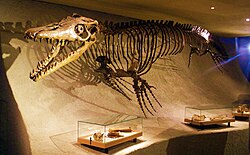
Picture of Mosasaurus
- Source
- Wikipedia/Commons
- Credit
- Ghedoghedo
- Licence
- CC BY-SA 3.0
- Commercial use
- the licence allows it
CT scan
- Source
- MorphoSource
- Licence
- In Copyright
- Commercial use
- cannot be read from the licence given — check the record
- Specimen
- Mosasaurus conodon · SMU:76348
3D model
- Source
- Sketchfab
- Credit
- Paleo Modelist
- Licence
- CC Attribution
- Commercial use
- cannot be read from the licence given — check the record
The description on this site
- Source
- Wikipedia, “Mosasaurus”
- Licence
- CC BY-SA 4.0
This is what the site found, which is not the same as what exists.
Keep going
What may have been alongside itMosasaurinae through timeFormations of the Late CretaceousThe world it lived on
Occurrence data from the Paleobiology Database, CC BY 4.0. Parkinson 1822