Parmacella
Parmacella is a genus of air-breathing land slugs, terrestrial gastropod mollusks in the family Parmacellidae.

Valter Jacinto · Public Domain · via Wikipedia/Commons. May be a photograph of a specimen, or an artist’s reconstruction — an interpretation of a skeleton, since colour and soft tissue are almost never preserved.
On record
Recorded, not inferred- Sits inside
- ParmacellidaePBDB
- Life habit
- epifaunalPBDB, for Gastropoda
- Motility
- actively mobilePBDB, for Gastropoda
- Vision
- limitedPBDB, for Gastropoda
Time the record covers
At most 8.8 million years on record.
Every occurrence read is dated to somewhere between 8.725 Mya and 11.7 ka, and nothing in the dating separates them, so that window is what the record shows rather than a span.
14 occurrences of Parmacella on record, most of them in the Miocene. Bar height is expected occurrences, not a count: each fossil is spread across the span it is dated to, so a tall narrow bar means tight dating and a low wide one means loose.
When
14 occurrences- Miocene92%
- Pliocene5%
- Pleistocene3%
These are dates about fossils, not the animal: the record can only begin after it arose and end before it died out, so either end may reach further. Shares are expected occurrences: a fossil dated to a span is counted partly in each period it straddles. More on what this infers.
Found in
3 formations
Loading coastlines…
The named rock units Parmacella has been recovered from, largest first. Drawn where the rock is now, not where it formed. 1 occurrence has no formation on record, which is common for older literature.
Parmacella and its relatives
MioceneWhere Parmacella and its relatives were recorded in the Miocene.
Found in the same rock
251 taxa- Agriolimacidae10 sites
- Cochlostoma esuanum10 sites
- Limax fossilis10 sites
- Melanopsis narzolina10 sites
- Milacidae10 sites
- Saccoia globosa10 sites
- Saccoia oryza10 sites
- Truciella ballesioi10 sites
- Craspedopoma conoidale9 sites
- Lucilla miocaenica9 sites
- Melanoides curvicosta9 sites
- Nordsieckia pontica9 sites
- Theodoxus mutinensis9 sites
- Anguinae8 sites
- Apodemus gudrunae8 sites
- Chiroptera8 sites
- Clausilia (Clausilia) baudoni8 sites
- Glis minor8 sites
- Latonia8 sites
- Prolagus8 sites
- Theodoxus doderleini8 sites
- Apodemus atavus7 sites
- Centralomys benericettii7 sites
- Colubrinae7 sites
The Paleobiology Database records 13 sites for Parmacella, and this reads all of them. The number is how many of those sites it was catalogued from too. The 24 sharing the most are listed.
This is not a list of everything alive at the time. It is only what has come out of the same ground as this animal and been written down.
Entered from
5 references- Late Messinian continental and Lago-Mare gastropods from the Tertiary Piedmont Basin, NW Italy8
- Late Messinian mollusks and vertebrates from Moncucco Torinese, north-western Italy. Paleoecological and paleoclimatological implications3
- The section of Torre Picchio (Terni, Umbria, Central Italy): A Villafranchian site rich in vertebrates, molluscs, ostracods and plants.1
- The vertebrate locality Maramena (Macedonia, Greece) at the Turolian-Ruscinian Boundary (Neogene). 1. General Introduction1
- Mammalian fossils of Samos and Pikermi, Part 1. The Turolian rodents and insectivores of Samos1
Each of the 14 occurrences read was entered from one of these publications, ordered by how many each accounts for. This is not a search for papers mentioning the name. Entries link to doi.org where the Paleobiology Database holds an identifier, and to its own record where it does not. Relayed as the Paleobiology Database holds them, not checked against what they resolve to.
Media and terms
Media content1
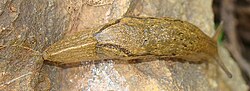
Picture of Parmacella
- Source
- Wikipedia/Commons
- Credit
- Valter Jacinto
- Licence
- Public Domain
- Commercial use
- the licence allows it
No 3D scan of Parmacella was found in Sketchfab.
Smithsonian Open Access and MorphoSource were not reached for this taxon, so this list is what the others held rather than everything there is.
The description on this site
- Source
- Wikipedia, “Parmacella”
- Licence
- CC BY-SA 4.0
This is what the site found, which is not the same as what exists.
Keep going
What may have been alongside itParmacellidae through timeFormations of the MioceneThe world it lived on
Occurrence data from the Paleobiology Database, CC BY 4.0. Cuvier 1804