Paradoxides
Paradoxides is a genus of large to very large trilobite found throughout the world during the Middle Cambrian period. One record-breaking specimen of Paradoxides davidis, described by John William Salter in 1863, is 37 cm (15 in). The cephalon was semicircular with free cheeks ending in long, narrow, recurved spines. Eyes were crescent shaped providing an almost 360° view, but only in the horizontal plane. Its elongate thorax was composed of 19–21 segments and adorned with longish, recurved pleural spines. Its pygidium was comparatively small. Paradoxides is a characteristic Middle-Cambrian trilobite of the 'Atlantic' (Avalonian) fauna. Avalonian rocks were deposited near a small continent called Avalonia in the Paleozoic Iapetus Ocean. Avalonian beds are now in a narrow strip along the East Coast of North America, and in Europe.

Ryan Schwark · CC0 · via Wikipedia/Commons. May be a photograph of a specimen, or an artist’s reconstruction — an interpretation of a skeleton, since colour and soft tissue are almost never preserved.
On record
Recorded, not inferred- Sits inside
- ParadoxididaePBDB
- Diet
- carnivorePBDB, for Paradoxidoidea
- Life habit
- low-level epifaunalPBDB, for Redlichiida
- Motility
- fast-movingPBDB, for Redlichiida
- Vision
- well-developedPBDB, for Paradoxididae
- Environment
- marinePBDB, for Trilobita
Time the record covers
At least 7.7 million years on record.
The record covers at least 508.2 Mya to 500.5 Mya. No occurrence read is dated outside 516.2 Mya to 497 Mya.
138 occurrences of Paradoxides on record, most of them in the Cambrian. Bar height is expected occurrences, not a count: each fossil is spread across the span it is dated to, so a tall narrow bar means tight dating and a low wide one means loose.
When
138 occurrences- Cambrian100%
These are dates about fossils, not the animal: the record can only begin after it arose and end before it died out, so either end may reach further. Shares are expected occurrences: a fossil dated to a span is counted partly in each period it straddles. More on what this infers.
Found in
33 formations
- Jince Formation29
- Chamberlain's Brook Formation13
- Sosink Formation12
- Murero Formation · Mesones Group7
- Fjällbränna Formation6
- Koruk Formation5
Loading coastlines…
The named rock units Paradoxides has been recovered from, largest first. Drawn where the rock is now, not where it formed. 9 further formations hold fewer occurrences each and are not listed. 7 occurrences have no formation on record, which is common for older literature.
Paradoxides and its relatives
CambrianWhere Paradoxides and its relatives were recorded in the Cambrian.
Found in the same rock
329 taxa- Conocoryphe20 sites
- Ellipsocephalus17 sites
- Ctenocephalus13 sites
- Lobocephalina emmrichi11 sites
- Conocoryphe sulzeri10 sites
- Derikaspis8 sites
- Hydrocephalus carens8 sites
- Peronopsis8 sites
- Ptychoparia striata8 sites
- Skreiaspis spinosus8 sites
- Acadoparadoxides7 sites
- Eccaparadoxides eteminicus7 sites
- Hyolithes7 sites
- Hypagnostus parvifrons7 sites
- Lingulella7 sites
- Peronopsis fallax7 sites
- Phalagnostus7 sites
- Solenopleuropsis7 sites
- Acrothele6 sites
- Agraulos ceticephalus6 sites
- Ceratocystis6 sites
- Dorypyge6 sites
- Phalacroma6 sites
- Ptychagnostus6 sites
The Paleobiology Database records 89 sites for Paradoxides, and this reads all of them. The number is how many of those sites it was catalogued from too. The 24 sharing the most are listed.
This is not a list of everything alive at the time. It is only what has come out of the same ground as this animal and been written down.
Entered from
43 references- Trilobiti Ceskeho stredniho Kambria [Middle Cambrian trilobites of Bohemia]14
- Middle Cambrian (Acadian series) conocoryphid and paradoxidid trilobites from the upper Chamberlain's Brook Formation, Newfoundland and New Brunswick9
- Chlupáč et al., 19989
- Middle Cambrian trilobites from the Sosnik Formation, Derik-Mardin district, south-eastern Turkey8
- Jednostki litostratygraficzne kambru i gornego prekambru Gor Swietokrzyskich [Cambrian and Upper Precambrian lithostratigraphic units in the Holy Cross Mountains]7
- Middle Cambrian agnostoids and trilobites from the Lower Allochthon, Swedish Caledonides6
- Révision biostratigraphique du Cambrien moyen du versant méridional de la Montagne Noire (Languedoc, France)6
- New Cambrian trilobites from the Northern Siberian Platform6
- Cambrian stratigraphy and trilobites of the Samur Dag area, south of Hakkari, southeastern Turkey5
- Asturicystis havliceki sp. nov. (Echinodermata, Homostelea) from the Middle Cambrian of Bohemia (Barrandian area, Czech Republic)5
- Lower Cambrian (Branchian) trilobites and biostratigraphy of the Hanford Brook Formation, southern New Brunswick4
- Precambrian? and Cambrian stratigraphy of the Penbegli-Tut inlier, southeastern Turkey4
Each of the 138 occurrences read was entered from one of these publications, ordered by how many each accounts for. This is not a search for papers mentioning the name. 31 further references are not listed. Entries link to doi.org where the Paleobiology Database holds an identifier, and to its own record where it does not. Relayed as the Paleobiology Database holds them, not checked against what they resolve to.
Media and terms
Media content2

Picture of Paradoxides
- Source
- Wikipedia/Commons
- Credit
- Ryan Schwark
- Licence
- CC0
- Commercial use
- the licence allows it
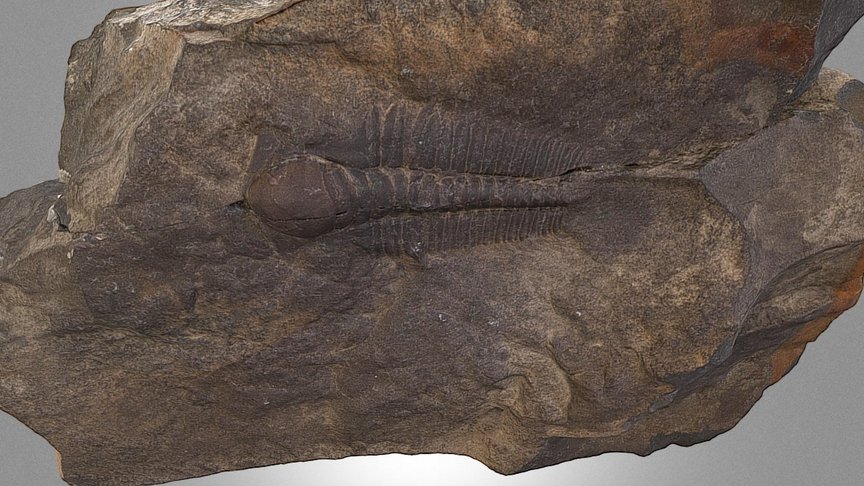
3D model
- Source
- Sketchfab
- Licence
- CC0 Public Domain
- Commercial use
- the licence allows it
Smithsonian Open Access and MorphoSource were not reached for this taxon, so this list is what the others held rather than everything there is.
The description on this site
- Source
- Wikipedia, “Paradoxides”
- Licence
- CC BY-SA 4.0
This is what the site found, which is not the same as what exists.
Keep going
What may have been alongside itParadoxididae through timeFormations of the CambrianThe world it lived on
Occurrence data from the Paleobiology Database, CC BY 4.0. Brongniart 1822