Conocoryphe sulzeri

via iDigBio · CC0 · via iDigBio. May be a photograph of a specimen, or an artist’s reconstruction — an interpretation of a skeleton, since colour and soft tissue are almost never preserved.
On record
Recorded, not inferred- Sits inside
- ConocoryphePBDB
- Diet
- carnivorePBDB, for Trilobita
- Life habit
- low-level epifaunalPBDB, for Trilobita
- Motility
- fast-movingPBDB, for Trilobita
- Vision
- blindPBDB, for Conocoryphidae
- Environment
- marinePBDB, for Trilobita
Time the record covers
At most 12 million years on record.
Every occurrence read is dated to somewhere between 508.2 Mya and 497 Mya, and nothing in the dating separates them, so that window is what the record shows rather than a span.
11 occurrences of Conocoryphe sulzeri on record, most of them in the Cambrian. Bar height is expected occurrences, not a count: each fossil is spread across the span it is dated to, so a tall narrow bar means tight dating and a low wide one means loose.
When
11 occurrences- Cambrian100%
These are dates about fossils, not the animal: the record can only begin after it arose and end before it died out, so either end may reach further. Shares are expected occurrences: a fossil dated to a span is counted partly in each period it straddles. More on what this infers.
Found in
5 formations
- Jince Formation7
- Quartzites et Poudingues de Trémentines Formation1
- Skryje Formation1
- Senice Formation1
- Buchava Formation1
Loading coastlines…
The named rock units Conocoryphe sulzeri has been recovered from, largest first. Drawn where the rock is now, not where it formed.
Conocoryphe sulzeri and its relatives
CambrianWhere Conocoryphe sulzeri and its relatives were recorded in the Cambrian.
Found in the same rock
61 taxa- Lobocephalina emmrichi8 sites
- Ptychoparia striata7 sites
- Ellipsocephalus5 sites
- Hydrocephalus carens5 sites
- Paradoxides (Eccaparadoxides) pusillus5 sites
- Agraulos ceticephalus4 sites
- Ctenocephalus4 sites
- Paradoxides (Hydrocephalus)4 sites
- Paradoxides gracilis4 sites
- Peronopsis4 sites
- Peronopsis integra4 sites
- Phalagnostus4 sites
- Jincella prantli3 sites
- Lichenoides priscus3 sites
- Parabailiela granulata3 sites
- Phalacroma3 sites
- Sao3 sites
- Skreiaspis spinosus3 sites
- Stromatocystites pentangularis3 sites
- Condylopyge rex2 sites
- Etoctenocystis bohemica2 sites
- Hypagnostus2 sites
- Konicekion2 sites
- Luhops expectans2 sites
The Paleobiology Database records 11 sites for Conocoryphe sulzeri, and this reads all of them. The number is how many of those sites it was catalogued from too. The 24 sharing the most are listed.
This is not a list of everything alive at the time. It is only what has come out of the same ground as this animal and been written down.
Entered from
7 references- Trilobiti Ceskeho stredniho Kambria [Middle Cambrian trilobites of Bohemia]5
- Association of fossils and history of research at the Týřovice - “Pod hruškou” locality (Middle Cambrian, Skrje-Týřovice Basin, Barrandian area)1
- Research of the classical paleontological locality “Luh” in the Cambrian of Skryje1
- Chlupáč et al., 19981
- Geology of the Barrandian: A Field Trip Guide. Senckenberg-Buchen, Frankfurt1
- Vyscystis ubaghsi gen. et sp.nov., imbricate eocrinoid from Czechoslovakia (Echinodermata, Middle Cambrian)1
- Les trilobites mésocambriens de Cléré-sur-Layon (Massif armoricain)1
Each of the 11 occurrences read was entered from one of these publications, ordered by how many each accounts for. This is not a search for papers mentioning the name. Entries link to doi.org where the Paleobiology Database holds an identifier, and to its own record where it does not. Relayed as the Paleobiology Database holds them, not checked against what they resolve to.
Media and terms
Media content2
Picture of Conocoryphe sulzeri
- Source
- iDigBio
- Credit
- via iDigBio
- Licence
- CC0
- Commercial use
- the licence allows it
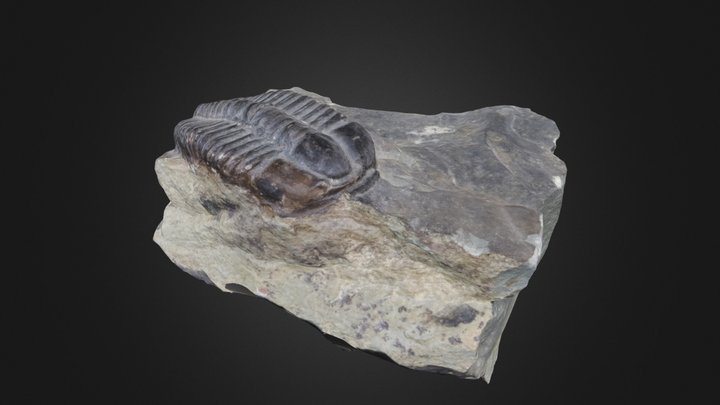
3D model
- Source
- Sketchfab
- Licence
- CC0 Public Domain
- Commercial use
- the licence allows it
Smithsonian Open Access was not reached for this taxon, so this list is what the others held rather than everything there is.
This is what the site found, which is not the same as what exists.
Keep going
What may have been alongside itConocoryphe through timeFormations of the CambrianThe world it lived on
Occurrence data from the Paleobiology Database, CC BY 4.0. Schlotheim 1823