Palaeonisciformes
Palaeoniscoids are an extinct grouping of primitive ray-finned fish (Actinopterygii), spanning from the Silurian/Devonian to the Cretaceous. Though often assigned to their own order, the Palaeonisciformes, they are generally considered paraphyletic, but their exact relationships to living ray-finned fish are uncertain. While some and perhaps most palaeoniscoids likely belong to the stem-group of Actinopteryii it has been suggested that some may belong to the crown group, with some of these possibly related to Cladistia and/or Chondrostei. Many palaeoniscoids share a conservative body shape and a similar arrangement of skull bones, though paleoniscoids as a whole exhibit considerable diversity in body shape.

R. H. Traquair · Public Domain · via Wikipedia/Commons. May be a photograph of a specimen, or an artist’s reconstruction — an interpretation of a skeleton, since colour and soft tissue are almost never preserved.
On record
Recorded, not inferred- Sits inside
- ActinopterygiiPBDB
- Diet
- carnivorePBDB
- Life habit
- nektonicPBDB
- Motility
- actively mobilePBDB
Time the record covers
At least 266 million years on record.
The record covers at least 387.95 Mya to 121.4 Mya. No occurrence read is dated outside 410.62 Mya to 113.2 Mya.
1,188 occurrences of Palaeonisciformes on record, most of them in the Carboniferous. Bar height is expected occurrences, not a count: each fossil is spread across the span it is dated to, so a tall narrow bar means tight dating and a low wide one means loose.
When
1,188 occurrences- Devonian4%
- Carboniferous36%
- Permian20%
- Early Triassic5%
- Middle Triassic4%
- Late Triassic28%
- Early Jurassic2%
- Middle Jurassicunder 1%
- Late Jurassicunder 1%
- Early Cretaceousunder 1%
These are dates about fossils, not the animal: the record can only begin after it arose and end before it died out, so either end may reach further. Shares are expected occurrences: a fossil dated to a span is counted partly in each period it straddles. More on what this infers.
Found in
269 formations
- Gullane Formation · Strathclyde Group49
- Chinle Formation46
- Westbury Formation · Penarth Group38
- Raisby Formation37
- Slaný Formation32
- Heath Formation · Big Snowy Group27
Loading coastlines…
The named rock units Palaeonisciformes has been recovered from, largest first. Drawn where the rock is now, not where it formed. 245 further formations hold fewer occurrences each and are not listed. 194 occurrences have no formation on record, which is common for older literature.
Palaeonisciformes and its relatives
CarboniferousWhere Palaeonisciformes and its relatives were recorded in the Carboniferous.
Found in the same rock
1,408 taxa- Birgeria50 sites
- Osteichthyes29 sites
- Redfieldiidae28 sites
- Actinopterygii24 sites
- Norigondolella21 sites
- Palaeoniscidae21 sites
- Gyrolepis20 sites
- Metapolygnathus17 sites
- Turseodus17 sites
- Reptilia16 sites
- Archosauria15 sites
- Metoposauridae15 sites
- Palaeoniscum freieslebeni15 sites
- Birgeria acuminata14 sites
- Hayashiella nodosa14 sites
- Semionotidae14 sites
- Archosauriformes13 sites
- Lissodus minimus13 sites
- Mystriosuchinae13 sites
- Nemacanthus monilifer13 sites
- Semionotus13 sites
- Theropoda13 sites
- Elasmobranchii12 sites
- Hybodus12 sites
The Paleobiology Database records 743 sites for Palaeonisciformes, and this reads 240 of them. The number is how many of those sites it was catalogued from too. The 24 sharing the most are listed.
This is not a list of everything alive at the time. It is only what has come out of the same ground as this animal and been written down.
Entered from
323 references- The early diversification of ray-finned fishes (Actinopterygii): hypotheses, challenges and future prospects66
- Štamberg and Zajíc, 200855
- Catalogue of the Fossil Fishes in the British Museum (Natural History). Part II47
- Fossil succession and sequence stratigraphy of the Upper Triassic of Black Bear Ridge, northeast British Columbia, a GSSP prospect for the Carnian-Norian boundary38
- Monograph of the Permian fossils of England29
- Recent discoveries of Carboniferous fishes in Edinburgh27
- The Rhadinichthyids (paleoniscoid actinopterygians) from the Bear Gulch limestone of Montana (USA, Lower Carboniferous)21
- Redfieldiid fishes from the Triassic-Liassic Newark Supergroup of eastern North America20
- An early actinopterygian ichthyofauna from the Scottish Lower Coal Measures Formation: Westphalian A (Bashkirian)18
- End-Devonian extinction and a bottleneck in the early evolution of modern jawed vertebrates18
- Type and reference sections of the Middle and Upper Permian of the Volga and Kama River Regions: A Field Guidebook of XVIII International Congress on Carboniferous and Permian17
- The Middle Devonian fishes of the Baltic States (Estonia, Latvia) and Belarus17
Each of the 1,188 occurrences read was entered from one of these publications, ordered by how many each accounts for. This is not a search for papers mentioning the name. 311 further references are not listed. Entries link to doi.org where the Paleobiology Database holds an identifier, and to its own record where it does not. Relayed as the Paleobiology Database holds them, not checked against what they resolve to.
Media and terms
Media content2
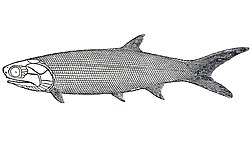
Picture of Palaeonisciformes
- Source
- Wikipedia/Commons
- Credit
- R. H. Traquair
- Licence
- Public Domain
- Commercial use
- the licence allows it
Laser scan
- Source
- MorphoSource
- Licence
- In Copyright
- Commercial use
- cannot be read from the licence given — check the record
- Specimen
- Palaeonisciformes indet. · TMNH:00864
Smithsonian Open Access was not reached for this taxon, so this list is what the others held rather than everything there is.
The description on this site
- Licence
- CC BY-SA 4.0
This is what the site found, which is not the same as what exists.
Keep going
What may have been alongside itActinopterygii through timeFormations of the CarboniferousThe world it lived on
Occurrence data from the Paleobiology Database, CC BY 4.0. Hay 1902