Ophisaurus ventralis
The eastern glass lizard is a species of legless lizard in the family Anguidae and the longest and heaviest species of glass lizards in the genus Ophisaurus, endemic to the Southeastern United States. The streamlined, legless species is often confused with snakes. Glass lizards differ from snakes as they possess a moveable eyelid and an external ear opening as well as a lateral groove that separates the different types of scales on the animal, while all three of these features are absent in snakes. Snakes also have flexible jaws while lizards do not. Ventralis comes from the Latin "venter" meaning belly; this is in reference to the snake-like movement.

en:user:Fl295 · Public Domain · via Wikipedia/Commons. May be a photograph of a specimen, or an artist’s reconstruction — an interpretation of a skeleton, since colour and soft tissue are almost never preserved.
On record
Recorded, not inferred- Also called
- eastern glass lizardPBDB
- Sits inside
- OphisaurusPBDB
- Diet
- insectivore, carnivorePBDB, for Anguidae
- Motility
- actively mobilePBDB, for Osteichthyes
- Environment
- terrestrialPBDB, for Amniota
Time the record covers
At least 12 million years on record.
The record covers at least 12.5 Mya to 129 ka. No occurrence read is dated outside 16.3 Mya to 11.7 ka.
7 occurrences of Ophisaurus ventralis on record, most of them in the Pleistocene. The Paleobiology Database records this as a living group. Bar height is expected occurrences, not a count: each fossil is spread across the span it is dated to, so a tall narrow bar means tight dating and a low wide one means loose.
When
7 occurrences- Miocene14%
- Pleistocene86%
These are dates about fossils, not the animal: the record can only begin after it arose and end before it died out, so either end may reach further. Shares are expected occurrences: a fossil dated to a span is counted partly in each period it straddles. More on what this infers.
Found in
2 formations
- Valentine Formation · Ogallala Group1
- Wicomico Formation1
Loading coastlines…
The named rock units Ophisaurus ventralis has been recovered from, largest first. Drawn where the rock is now, not where it formed. 5 occurrences have no formation on record, which is common for older literature.
Ophisaurus ventralis and its relatives
PleistoceneWhere Ophisaurus ventralis and its relatives were recorded in the Pleistocene.
Found in the same rock
248 taxa- Anolis carolinensis5 sites
- Dasypus bellus5 sites
- Amblystoma4 sites
- Crotalus adamanteus4 sites
- Equus4 sites
- Gastrophryne carolinensis4 sites
- Micrurus4 sites
- Odocoileus virginianus4 sites
- Scaphiopus (Scaphiopus) holbrooki4 sites
- Sylvilagus floridanus4 sites
- Terrapene carolina4 sites
- Carphophis amoenus3 sites
- Coluber constrictor3 sites
- Conepatus leuconotus3 sites
- Elaphe3 sites
- Eumeces3 sites
- Geomys pinetis3 sites
- Gopherus polyphemus3 sites
- Heterodon platyrhinos3 sites
- Hyla3 sites
- Lynx rufus3 sites
- Masticophis3 sites
- Neofiber alleni3 sites
- Oryzomys palustris3 sites
The Paleobiology Database records 7 sites for Ophisaurus ventralis, and this reads all of them. The number is how many of those sites it was catalogued from too. The 24 sharing the most are listed.
This is not a list of everything alive at the time. It is only what has come out of the same ground as this animal and been written down.
Entered from
6 references- Glass lizards (Ophisaurus) in the Pleistocene and Pliocene of Florida2
- Reptiles of the Egelhoff local fauna (Upper Miocene) of Nebraska1
- The Pleistocene vertebrate fauna of Reddick, Florida1
- A Pleistocene herpetofauna near Orange Lake, Florida1
- Amphibians and reptiles from the Pleistocene (Illinoian) of Williston, Florida1
- The Pleistocene herpetofauna of Saber-tooth Cave, Citrus County, Florida1
Each of the 7 occurrences read was entered from one of these publications, ordered by how many each accounts for. This is not a search for papers mentioning the name. Entries link to doi.org where the Paleobiology Database holds an identifier, and to its own record where it does not. Relayed as the Paleobiology Database holds them, not checked against what they resolve to.
Media and terms
Media content1
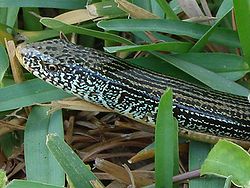
Picture of Ophisaurus ventralis
- Source
- Wikipedia/Commons
- Credit
- en:user:Fl295
- Licence
- Public Domain
- Commercial use
- the licence allows it
No 3D scan of Ophisaurus ventralis was found in Sketchfab.
Smithsonian Open Access and MorphoSource were not reached for this taxon, so this list is what the others held rather than everything there is.
The description on this site
- Licence
- CC BY-SA 4.0
This is what the site found, which is not the same as what exists.
Keep going
What may have been alongside itOphisaurus through timeFormations of the PleistoceneThe world it lived on
Occurrence data from the Paleobiology Database, CC BY 4.0. Linnaeus 1766