Oncorhynchus
Oncorhynchus is a genus of ray-finned fish in the subfamily Salmoninae of the family Salmonidae, native to coldwater tributaries of the North Pacific basin. The genus contains sixteen extant species, namely six species of Pacific salmon and ten species of Pacific trout, all of which are migratory mid-level predatory fish that display natal homing and semelparity.

David Menke · Public Domain · via Wikipedia/Commons. May be a photograph of a specimen, or an artist’s reconstruction — an interpretation of a skeleton, since colour and soft tissue are almost never preserved.
On record
Recorded, not inferred- Also called
- Pacific salmonPBDB
- Sits inside
- SalmonidaePBDB
- Diet
- carnivorePBDB, for Salmoniformes
- Life habit
- nektonicPBDB, for Salmoniformes
- Motility
- actively mobilePBDB, for Salmoniformes
Time the record covers
At least 7.1 million years on record.
The record covers at least 7.246 Mya to 129 ka. No occurrence read is dated outside 11.63 Mya to 11.7 ka.
22 occurrences of Oncorhynchus on record, most of them in the Pliocene. The Paleobiology Database records this as a living group. Bar height is expected occurrences, not a count: each fossil is spread across the span it is dated to, so a tall narrow bar means tight dating and a low wide one means loose.
When
22 occurrences- Miocene31%
- Pliocene43%
- Pleistocene26%
These are dates about fossils, not the animal: the record can only begin after it arose and end before it died out, so either end may reach further. Shares are expected occurrences: a fossil dated to a span is counted partly in each period it straddles. More on what this infers.
Found in
9 formations
- Pinole Tuff Formation3
- San Mateo Formation2
- Alturas Formation2
- Mehrten Formation1
- Wilson Grove Formation1
- Madras Formation1
Loading coastlines…
The named rock units Oncorhynchus has been recovered from, largest first. Drawn where the rock is now, not where it formed. 9 occurrences have no formation on record, which is common for older literature.
Oncorhynchus and its relatives
PlioceneWhere Oncorhynchus and its relatives were recorded in the Pliocene.
Found in the same rock
372 taxa- Chasmistes5 sites
- Catostomus4 sites
- Ptychocheilus4 sites
- Camelidae3 sites
- Catostomidae3 sites
- Cocconeis3 sites
- Gila3 sites
- Isurus oxyrinchus3 sites
- Melosira3 sites
- Odobeninae3 sites
- Panalcidae3 sites
- Acrocheilus2 sites
- Anas2 sites
- Anas crecca2 sites
- Anomoeonemis costata2 sites
- Aves2 sites
- Balaenopteridae2 sites
- Balanus2 sites
- Candona2 sites
- Carcharodon carcharias2 sites
- Cepphus2 sites
- Chlamys hastata2 sites
- Cyprideis2 sites
- Cyprinidae2 sites
The Paleobiology Database records 22 sites for Oncorhynchus, and this reads all of them. The number is how many of those sites it was catalogued from too. The 24 sharing the most are listed.
This is not a list of everything alive at the time. It is only what has come out of the same ground as this animal and been written down.
Entered from
14 references- Smilodonichthys rastrosus, a new Pliocene salmonid fish from western United States5
- Biogeography of the Pliocene and Pleistocene vertebrate faunas of Northeastern California and their temporal significance to the development of the Modoc Plateau and Klamath Mountain Region4
- The vertebrate fossils of the marine Cenozoic San Mateo Formation at Oceanside, California2
- Reconstructing paleohydrology in the northwest Great Basin since the last deglaciation using Paisley Caves fish remains (Oregon, U.S.A.)1
- Geochronology and Paleontology of the Paisley Fish Locality, Summer Lake Basin, Northern Lake County, Oregon1
- Geology and Paleontology of the Late Miocene Wilson Grove Formation at Bloomfield Quarry, Sonoma County, California1
- The giant, spike-toothed salmon, Oncorhynchus rastrosus and the “Proto-Tuolumne River” (early Pliocene) of central California1
- Miocene salmon (Oncorhynchus) from Western North America: Gill Raker evolution correlated with plankton productivity in the Eastern Pacific1
- A late Pleistocene Stellar sea lion (Eumetopias jubatus) from Courtenay, British Columbia: its death, associated biota, and paleoenvironment1
- Two Pliocene (Blancan) vertebrate faunas from Douglas County, Nevada1
- A catalogue of late Quaternary vertebrates from California: Part One, nonmarine lower vertebrate and avian taxa1
- Pliocene Molluscs and Fishes from Northeastern California and Northwestern Nevada1
Each of the 22 occurrences read was entered from one of these publications, ordered by how many each accounts for. This is not a search for papers mentioning the name. 2 further references are not listed. Entries link to doi.org where the Paleobiology Database holds an identifier, and to its own record where it does not. Relayed as the Paleobiology Database holds them, not checked against what they resolve to.
Media and terms
Media content2

Picture of Oncorhynchus
- Source
- Wikipedia/Commons
- Credit
- David Menke
- Licence
- Public Domain
- Commercial use
- the licence allows it
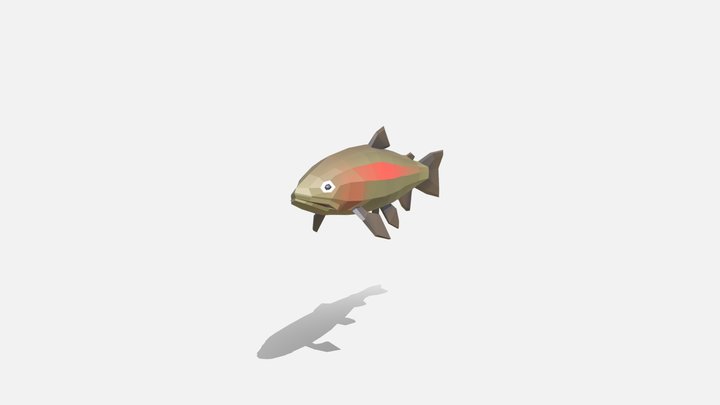
3D model
- Source
- Sketchfab
- Licence
- CC Attribution-NonCommercial-ShareAlike
- Commercial use
- the licence does not allow it
Smithsonian Open Access and MorphoSource were not reached for this taxon, so this list is what the others held rather than everything there is.
The description on this site
- Licence
- CC BY-SA 4.0
This is what the site found, which is not the same as what exists.
Keep going
What may have been alongside itSalmonidae through timeFormations of the PlioceneThe world it lived on
Occurrence data from the Paleobiology Database, CC BY 4.0. Suckley 1860