Nostoceratidae
Nostoceratidae was a diverse family of heteromorph ammonites found throughout the oceans of the world during the Late Cretaceous period. Many genera, such as Yezoceras, Ainoceras, Limusoceras, Anaklinoceras, and some species of Bostrychoceras and Eubostrychoceras, display, as young shells at least, a helical coiling very similar to the shells of the related family, Turrilitidae. As adults, though, the coils then curve away from the axis of coiling, either as an oxbow-like curve around the juvenile coils as in Ainoceras and Anaklinoceras, or in a simple curved loop beneath the juvenile coils, as in Yezoceras. Other genera form loose coils, sometimes in a spiral, such as those of Madagascarites, Muramotoceras, Hyphantoceras, and Nipponites.

Mr Fink ( talk ) · CC BY-SA 3.0 · via Wikipedia/Commons. May be a photograph of a specimen, or an artist’s reconstruction — an interpretation of a skeleton, since colour and soft tissue are almost never preserved.
On record
Recorded, not inferred- Sits inside
- TurrilitoideaPBDB
- Diet
- carnivorePBDB, for Ammonoidea
- Life habit
- nektonicPBDB, for Ammonoidea
- Motility
- fast-movingPBDB, for Ammonoidea
- Vision
- well-developedPBDB, for Cephalopoda
- Environment
- marinePBDB, for Cephalopoda
Time the record covers
At least 34 million years on record.
The record covers at least 106.3 Mya to 72.2 Mya. No occurrence read is dated outside 113.2 Mya to 66 Mya.
688 occurrences of Nostoceratidae on record, most of them in the Late Cretaceous. Bar height is expected occurrences, not a count: each fossil is spread across the span it is dated to, so a tall narrow bar means tight dating and a low wide one means loose.
When
688 occurrencesThese are dates about fossils, not the animal: the record can only begin after it arose and end before it died out, so either end may reach further. Shares are expected occurrences: a fossil dated to a span is counted partly in each period it straddles. More on what this infers.
Found in
106 formations
- Pierre Shale Formation · Montana Group80
- Saratoga Chalk Formation · Navarro Group43
- Nacatoch Sand Formation37
- Seidan Formation17
- Neylandville Marl Formation16
- Annona Formation · Taylor Group16
Loading coastlines…
The named rock units Nostoceratidae has been recovered from, largest first. Drawn where the rock is now, not where it formed. 82 further formations hold fewer occurrences each and are not listed. 147 occurrences have no formation on record, which is common for older literature.
Nostoceratidae and its relatives
Late CretaceousWhere Nostoceratidae and its relatives were recorded in the Late Cretaceous.
Found in the same rock
1,639 taxa- Inoceramus45 sites
- Baculites27 sites
- Nostoceras hyatti24 sites
- Didymoceras22 sites
- Exiteloceras jenneyi22 sites
- Nostoceras21 sites
- Nostoceras (Nostoceras) helicinum21 sites
- Scaphites19 sites
- Yezoites puerculus19 sites
- Nuculana18 sites
- Turritella trilira18 sites
- Baculites claviformis17 sites
- Cymbophora17 sites
- Cardium16 sites
- Eubostrychoceras16 sites
- Nostoceras (Nostoceras) approximans16 sites
- Tenea16 sites
- Tetragonites glabrus16 sites
- Baculites ovatus15 sites
- Gyrodes15 sites
- Anchura14 sites
- Gaudryceras (Gaudryceras) denseplicatum14 sites
- Granocardium14 sites
- Hamites14 sites
The Paleobiology Database records 484 sites for Nostoceratidae, and this reads 240 of them. The number is how many of those sites it was catalogued from too. The 24 sharing the most are listed.
This is not a list of everything alive at the time. It is only what has come out of the same ground as this animal and been written down.
Entered from
120 references- Upper Campanian-Maastrichtian ammonites (Nostoceratidae, Diplomoceratidae) from Tercis les Bains (Landes, France)57
- The larger invertebrate fossils of the Navarro group of Texas53
- Ammonites from the Saratoga Chalk (Upper Cretaceous), Arkansas43
- Heteromorph ammonites from the Upper Campanian (Upper Cretaceous) Baculites cuneatus and Baculites reesidei zones of the Pierre Shale in Colorado, USA35
- Late Campanian (Cretaceous) heteromorph ammonites29
- Upper Cretaceous of the Pacific Coast26
- Atabekyan and Khakimov, 197621
- Upper Cretaceous ammonites of California. Part III21
- Les grès verts helvétiques (Aptien moyen-Albien supérieur) de Haute-Savoie, Valais et Vaud (Alpes occidentales franco-suisses)19
- Ammonite faunas, biostratigraphy, and sequence stratigraphy of the Coniacian-Santonian of the Corbières (NE Pyrénées)17
- The Red Bird Section of the Upper Cretaceous Pierre Shale in Wyoming15
- Mode of occurrence and taphonomy of the heteromorph ammonite Pravitoceras sigmoidale Yabe from the Upper Cretaceous Izumi Group, Japan14
Each of the 688 occurrences read was entered from one of these publications, ordered by how many each accounts for. This is not a search for papers mentioning the name. 108 further references are not listed. Entries link to doi.org where the Paleobiology Database holds an identifier, and to its own record where it does not. Relayed as the Paleobiology Database holds them, not checked against what they resolve to.
Media and terms
Media content1
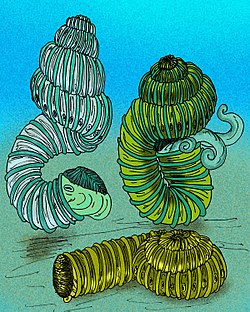
Picture of Nostoceratidae
- Source
- Wikipedia/Commons
- Credit
- Mr Fink ( talk )
- Licence
- CC BY-SA 3.0
- Commercial use
- the licence allows it
No 3D scan of Nostoceratidae was found in Sketchfab.
Smithsonian Open Access and MorphoSource were not reached for this taxon, so this list is what the others held rather than everything there is.
The description on this site
- Licence
- CC BY-SA 4.0
This is what the site found, which is not the same as what exists.
Keep going
What may have been alongside itTurrilitoidea through timeFormations of the Late CretaceousThe world it lived on
Occurrence data from the Paleobiology Database, CC BY 4.0. (Hyatt 1894)