Didymoceras
Didymoceras is an extinct genus of ammonite cephalopod from the Late Cretaceous epoch. It is one of the most bizarrely shaped genera, with a shell that spirals upwards into a loose, hooked tip. It is thought to have drifted in the water vertically, moving up and down. The genus name comes from Ancient Greek δίδυμος (dídumos), meaning "twin", and κέρας (céras), meaning "horn".

Mr Fink ( talk ) · CC BY-SA 3.0 · via Wikipedia/Commons. May be a photograph of a specimen, or an artist’s reconstruction — an interpretation of a skeleton, since colour and soft tissue are almost never preserved.
On record
Recorded, not inferred- Sits inside
- NostoceratidaePBDB
- Diet
- carnivorePBDB, for Ammonoidea
- Life habit
- nektonicPBDB, for Ammonoidea
- Motility
- fast-movingPBDB, for Ammonoidea
- Vision
- well-developedPBDB, for Cephalopoda
- Environment
- marinePBDB, for Cephalopoda
Time the record covers
At least 395 million years on record.
The record covers at least 468 Mya to 72.2 Mya. No occurrence read is dated outside 477.1 Mya to 66 Mya.
139 occurrences of Didymoceras on record, most of them in the Late Cretaceous. Bar height is expected occurrences, not a count: each fossil is spread across the span it is dated to, so a tall narrow bar means tight dating and a low wide one means loose.
When
139 occurrences- Ordovicianunder 1%
- Late Cretaceous99%
These are dates about fossils, not the animal: the record can only begin after it arose and end before it died out, so either end may reach further. Shares are expected occurrences: a fossil dated to a span is counted partly in each period it straddles. More on what this infers.
Found in
35 formations
- Pierre Shale Formation · Montana Group25
- Annona Formation · Taylor Group11
- Korojon Calcarenite Formation7
- Bearpaw Formation6
- St Lucia Formation5
- Marshalltown Formation4
Loading coastlines…
The named rock units Didymoceras has been recovered from, largest first. Drawn where the rock is now, not where it formed. 11 further formations hold fewer occurrences each and are not listed. 22 occurrences have no formation on record, which is common for older literature.
Didymoceras and its relatives
Late CretaceousWhere Didymoceras and its relatives were recorded in the Late Cretaceous.
Found in the same rock
572 taxa- Baculites15 sites
- Inoceramus11 sites
- Nostoceras (Didymoceras) attenuatum11 sites
- Nostoceras hyatti9 sites
- Nostoceras7 sites
- Menuites6 sites
- Nostoceras (Didymoceras) obtusum6 sites
- Nostoceras (Nostoceras)6 sites
- Placenticeras6 sites
- Solenoceras crassum6 sites
- Baculites ovatus5 sites
- Desmophyllites diphylloides5 sites
- Pachydiscus (Pachydiscus)5 sites
- Pachydiscus (Pachydiscus) ootacodensis5 sites
- Baculites cuneatus4 sites
- Baculites scotti4 sites
- Baculites subanceps4 sites
- Baculites taylorensis4 sites
- Bryozoa4 sites
- Cirroceras conradi4 sites
- Cymbophora4 sites
- Diplomoceras cylindraceum4 sites
- Exiteloceras jenneyi4 sites
- Gaudryceras kayei4 sites
The Paleobiology Database records 116 sites for Didymoceras, and this reads all of them. The number is how many of those sites it was catalogued from too. The 24 sharing the most are listed.
This is not a list of everything alive at the time. It is only what has come out of the same ground as this animal and been written down.
Entered from
42 references- Upper Campanian-Maastrichtian ammonites (Nostoceratidae, Diplomoceratidae) from Tercis les Bains (Landes, France)12
- Late Campanian (Cretaceous) heteromorph ammonites11
- Maastrichtian heteromorph ammonites from the Carnarvon Basin, Western Australia9
- The Red Bird Section of the Upper Cretaceous Pierre Shale in Wyoming9
- Upper Campanian ammonites from the Ozan-Annona Formation boundary in Southwestern Arkansas7
- Geology of the Fort Peck area, Garfield, McCone and Valley counties, Montana7
- Heteromorph ammonites from the Upper Campanian (Upper Cretaceous) Baculites cuneatus and Baculites reesidei zones of the Pierre Shale in Colorado, USA6
- Campanian ammontes from the Annona Chalk near Yancy, Arkansas6
- Cretaceous heteromorph ammonites from Zululand5
- Upper Cretaceous (Campanian and Maestrichtian) ammonites from southern Alaska5
- Upper Cretaceous ammonites of California. Part III5
- Upper Cretaceous of the Pacific Coast5
Each of the 139 occurrences read was entered from one of these publications, ordered by how many each accounts for. This is not a search for papers mentioning the name. 30 further references are not listed. Entries link to doi.org where the Paleobiology Database holds an identifier, and to its own record where it does not. Relayed as the Paleobiology Database holds them, not checked against what they resolve to.
Media and terms
Media content3

Picture of Didymoceras
- Source
- Wikipedia/Commons
- Credit
- Mr Fink ( talk )
- Licence
- CC BY-SA 3.0
- Commercial use
- the licence allows it
CT scan
- Source
- MorphoSource
- Licence
- not stated by the source
- Commercial use
- cannot be read from the licence given — check the record
- Specimen
- Didymoceras nebrascense · USNM:PAL:USNM PAL482421
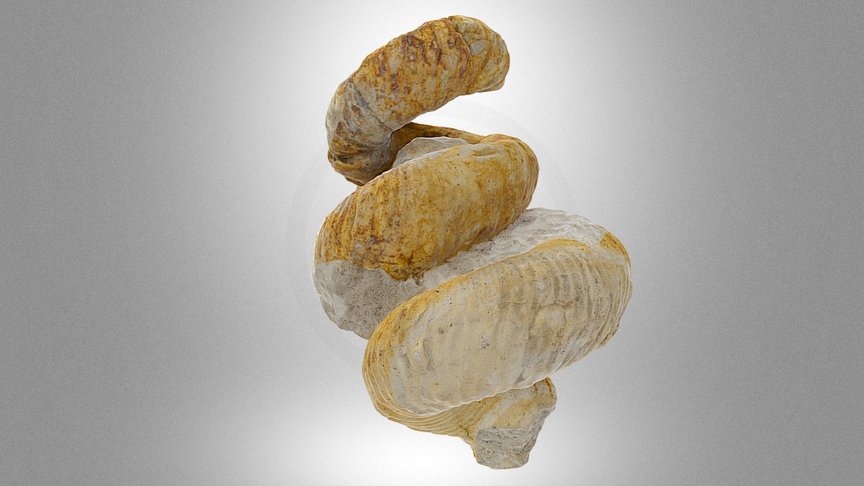
3D model
- Source
- Sketchfab
- Licence
- CC0 Public Domain
- Commercial use
- the licence allows it
The description on this site
- Source
- Wikipedia, “Didymoceras”
- Licence
- CC BY-SA 4.0
This is what the site found, which is not the same as what exists.
Keep going
What may have been alongside itNostoceratidae through timeFormations of the Late CretaceousThe world it lived on
Occurrence data from the Paleobiology Database, CC BY 4.0. (Hyatt 1900)