Myrmica
Myrmica is a genus of ants within the subfamily Myrmicinae. It is widespread throughout the temperate regions of the Holarctic and high mountains in Southeast Asia.

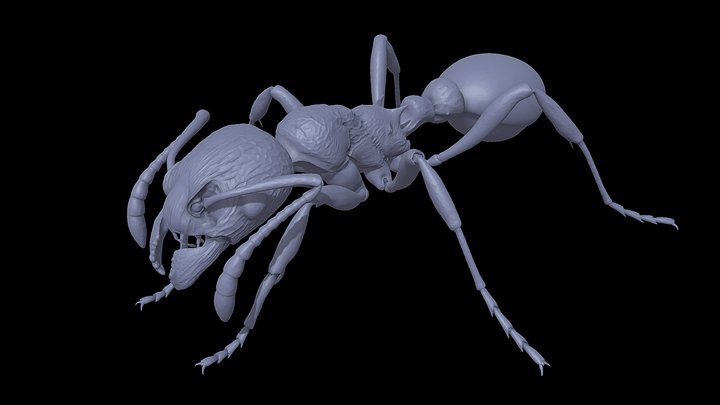
Sarefo · CC BY-SA 4.0 · via Wikipedia/Commons. May be a photograph of a specimen, or an artist’s reconstruction — an interpretation of a skeleton, since colour and soft tissue are almost never preserved.
On record
Recorded, not inferred- Sits inside
- MyrmiciniPBDB
- Motility
- actively mobilePBDB, for Arthropoda
- Environment
- terrestrialPBDB, for Insecta
Time the record covers
At least 45 million years on record.
The record covers at least 45.9 Mya to 129 ka. No occurrence read is dated outside 51.1 Mya to 11.7 ka.
43 occurrences of Myrmica on record, most of them in the Eocene. The Paleobiology Database records this as a living group. Bar height is expected occurrences, not a count: each fossil is spread across the span it is dated to, so a tall narrow bar means tight dating and a low wide one means loose.
When
43 occurrences- Eocene56%
- Oligocene9%
- Miocene16%
- Pleistocene19%
These are dates about fossils, not the animal: the record can only begin after it arose and end before it died out, so either end may reach further. Shares are expected occurrences: a fossil dated to a span is counted partly in each period it straddles. More on what this infers.
Found in
5 formations
- Upper Freshwater-Molasse Formation4
- Kap København Formation2
- Quadra Sand Formation2
- Green River Formation1
- Cypris Formation1
Loading coastlines…
The named rock units Myrmica has been recovered from, largest first. Drawn where the rock is now, not where it formed. 33 occurrences have no formation on record, which is common for older literature.
Myrmica and its relatives
EoceneWhere Myrmica and its relatives were recorded in the Eocene.
Found in the same rock
3,308 taxa- Gesomyrmex hoernesi10 sites
- Yantaromyrmex geinitzi10 sites
- Plagiolepis kuenowi9 sites
- Prenolepis henschei9 sites
- Lasius schiefferdeckeri8 sites
- Nylanderia pygmaea8 sites
- Tetraponera simplex8 sites
- Ctenobethylus goepperti7 sites
- Stenus7 sites
- Aleocharinae6 sites
- Aphaenogaster sommerfeldti6 sites
- Eotemnothorax gracilis6 sites
- Formica flori6 sites
- Gnamptogenys europaea6 sites
- Monogedania clunipes6 sites
- Pachycondyla succinea6 sites
- Plagiolepis klinsmanni6 sites
- Tetraponera ocellata6 sites
- Yantaromyrmex samlandicus6 sites
- Bembidion5 sites
- Bradoponera meieri5 sites
- Ceratopogon forcipiformis5 sites
- Chrysomelidae5 sites
- Culicoides speciosus5 sites
The Paleobiology Database records 31 sites for Myrmica, and this reads all of them. The number is how many of those sites it was catalogued from too. The 24 sharing the most are listed.
This is not a list of everything alive at the time. It is only what has come out of the same ground as this animal and been written down.
Entered from
15 references- Myrmica ants (Hymenoptera: Formicidae) in late Eocene European ambers13
- Heer, 18495
- New fossil ants of the subfamily Myrmicinae (Hymenoptera, Formicidae) from the Upper Oligocene of Enspel (Westerwald Mountains, Rhineland Palatinate, Germany)3
- Environmental interpretation of fossil insect assemblages from MIS 5 at Ziegler Reservoir, Snowmass Village, Colorado3
- The Ants of the Genus Myrmica (Hymenoptera, Formicidae) from Baltic and Saxonian Amber (Late Eocene)3
- The Ants of the Baltic Amber3
- Die Ameisen des baltischen Bernsteins3
- Palaeoentomology of the Kap København Formation, a Plio-Pleistocene sequence in Peary Land, North Greenland2
- Pre-Vashon fossil Coleoptera of Fraser age from the Fraser Lowland, British Columbia2
- A new spineless species of the genus Myrmica Latreille, 1804 (Hymenoptera: Formicidae: Myrmicinae) from late Eocene Baltic amber1
- The fossil Coleoptera of the Two Creeks Forest Bed, Wisconsin1
- Bemerkungen über die Insektenfauna von Oeningen nebst Revision der Heer'schen Typen1
Each of the 43 occurrences read was entered from one of these publications, ordered by how many each accounts for. This is not a search for papers mentioning the name. 3 further references are not listed. Entries link to doi.org where the Paleobiology Database holds an identifier, and to its own record where it does not. Relayed as the Paleobiology Database holds them, not checked against what they resolve to.
Media and terms
Media content2

Picture of Myrmica
- Source
- Wikipedia/Commons
- Credit
- Sarefo
- Licence
- CC BY-SA 4.0
- Commercial use
- the licence allows it
Smithsonian Open Access and MorphoSource were not reached for this taxon, so this list is what the others held rather than everything there is.
The description on this site
- Source
- Wikipedia, “Myrmica”
- Licence
- CC BY-SA 4.0
This is what the site found, which is not the same as what exists.
Keep going
What may have been alongside itMyrmicini through timeFormations of the EoceneThe world it lived on
Occurrence data from the Paleobiology Database, CC BY 4.0. Latreille 1804