Mycteria americana
The wood stork is a large wading bird in the family Ciconiidae (storks). Originally described in 1758 by Carl Linnaeus, this stork is native to the subtropics and tropics of the Americas, where it persists in habitats with fluctuating water levels. It is the only stork species that breeds in North America. The head and neck are bare of feathers, and dark grey in colour. The plumage is mostly white, with the exception of the tail and some of the wing feathers, which are black with a greenish-purplish sheen.

Googie man ( talk ) · CC BY-SA 3.0 · via Wikipedia/Commons. May be a photograph of a specimen, or an artist’s reconstruction — an interpretation of a skeleton, since colour and soft tissue are almost never preserved.
On record
Recorded, not inferred- Also called
- wood storkPBDB
- Sits inside
- MycteriaPBDB
- Diet
- carnivorePBDB, for Coelurosauria
- Life habit
- ground dwelling, solitaryPBDB, for Theropoda
- Motility
- actively mobilePBDB, for Theropoda
- Environment
- terrestrialPBDB, for Theropoda
Time the record covers
At most 2.6 million years on record.
Every occurrence read is dated to somewhere between 2.58 Mya and 0 Mya, and nothing in the dating separates them, so that window is what the record shows rather than a span.
6 occurrences of Mycteria americana on record, most of them in the Pleistocene. The Paleobiology Database records this as a living group. Bar height is expected occurrences, not a count: each fossil is spread across the span it is dated to, so a tall narrow bar means tight dating and a low wide one means loose.
When
6 occurrences- Pleistocene83%
- Holocene17%
These are dates about fossils, not the animal: the record can only begin after it arose and end before it died out, so either end may reach further. Shares are expected occurrences: a fossil dated to a span is counted partly in each period it straddles. More on what this infers.
Mycteria americana and its relatives
PleistoceneWhere Mycteria americana and its relatives were recorded in the Pleistocene.
Found in the same rock
373 taxa- Podilymbus podiceps4 sites
- Aenocyon dirus3 sites
- Ardea alba3 sites
- Ardea herodias3 sites
- Didelphis virginiana3 sites
- Equus3 sites
- Mammut americanum3 sites
- Mammuthus columbi3 sites
- Siren lacertina3 sites
- Alligator mississippiensis2 sites
- Amphiuma means2 sites
- Ardea cocoi2 sites
- Bison2 sites
- Buteo2 sites
- Cathartes aura2 sites
- Ciconia maltha2 sites
- Coragyps atratus2 sites
- Crotalus adamanteus2 sites
- Eudocimus albus2 sites
- Farancia abacura2 sites
- Gallinula chloropus2 sites
- Grus americana2 sites
- Hesperotestudo crassiscutata2 sites
- Holmesina septentrionalis2 sites
The Paleobiology Database records 5 sites for Mycteria americana, and this reads all of them. The number is how many of those sites it was catalogued from too. The 24 sharing the most are listed.
This is not a list of everything alive at the time. It is only what has come out of the same ground as this animal and been written down.
Entered from
6 references- The fossil avifauna of the tar seeps Las Breas de San Felipe, Matanzas, Cuba1
- A late Pleistocene (Wisconsinan) avifauna from West Palm Beach, Florida1
- The non-passerine Pleistocene avifauna of the Talara Tar Seeps, northwestern Peru1
- The fossil avifauna of Itchtucknee River, Florida1
- Pre-Columbian bird remains from Venezuela1
- Fossil birds found at Vero, Florida1
Each of the 6 occurrences read was entered from one of these publications, ordered by how many each accounts for. This is not a search for papers mentioning the name. Entries link to doi.org where the Paleobiology Database holds an identifier, and to its own record where it does not. Relayed as the Paleobiology Database holds them, not checked against what they resolve to.
Media and terms
Media content1
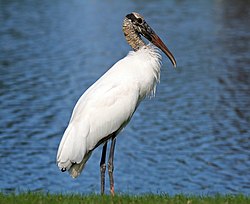
Picture of Mycteria americana
- Source
- Wikipedia/Commons
- Credit
- Googie man ( talk )
- Licence
- CC BY-SA 3.0
- Commercial use
- the licence allows it
No 3D scan of Mycteria americana was found in Sketchfab.
Smithsonian Open Access and MorphoSource were not reached for this taxon, so this list is what the others held rather than everything there is.
The description on this site
- Source
- Wikipedia, “Wood stork”
- Licence
- CC BY-SA 4.0
This is what the site found, which is not the same as what exists.
Keep going
What may have been alongside itMycteria through timeFormations of the PleistoceneThe world it lived on
Occurrence data from the Paleobiology Database, CC BY 4.0. Linnaeus 1758