Monodelphis domestica
The gray short-tailed opossum is a small South American member of the family Didelphidae. Unlike most other marsupials, the gray short-tailed opossum does not have a true pouch. The scientific name Monodelphis is derived from Greek and means "single womb" and the Latin word domestica which means "domestic". It was the first marsupial to have its genome sequenced. The gray short-tailed opossum is used as a research model in science, and is also frequently found in the exotic pet trade. It is also known as the Brazilian opossum, rainforest opossum and in a research setting the laboratory opossum.

The original uploader was Dawson at English Wikipedia . · CC BY-SA 2.5 · via Wikipedia/Commons. May be a photograph of a specimen, or an artist’s reconstruction — an interpretation of a skeleton, since colour and soft tissue are almost never preserved.
On record
Recorded, not inferred- Also called
- gray short-tailed opposumPBDB
- Sits inside
- MonodelphisPBDB
- Diet
- insectivore, carnivorePBDB, for Marmosinae
- Life habit
- scansorialPBDB, for Didelphidae
- Motility
- actively mobilePBDB, for Osteichthyes
- Environment
- terrestrialPBDB, for Marmosinae
- Mass
- 0.1 gWikidata
Time the record covers
At most 2.6 million years on record.
Every occurrence read is dated to somewhere between 2.58 Mya and 0 Mya, and nothing in the dating separates them, so that window is what the record shows rather than a span.
6 occurrences of Monodelphis domestica on record, most of them in the Pleistocene. The Paleobiology Database records this as a living group. Bar height is expected occurrences, not a count: each fossil is spread across the span it is dated to, so a tall narrow bar means tight dating and a low wide one means loose.
When
6 occurrences- Pleistocene100%
- Holoceneunder 1%
These are dates about fossils, not the animal: the record can only begin after it arose and end before it died out, so either end may reach further. Shares are expected occurrences: a fossil dated to a span is counted partly in each period it straddles. More on what this infers.
Monodelphis domestica and its relatives
PleistoceneWhere Monodelphis domestica and its relatives were recorded in the Pleistocene.
Found in the same rock
109 taxa- Thrichomys6 sites
- Oryzomys5 sites
- Cuniculus paca4 sites
- Dasypus4 sites
- Didelphidae4 sites
- Necromys4 sites
- Oryzomys subflavus4 sites
- Dasypodinae3 sites
- Dasypus (Dasypus) septemcinctus3 sites
- Desmodus3 sites
- Gracilinanus3 sites
- Mazama3 sites
- Oligoryzomys3 sites
- Oryzomyini3 sites
- Pecari tajacu3 sites
- Phyllostomus3 sites
- Proechimys3 sites
- Pseudoryzomys simplex3 sites
- Sturnira3 sites
- Thylamys3 sites
- Tonatia3 sites
- Akodon2 sites
- Akodon cursor2 sites
- Calomys callosus2 sites
The Paleobiology Database records 6 sites for Monodelphis domestica, and this reads all of them. The number is how many of those sites it was catalogued from too. The 24 sharing the most are listed.
This is not a list of everything alive at the time. It is only what has come out of the same ground as this animal and been written down.
Entered from
3 references- Fauna de mamíferos do Quaternário de Serra da Mesa (Goiás, Brasil)3
- La Faune Pleistocene du Piaui (Nordeste du Bresil): Implications Paleoecologiques et Biochronologiques2
- Quaternary mammals from Serra do Bodoquena, Mato Grosso do Sul, Brazil1
Each of the 6 occurrences read was entered from one of these publications, ordered by how many each accounts for. This is not a search for papers mentioning the name. Each entry links to the Paleobiology Database's own record for the work.
Media and terms
Media content2
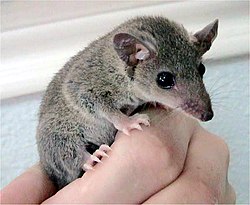
Picture of Monodelphis domestica
- Source
- Wikipedia/Commons
- Credit
- The original uploader was Dawson at English Wikipedia .
- Licence
- CC BY-SA 2.5
- Commercial use
- the licence allows it
CT scan
- Source
- MorphoSource
- Licence
- In Copyright
- Commercial use
- cannot be read from the licence given — check the record
- Specimen
- Monodelphis domestica domestica · MVZ:Mamm:MVZ:Mamm:144307
Smithsonian Open Access was not reached for this taxon, so this list is what the others held rather than everything there is.
The description on this site
- Licence
- CC BY-SA 4.0
This is what the site found, which is not the same as what exists.
Keep going
What may have been alongside itMonodelphis through timeFormations of the PleistoceneThe world it lived on
Occurrence data from the Paleobiology Database, CC BY 4.0. (Wagner 1842)