Macrocranion
Macrocranion is a genus of extinct mammal from the Eocene epoch of Europe and North America. Exceptional fossils have been found in the Messel Pit of Germany. Macrocranion species are often described as forest-floor predators, about the size of small squirrels but with longer limbs. The genus is represented at the Messel Pit site by two species, M. tupaidon and M. tenerum.

H. Zell · CC BY-SA 3.0 · via Wikipedia/Commons. May be a photograph of a specimen, or an artist’s reconstruction — an interpretation of a skeleton, since colour and soft tissue are almost never preserved.
On record
Recorded, not inferred- Sits inside
- AmphilemuridaePBDB
- Diet
- insectivorePBDB, for Macroscelidea
- Life habit
- ground dwellingPBDB, for Macroscelidea
- Motility
- actively mobilePBDB, for Osteichthyes
- Environment
- terrestrialPBDB, for Eutheria
Time the record covers
At least 11 million years on record.
The record covers at least 51.1 Mya to 39.7 Mya. No occurrence read is dated outside 59.24 Mya to 37 Mya.
53 occurrences of Macrocranion on record, most of them in the Eocene. The Paleobiology Database records this as a living group, and the chart stops with its fossils rather than at the present. Bar height is expected occurrences, not a count: each fossil is spread across the span it is dated to, so a tall narrow bar means tight dating and a low wide one means loose.
When
53 occurrencesThese are dates about fossils, not the animal: the record can only begin after it arose and end before it died out, so either end may reach further. Shares are expected occurrences: a fossil dated to a span is counted partly in each period it straddles. More on what this infers.
Found in
17 formations
- Willwood Formation17
- Wasatch Formation8
- Wind River Formation6
- San Jose Formation3
- Tienen Formation · Landen Group3
- Aycross Formation2
Loading coastlines…
The named rock units Macrocranion has been recovered from, largest first. Drawn where the rock is now, not where it formed. 1 occurrence has no formation on record, which is common for older literature.
Macrocranion and its relatives
EoceneWhere Macrocranion and its relatives were recorded in the Eocene.
Found in the same rock
730 taxa- Coryphodon23 sites
- Phenacodus vortmani20 sites
- Apheliscus17 sites
- Hyopsodus16 sites
- Paramys copei16 sites
- Phenacodus16 sites
- Prodiacodon tauricinerei15 sites
- Sifrhippus grangeri15 sites
- Haplomylus speirianus14 sites
- Paramys excavatus13 sites
- Phenacolemurinae13 sites
- Hyopsodus loomisi12 sites
- Viverravus acutus12 sites
- Ectypodus tardus11 sites
- Esthonyx spatularius11 sites
- Knightomys depressus11 sites
- Paramys11 sites
- Thryptacodon antiquus11 sites
- Didymictis leptomylus10 sites
- Herpetotherium innominatum10 sites
- Niptomomys doreenae10 sites
- Bunophorus9 sites
- Cantius mckennai9 sites
- Copecion brachypternus9 sites
The Paleobiology Database records 52 sites for Macrocranion, and this reads all of them. The number is how many of those sites it was catalogued from too. The 24 sharing the most are listed.
This is not a list of everything alive at the time. It is only what has come out of the same ground as this animal and been written down.
Entered from
28 references- Synonymies and reidentifications of North American fossil mammals9
- Faunal Zonation of the Willwood Formation in the Central Bighorn Basin, Wyoming7
- Earliest Eocene mammalian fauna from the Paleocene-Eocene Thermal Maximum at Sand Creek Divide, southern Bighorn Basin, Wyoming3
- The mammal fauna of the early Eocene Blackheath Formation of Abbey Wood, London3
- Distribution and stratigraphic correlation of upper Paleocene and lower Eocene fossil mammal and plant localities of the Fort Union, Willwood, and Tatman formations, southern Bighorn Basin, Wyoming3
- The earliest Eocene mammal fauna of the Erquelinnes Sand Member near the French-Belgian border2
- New species of Macrocranion (Mammalia, Lipotyphla) from the earliest Eocene of North America and its biogeographic implications2
- Revision of the Wind River faunas, early Eocene of central Wyoming. Part 5. Geology and biostratigraphy of the upper part of the Wind River Formation, northeastern Wind River Basin2
- Geology, Paleontology, and Correlation of Eocene Volcaniclastic Rocks, Southeast Absaroka Range, Hot Springs County, Wyoming2
- Magnetic polarity stratigraphy and fossil mammalia of the San José formation, Eocene, New Mexico2
- Tarsal diversity in the earliest Eocene mammal fauna of Dormaal, Belgium1
- Paleocene-Eocene land mammals from three new latest Clarkforkian and earliest Wasatchian wash sites at Polecat Bench in the northern Bighorn Basin, Wyoming.1
Each of the 53 occurrences read was entered from one of these publications, ordered by how many each accounts for. This is not a search for papers mentioning the name. 16 further references are not listed. Entries link to doi.org where the Paleobiology Database holds an identifier, and to its own record where it does not. Relayed as the Paleobiology Database holds them, not checked against what they resolve to.
Media and terms
Media content1
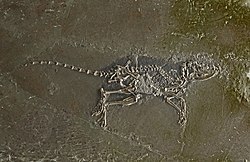
Picture of Macrocranion
- Source
- Wikipedia/Commons
- Credit
- H. Zell
- Licence
- CC BY-SA 3.0
- Commercial use
- the licence allows it
No 3D scan of Macrocranion was found in Smithsonian Open Access and Sketchfab.
MorphoSource was not reached for this taxon, so this list is what the others held rather than everything there is.
The description on this site
- Licence
- CC BY-SA 4.0
This is what the site found, which is not the same as what exists.
Keep going
What may have been alongside itAmphilemuridae through timeFormations of the EoceneThe world it lived on
Occurrence data from the Paleobiology Database, CC BY 4.0. Weitzel 1949