Macaca sylvanus
The Barbary macaque is a macaque species native to the Atlas Mountains of Morocco, Algeria and Tunisia, along with a small introduced population in Gibraltar. It is the type species of the genus Macaca. From the Early Pliocene to the Late Pleistocene, until around 85–40,000 years ago, it was widely distributed in Europe. Today, the Barbary macaques in Gibraltar are the only Old World monkeys in Europe. About 300 individuals live on the Rock of Gibraltar. This population appears to be stable or increasing, while the North African population is declining.

Vitold Muratov · CC BY-SA 3.0 · via Wikipedia/Commons. May be a photograph of a specimen, or an artist’s reconstruction — an interpretation of a skeleton, since colour and soft tissue are almost never preserved.
On record
Recorded, not inferred- Also called
- Barbary macaquePBDB
- Sits inside
- MacacaPBDB
- Diet
- frugivore, folivorePBDB, for Cercopithecidae
- Life habit
- arborealPBDB, for Cercopithecidae
- Motility
- actively mobilePBDB, for Osteichthyes
- Environment
- terrestrialPBDB, for Eutheria
Time the record covers
At least 1.6 million years on record.
The record covers at least 1.8 Mya to 129 ka. No occurrence read is dated outside 5.333 Mya to 0 Mya.
16 occurrences of Macaca sylvanus on record, most of them in the Pleistocene. The Paleobiology Database records this as a living group. Bar height is expected occurrences, not a count: each fossil is spread across the span it is dated to, so a tall narrow bar means tight dating and a low wide one means loose.
When
16 occurrences- Pliocene7%
- Pleistocene93%
- Holoceneunder 1%
These are dates about fossils, not the animal: the record can only begin after it arose and end before it died out, so either end may reach further. Shares are expected occurrences: a fossil dated to a span is counted partly in each period it straddles. More on what this infers.
Found in
2 formations
Loading coastlines…
The named rock units Macaca sylvanus has been recovered from, largest first. Drawn where the rock is now, not where it formed. 14 occurrences have no formation on record, which is common for older literature.
Macaca sylvanus and its relatives
PleistoceneWhere Macaca sylvanus and its relatives were recorded in the Pleistocene.
Found in the same rock
310 taxa- Equus10 sites
- Mimomys7 sites
- Stephanorhinus etruscus6 sites
- Apodemus5 sites
- Arvicola5 sites
- Canis lupus5 sites
- Cervus elaphus5 sites
- Cricetus cricetus5 sites
- Crocidura5 sites
- Microtus5 sites
- Myodes5 sites
- Pliomys5 sites
- Sus scrofa5 sites
- Aves4 sites
- Bos primigenius4 sites
- Castor fiber4 sites
- Cervidae4 sites
- Dama4 sites
- Hystrix4 sites
- Lepus4 sites
- Lynx pardinus4 sites
- Sorex4 sites
- Talpa minor4 sites
- Testudo hermanni4 sites
The Paleobiology Database records 16 sites for Macaca sylvanus, and this reads all of them. The number is how many of those sites it was catalogued from too. The 24 sharing the most are listed.
This is not a list of everything alive at the time. It is only what has come out of the same ground as this animal and been written down.
Entered from
12 references- From tortoises to elephants: the impact of elephants in the broad spectrum diet at Bolomor Cave (MIS 9–5 Spain)3
- Biochronology of the Pleistocene deposits at Betfia (Bihor, Romania)2
- Insularity and Quaternary vertebrate faunas in Britain and Ireland2
- First record of Macaca (Cercopithecidae, Primates) in the Middle Pleistocene of Greece1
- Subsistence patterns of Early Pleistocene hominids in the Levant - taphonomic evidence from the 'Ubeidiya Formation1
- Une faune tres diversifee du Pleistocene inferieur de la Sierra de Quibas (province de Murcia, Espagne)1
- Preliminary data on the micro- and macromammal remains from Casa Sgherri, Lower Valdarno (Tuscany, Italy)1
- Mittelpleistozane Saugetierfaunen aus Mitteleuropa - der Versuch einer biostratigraphischen Zuordnung1
- The Pleistocene Vertebrate Faunas of West Runton, Norfolk, England1
- I giacimenti Quaternari di vertebrati fossili nell'Italia Nord-Orientale1
- Les Faunes de grands mammiferes de la Grotte du Vallonnet, Roquebrune-Cap-Martin, Alpes-Maritimes1
- Primatezahne (Cercopithecidae) aus einer Plistozanen Spaltenfullung im Steinbruch Tourkobounja, Athen1
Each of the 16 occurrences read was entered from one of these publications, ordered by how many each accounts for. This is not a search for papers mentioning the name. Entries link to doi.org where the Paleobiology Database holds an identifier, and to its own record where it does not. Relayed as the Paleobiology Database holds them, not checked against what they resolve to.
Media and terms
Media content3

Picture of Macaca sylvanus
- Source
- Wikipedia/Commons
- Credit
- Vitold Muratov
- Licence
- CC BY-SA 3.0
- Commercial use
- the licence allows it
CT scan
- Source
- MorphoSource
- Licence
- not stated by the source
- Commercial use
- cannot be read from the licence given — check the record
- Specimen
- Macaca sylvanus · iphes:BB'13C2IIZ.1302
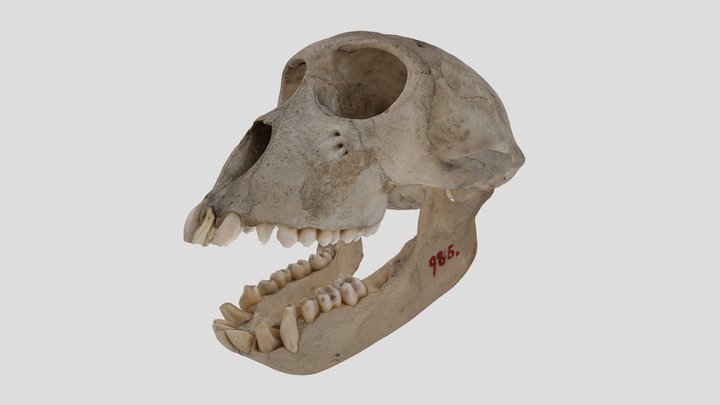
3D model
- Source
- Sketchfab
- Credit
- Yale Peabody Museum
- Licence
- CC Attribution
- Commercial use
- cannot be read from the licence given — check the record
The description on this site
- Licence
- CC BY-SA 4.0
This is what the site found, which is not the same as what exists.
Keep going
What may have been alongside itMacaca through timeFormations of the PleistoceneThe world it lived on
Occurrence data from the Paleobiology Database, CC BY 4.0. (Linnaeus 1758)