Loranthaceae
Loranthaceae, commonly known as the showy mistletoes, is a family of flowering plants. It consists of about 75 genera and 1,000 species of woody plants, many of them hemiparasites. The three terrestrial species are Nuytsia floribunda, Atkinsonia ligustrina, and Gaiadendron punctatum Loranthaceae are primarily xylem parasites, but their haustoria may sometimes tap the phloem, while Tristerix aphyllus is almost holoparasitic. For a more complete description of the Australian Loranthaceae, see Flora of Australia online Archived 2018-04-01 at the Wayback Machine, for the Malesian Loranthaceae see Flora of Malesia.

Franz Xaver · CC BY-SA 3.0 · via Wikipedia/Commons. May be a photograph of a specimen, or an artist’s reconstruction — an interpretation of a skeleton, since colour and soft tissue are almost never preserved.
On record
Recorded, not inferred- Also called
- mistletoePBDB
- Sits inside
- SantalalesPBDB
- Diet
- "photoautotroph"PBDB, for Angiospermae
Time the record covers
At least 93 million years on record.
The record covers at least 93.9 Mya to 11.7 ka. No occurrence read is dated outside 113.2 Mya to 0 Mya.
163 occurrences of Loranthaceae on record, most of them in the Paleocene. The Paleobiology Database records this as a living group. Bar height is expected occurrences, not a count: each fossil is spread across the span it is dated to, so a tall narrow bar means tight dating and a low wide one means loose.
When
163 occurrences- Early Cretaceousunder 1%
- Late Cretaceous18%
- Paleocene28%
- Eocene26%
- Oligocene2%
- Miocene10%
- Plioceneunder 1%
- Pleistocene14%
- Holocene1%
These are dates about fossils, not the animal: the record can only begin after it arose and end before it died out, so either end may reach further. Shares are expected occurrences: a fossil dated to a span is counted partly in each period it straddles. More on what this infers.
Found in
32 formations
- Yaw Formation20
- Mirador Formation19
- Guasare Formation11
- Zarga-Ghazal Formation · Darfur Group9
- Turtel Mountain Formation7
- Fort Union Formation6
Loading coastlines…
The named rock units Loranthaceae has been recovered from, largest first. Drawn where the rock is now, not where it formed. 8 further formations hold fewer occurrences each and are not listed. 42 occurrences have no formation on record, which is common for older literature.
Loranthaceae and its relatives
PaleoceneWhere Loranthaceae and its relatives were recorded in the Paleocene.
Found in the same rock
1,500 taxa- Laevigatosporites31 sites
- Cupanieidites28 sites
- Podocarpus27 sites
- Cunoniaceae25 sites
- Syncolporites25 sites
- Myrtaceae24 sites
- Agathis23 sites
- Cyathea23 sites
- Podocarpidites23 sites
- Verrucatosporites23 sites
- Araucaria22 sites
- Proteaceae22 sites
- Syzygium22 sites
- Acacia21 sites
- Casuarinaceae21 sites
- Dacrydium21 sites
- Dodonaea21 sites
- Eucalyptus21 sites
- Nothofagus21 sites
- Rapanea21 sites
- Araliaceae20 sites
- Asteraceae20 sites
- Botryococcus20 sites
- Chenopodiaceae20 sites
The Paleobiology Database records 111 sites for Loranthaceae, and this reads all of them. Of that, one read hit the database's own return limit, so every count below is a floor rather than a total. The number is how many of those sites it was catalogued from too. The 24 sharing the most are listed.
This is not a list of everything alive at the time. It is only what has come out of the same ground as this animal and been written down.
Entered from
38 references- Palaeofloristic and palaeovegetational changes across the Paleocene/Eocene boundary in northern South America26
- A proto-monsoonal climate in the late Eocene of Southeast Asia: evidence from a sedimentary record in central Myanmar20
- Late Cretaceous spore-pollen zonation of the Central African Rift System (CARS), Kaikang Trough, Muglad Basin, South Sudan: angiosperm spread and links to the Elaterates Province13
- Early Pleistocene vegetation change in upland south-eastern Australia10
- A complete pollen record of the last 230 ka from Lynch's Crater, north-eastern Australia10
- A reconstruction of the early Palaeocene palaeovegetation of Turtle Mountain, south-western Manitoba, Canada7
- Middle Miocene palaeotopography at Little Bay, near Maroubra, New South Wales6
- Sporomorph biostratigraphy, floral changes, and paleoclimatology, Eocene and Earliest Oligocen of the eastern Gulf Coast6
- Palynology of the Lance (Late Cretaceous) and Fort Union (Paleocene) Formations of the type Lance area, Wyoming6
- Upper Cretaceous microflora (Maestrichtian) from Scollard, Alberta, Canada6
- Palinología del entorno cretácico/paleógeno del SO de la provincia de Santa Cruz: significado estratigráfico y paleoambiental4
- A Catalogue of Fossil Plants from India Part 6: Cenozoic (Quaternary) Palynology and Palaeobotany4
Each of the 163 occurrences read was entered from one of these publications, ordered by how many each accounts for. This is not a search for papers mentioning the name. 26 further references are not listed. Entries link to doi.org where the Paleobiology Database holds an identifier, and to its own record where it does not. Relayed as the Paleobiology Database holds them, not checked against what they resolve to.
Media and terms
Media content1
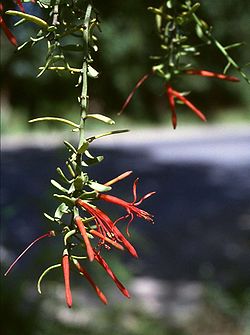
Picture of Loranthaceae
- Source
- Wikipedia/Commons
- Credit
- Franz Xaver
- Licence
- CC BY-SA 3.0
- Commercial use
- the licence allows it
No 3D scan of Loranthaceae was found in Sketchfab.
Smithsonian Open Access and MorphoSource were not reached for this taxon, so this list is what the others held rather than everything there is.
The description on this site
- Licence
- CC BY-SA 4.0
This is what the site found, which is not the same as what exists.
Keep going
What may have been alongside itSantalales through timeFormations of the PaleoceneThe world it lived on
Occurrence data from the Paleobiology Database, CC BY 4.0. de Jussieu 1808