Lithostrotion
Lithostrotion is a genus of rugose coral which is commonly found as a fossil within Carboniferous Limestone. Lithostrotion is a member of the family Lithostrotionidae. The genus Lithostrotion, a common and readily recognised group of fossils, became extinct by the end of the Palaeozoic era.

Jonathan Chen · CC BY-SA 4.0 · via Wikipedia/Commons. May be a photograph of a specimen, or an artist’s reconstruction — an interpretation of a skeleton, since colour and soft tissue are almost never preserved.
On record
Recorded, not inferred- Sits inside
- LithostrotioninaePBDB
- Diet
- suspension feederPBDB, for Rugosa
- Life habit
- epifaunalPBDB, for Rugosa
- Motility
- stationary, attachedPBDB, for Rugosa
- Vision
- blindPBDB, for Anthozoa
- Environment
- marinePBDB, for Rugosa
Time the record covers
At least 53 million years on record.
The record covers at least 351.9 Mya to 298.9 Mya. No occurrence read is dated outside 358.86 Mya to 201.4 Mya.
237 occurrences of Lithostrotion on record, most of them in the Carboniferous. Bar height is expected occurrences, not a count: each fossil is spread across the span it is dated to, so a tall narrow bar means tight dating and a low wide one means loose.
When
237 occurrences- Carboniferous98%
- Permian1%
- Early Triassicunder 1%
- Middle Triassicunder 1%
- Late Triassicunder 1%
These are dates about fossils, not the animal: the record can only begin after it arose and end before it died out, so either end may reach further. Shares are expected occurrences: a fossil dated to a span is counted partly in each period it straddles. More on what this infers.
Found in
78 formations
- Idmarrach Formation13
- Kogruk Formation · Lisburne Group10
- Waterhouses Limestone Formation8
- Mount Head Formation · Rundle Group7
- Tula Formation7
- Maydown Limestone Formation5
Loading coastlines…
The named rock units Lithostrotion has been recovered from, largest first. Drawn where the rock is now, not where it formed. 54 further formations hold fewer occurrences each and are not listed. 52 occurrences have no formation on record, which is common for older literature.
Lithostrotion and its relatives
CarboniferousWhere Lithostrotion and its relatives were recorded in the Carboniferous.
Found in the same rock
782 taxa- Syringopora31 sites
- Chonetes26 sites
- Palaeosmilia murchisoni23 sites
- Gigantoproductus21 sites
- Spirifer21 sites
- Dictyoclostus20 sites
- Echinoconchus punctatus18 sites
- Fenestella18 sites
- Angiospirifer bisulcatus17 sites
- Camarotoechia17 sites
- Cleiothyridina17 sites
- Composita17 sites
- Eomarginifera17 sites
- Archaediscus16 sites
- Caninia16 sites
- Brachythyris14 sites
- Chaetetes14 sites
- Diphyphyllum14 sites
- Dibunophyllum13 sites
- Endothyra bowmani13 sites
- Leptagonia analoga13 sites
- Siphonodendron martini13 sites
- Tetrataxis13 sites
- Dibunophyllum bipartitum12 sites
The Paleobiology Database records 115 sites for Lithostrotion, and this reads all of them. The number is how many of those sites it was catalogued from too. The 24 sharing the most are listed.
This is not a list of everything alive at the time. It is only what has come out of the same ground as this animal and been written down.
Entered from
66 references- The Yoredale Series of Upper Wensleydale and adjacent parts of North-West Yorkshire42
- Paleoecology of the Carboniferous reef complex and shelf limestones in the northwest Derbyshire, England17
- Late Visean to Early Serpukhovian rugose corals from the Yashui Section, Guizhou, South China12
- Preliminary data on the coral distribution in the Upper Visean (Mississippian) succession from Adarouch area (NE Central Morocco)12
- Serpukhovian coral assemblages from Idmarrach and Tirhela Formations (Adarouch, Morocco)10
- Carbonate Facies and the Lithostrotionid Corals of the Mississippian Kogruk Formation, DeLong Mountains, Northwestern Alaska10
- The Lower Carboniferous (Upper Visean) succession at Benburb, Northern Ireland9
- Rol korallov v biostratigrafii nizhnekamennougolnykh otlozheniy Tatarii [The biostratigraphic significance of corals from the Lower Carboniferous of Tatar]8
- The stratigraphy of the Carboniferous rocks of the Weaver Hills District, North Staffordshire8
- The succession of Early Carboniferous coral faunas in eastern Australia and China7
- Rugose corals from the Upper Visean (Carboniferous) of the Jerada Massif (NE Morocco): taxonomy, biostratigraphy, facies and palaeobiogeography6
- Geology and mineral deposits of southeastern Alaska6
Each of the 237 occurrences read was entered from one of these publications, ordered by how many each accounts for. This is not a search for papers mentioning the name. 54 further references are not listed. Entries link to doi.org where the Paleobiology Database holds an identifier, and to its own record where it does not. Relayed as the Paleobiology Database holds them, not checked against what they resolve to.
Media and terms
Media content2

Picture of Lithostrotion
- Source
- Wikipedia/Commons
- Credit
- Jonathan Chen
- Licence
- CC BY-SA 4.0
- Commercial use
- the licence allows it
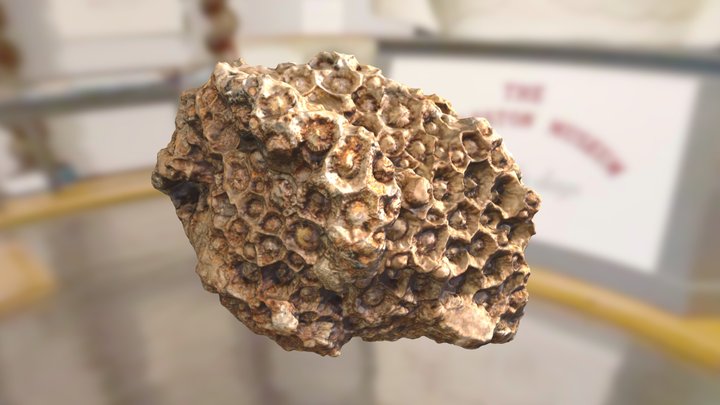
3D model
- Source
- Sketchfab
- Credit
- The Charleston Museum
- Licence
- CC Attribution-NonCommercial
- Commercial use
- the licence does not allow it
Smithsonian Open Access was not reached for this taxon, so this list is what the others held rather than everything there is.
The description on this site
- Licence
- CC BY-SA 4.0
This is what the site found, which is not the same as what exists.
Keep going
What may have been alongside itLithostrotioninae through timeFormations of the CarboniferousThe world it lived on
Occurrence data from the Paleobiology Database, CC BY 4.0. Fleming 1828