Lingularia

via iDigBio · CC BY-NC-SA · via iDigBio. May be a photograph of a specimen, or an artist’s reconstruction — an interpretation of a skeleton, since colour and soft tissue are almost never preserved.
On record
Recorded, not inferred- Sits inside
- LingulidaePBDB
- Diet
- suspension feederPBDB, for Lingulidae
- Life habit
- infaunalPBDB, for Lingulidae
- Motility
- facultatively mobilePBDB, for Lingulidae
- Vision
- blindPBDB, for Lingulata
- Environment
- marinePBDB, for Lophophorata
Time the record covers
At least 285 million years on record.
The record covers at least 379 Mya to 93.9 Mya. No occurrence read is dated outside 382.31 Mya to 89.8 Mya.
358 occurrences of Lingularia on record, most of them in the Early Triassic. Bar height is expected occurrences, not a count: each fossil is spread across the span it is dated to, so a tall narrow bar means tight dating and a low wide one means loose.
When
358 occurrences- Devonianunder 1%
- Carboniferous19%
- Permian4%
- Early Triassic50%
- Middle Triassic15%
- Late Triassic3%
- Early Jurassic7%
- Late Jurassicunder 1%
- Early Cretaceous1%
- Late Cretaceousunder 1%
These are dates about fossils, not the animal: the record can only begin after it arose and end before it died out, so either end may reach further. Shares are expected occurrences: a fossil dated to a span is counted partly in each period it straddles. More on what this infers.
Found in
69 formations
- Second Abden Shale Formation63
- Werfen Formation24
- Kayitou Formation19
- Dinwoody Formation18
- Grès à Voltzia Formation · Buntsandstein Group16
- Feixianguan Formation15
Loading coastlines…
The named rock units Lingularia has been recovered from, largest first. Drawn where the rock is now, not where it formed. 45 further formations hold fewer occurrences each and are not listed. 32 occurrences have no formation on record, which is common for older literature.
Lingularia and its relatives
Early TriassicWhere Lingularia and its relatives were recorded in the Early Triassic.
Found in the same rock
589 taxa- Paraparchites43 sites
- Streblopteria39 sites
- Glomospira37 sites
- Rastidiscus sp.37 sites
- Bivalvia28 sites
- Crurithyris urei23 sites
- Retispira decussatus21 sites
- Aclisina pulchra intermedia20 sites
- Eomarginifera longispinus20 sites
- Glabrocingulum20 sites
- Actinopteria19 sites
- Crinoidea17 sites
- Eumorphotis multiformis16 sites
- Productidae16 sites
- Pteria ussurica variabilis15 sites
- Unionites fassaensis15 sites
- Pseudorthoceras knoxense14 sites
- Unionites canalensis14 sites
- Neoschizodus laevigatus13 sites
- Pelecypoda lamellibranch spat13 sites
- Vertebrata12 sites
- Crurithyris11 sites
- Hollinella tingi11 sites
- Ortonia11 sites
The Paleobiology Database records 329 sites for Lingularia, and this reads 240 of them. The number is how many of those sites it was catalogued from too. The 24 sharing the most are listed.
This is not a list of everything alive at the time. It is only what has come out of the same ground as this animal and been written down.
Entered from
77 references- Personal Opinions67
- The paleoecology of a Lower Carboniferous marine transgression63
- Faunes et paysages du Grès à Voltzia du Nord des Vosges: Essai paléoécologique sur le Buntsandstein supérieur17
- Yang et al., 198715
- Temperature-related body size change of marine benthic macroinvertebrates across the Early Toarcian Anoxic Event13
- The Impact of Global Warming and Anoxia on Marine Benthic Community Dynamics: an Example from the Toarcian (Early Jurassic)10
- Das Festungsprofil auf Spitzbergen V: Stratigraphie und Invertebratenfauna der Äletern Eotrias10
- Recovery dynamics of benthic marine communities from the Lower Triassic Werfen Formation, northern Italy9
- A new paleoecological look at the Dinwoody Formation (Lower Triassic, Western USA): intrinsic versus extrinsic controls on ecosystem recovery after the end-Permian mass extinction9
- A brachiopod fauna from latest Permian to Induan of northern Guizhou, South China and its evolutionary pattern7
- Die Fossilien der Würzburger Trias: Brachiopoda7
- Recovery of benthic marine communities from the end-Permian mass extinction at the low latitudes of eastern Panthalassa6
Each of the 358 occurrences read was entered from one of these publications, ordered by how many each accounts for. This is not a search for papers mentioning the name. 65 further references are not listed. Entries link to doi.org where the Paleobiology Database holds an identifier, and to its own record where it does not. Relayed as the Paleobiology Database holds them, not checked against what they resolve to.
Media and terms
Media content2
Picture of Lingularia
- Source
- iDigBio
- Credit
- via iDigBio
- Licence
- CC BY-NC-SA
- Commercial use
- the licence does not allow it
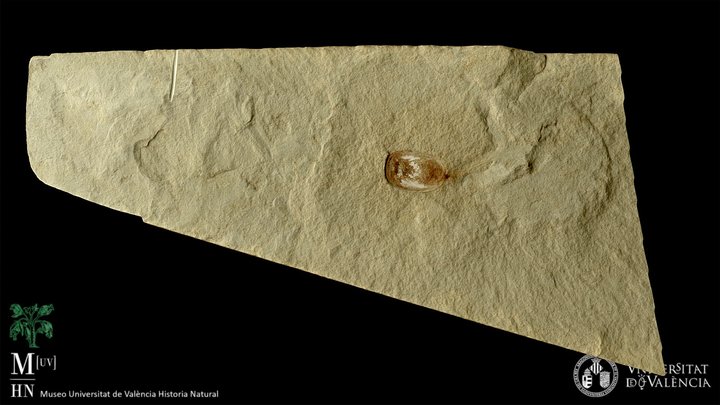
3D model
- Source
- Sketchfab
- Licence
- CC Attribution
- Commercial use
- cannot be read from the licence given — check the record
MorphoSource was not reached for this taxon, so this list is what the others held rather than everything there is.
This is what the site found, which is not the same as what exists.
Keep going
What may have been alongside itLingulidae through timeFormations of the Early TriassicThe world it lived on
Occurrence data from the Paleobiology Database, CC BY 4.0. Biernat and Emig 1993