Larus marinus
The great black-backed gull is the largest member of the gull and tern family Laridae. It is a very aggressive hunter, pirate and scavenger which breeds on the North Atlantic coasts and islands of northern Europe and northeastern North America. Southern populations are generally sedentary, while those breeding in the far north migrate farther south in winter. A few also move inland to large lakes and reservoirs. The adult has a white head, neck and underparts, dark blackish-grey wings and back, pink legs and the bill yellow with a red spot.

Andreas Trepte · CC BY-SA 2.5 · via Wikipedia/Commons. May be a photograph of a specimen, or an artist’s reconstruction — an interpretation of a skeleton, since colour and soft tissue are almost never preserved.
On record
Recorded, not inferred- Also called
- great black-backed gullPBDB
- Sits inside
- LarusPBDB
- Diet
- carnivorePBDB, for Coelurosauria
- Life habit
- ground dwelling, solitaryPBDB, for Theropoda
- Motility
- actively mobilePBDB, for Theropoda
- Environment
- marinePBDB, for Charadriiformes
Time the record covers
At most 129 thousand years on record.
Every occurrence read is dated to somewhere between 129 ka and 0 Mya, and nothing in the dating separates them, so that window is what the record shows rather than a span.
3 occurrences of Larus marinus on record, most of them in the Holocene. The Paleobiology Database records this as a living group. Bar height is expected occurrences, not a count: each fossil is spread across the span it is dated to, so a tall narrow bar means tight dating and a low wide one means loose.
When
3 occurrences- Pleistocene33%
- Holocene67%
These are dates about fossils, not the animal: the record can only begin after it arose and end before it died out, so either end may reach further. Shares are expected occurrences: a fossil dated to a span is counted partly in each period it straddles. More on what this infers.
Larus marinus and its relatives
HoloceneWhere Larus marinus and its relatives were recorded in the Holocene.
Found in the same rock
94 taxa- Larus argentatus2 sites
- Alca torda1 site
- Alligator mississippiensis1 site
- Amphiuma1 site
- Anas1 site
- Anas crecca1 site
- Anatidae1 site
- Anolis1 site
- Balaena mysticetus1 site
- Bison latifrons1 site
- Branta bernicla1 site
- Branta canadensis1 site
- Bufo1 site
- Canis familiaris1 site
- Cathartes aura1 site
- Catharus1 site
- Cepphus grylle1 site
- Chelydra serpentina1 site
- Colubrinae1 site
- Corvus corax1 site
- Crassostrea virginica1 site
- Deirochelys reticularia1 site
- Delphinapterus leucas1 site
- Elaphe1 site
The Paleobiology Database records 3 sites for Larus marinus, and this reads all of them. The number is how many of those sites it was catalogued from too. The 24 sharing the most are listed.
This is not a list of everything alive at the time. It is only what has come out of the same ground as this animal and been written down.
Entered from
3 references- The Pleistocene Avifauna of Clark Quarry, Glynn County, Georgia1
- Animals and the precontact Inuit of Labrador: an examination using faunal remains, space and myth1
- Northern birds from a Florida Indian midden1
Each of the 3 occurrences read was entered from one of these publications, ordered by how many each accounts for. This is not a search for papers mentioning the name. Entries link to doi.org where the Paleobiology Database holds an identifier, and to its own record where it does not. Relayed as the Paleobiology Database holds them, not checked against what they resolve to.
Media and terms
Media content1
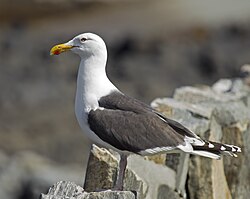
Picture of Larus marinus
- Source
- Wikipedia/Commons
- Credit
- Andreas Trepte
- Licence
- CC BY-SA 2.5
- Commercial use
- the licence allows it
No 3D scan of Larus marinus was found in Sketchfab.
Smithsonian Open Access and MorphoSource were not reached for this taxon, so this list is what the others held rather than everything there is.
The description on this site
- Licence
- CC BY-SA 4.0
This is what the site found, which is not the same as what exists.
Keep going
What may have been alongside itLarus through timeFormations of the HoloceneThe world it lived on
Occurrence data from the Paleobiology Database, CC BY 4.0. Linnaeus 1758