Lambis
Lambis is a genus of large sea snails sometimes known as spider conchs, marine gastropod mollusks in the family Strombidae, the true conch family.

H. Zell · CC BY-SA 3.0 · via Wikipedia/Commons. May be a photograph of a specimen, or an artist’s reconstruction — an interpretation of a skeleton, since colour and soft tissue are almost never preserved.
On record
Recorded, not inferred- Sits inside
- StrombusPBDB
- Diet
- omnivore, grazerPBDB, for Strombidae
- Life habit
- epifaunalPBDB, for Strombidae
- Motility
- actively mobilePBDB, for Strombidae
- Vision
- limitedPBDB, for Gastropoda
Time the record covers
At least 199 million years on record.
The record covers at least 199.5 Mya to 129 ka. No occurrence read is dated outside 201.4 Mya to 11.7 ka.
36 occurrences of Lambis on record, most of them in the Pleistocene. The Paleobiology Database records this as a living group. Bar height is expected occurrences, not a count: each fossil is spread across the span it is dated to, so a tall narrow bar means tight dating and a low wide one means loose.
When
36 occurrences- Early Jurassic6%
- Middle Jurassic8%
- Late Jurassic8%
- Early Cretaceous8%
- Paleocene6%
- Eocene22%
- Miocene3%
- Pleistocene39%
These are dates about fossils, not the animal: the record can only begin after it arose and end before it died out, so either end may reach further. Shares are expected occurrences: a fossil dated to a span is counted partly in each period it straddles. More on what this infers.
Found in
10 formations
- Waimanalo Formation5
- Arab Formation · Shaqra Group2
- Sa Wer Formation2
- Drug Formation2
- Khuiala Formation1
- Hangu Formation1
Loading coastlines…
The named rock units Lambis has been recovered from, largest first. Drawn where the rock is now, not where it formed. 19 occurrences have no formation on record, which is common for older literature.
Lambis and its relatives
PleistoceneWhere Lambis and its relatives were recorded in the Pleistocene.
Found in the same rock
442 taxa- Ampullina4 sites
- Natica3 sites
- Pinna3 sites
- Turbo3 sites
- Arca2 sites
- Cardita2 sites
- Cardium2 sites
- Cepatia cepacea2 sites
- Cerithium2 sites
- Chama2 sites
- Conus2 sites
- Cubitostrea multicostata2 sites
- Dolicholatirus2 sites
- Eovasum haimei2 sites
- Everticyclammina2 sites
- Exogyra2 sites
- Fusinus2 sites
- Globularia coxi2 sites
- Goniopygus2 sites
- Lima2 sites
- Lucina2 sites
- Mytilus2 sites
- Nerinea somaliensis2 sites
- Ostrea2 sites
The Paleobiology Database records 21 sites for Lambis, and this reads all of them. The number is how many of those sites it was catalogued from too. The 24 sharing the most are listed.
This is not a list of everything alive at the time. It is only what has come out of the same ground as this animal and been written down.
Entered from
20 references- Fossil mollusks of Oahu, Hawaii Islands5
- Pleistocene Coral Reef Terraces on the Saudi Arabian Side of the Gulf of Aqaba, Red Sea3
- Fauna de moluste a depozitelor Paleogene din nord-vestul Transilvaniei [Molluscan fauna from Paleogene deposits from NW Transilvania]3
- A contribution to the study of the Eocene in Western Pakistan and Western India: C. The description of the Scaphopoda and Gastropoda from standard sections in the Rakhi Nala and Zindar Pir areas of the Western Punjab and in the Kohat District3
- Late Pleistocene gastropods from the raised reefal limestone of Jeddah, Saudi Arabia: taxonomic and palaeoenvironmental implications2
- Le Jurassique D`Arabie Centrale2
- Jurassic sequences from the Somali coast of the Gulf of Aden2
- Cenozoic fossil mollusks from Western Pacific Islands; Gastropods (Turritellidae through Strombidae)2
- Recherches géologiques sur le Crétacé inférieur de l'Estremadura (Portugal)2
- Paléontologie de l’étage inférieur de la Formation Liasique de la Province de Luxembourg (Grand-Duché) et de Hettange, Département de la Moselle [Paleontology of the lower stage of the Liassic Formation of the Province of Luxembourg (Grand Duchy) and Hettange, Moselle Department]2
- Sedimentology of rocky shorelines: 4. Coarse gravel lithofacies, molluscan biofacies, and the stratigraphic and eustatic records in the type area of the Pleistocene Hulopoe Gravel, Lanai, Hawaii1
- An Early Pleistocene molluscan assemblage from Fiji: gastropod faunal composition, paleoecology and biogeography1
Each of the 36 occurrences read was entered from one of these publications, ordered by how many each accounts for. This is not a search for papers mentioning the name. 8 further references are not listed. Entries link to doi.org where the Paleobiology Database holds an identifier, and to its own record where it does not. Relayed as the Paleobiology Database holds them, not checked against what they resolve to.
Media and terms
Media content2

Picture of Lambis
- Source
- Wikipedia/Commons
- Credit
- H. Zell
- Licence
- CC BY-SA 3.0
- Commercial use
- the licence allows it
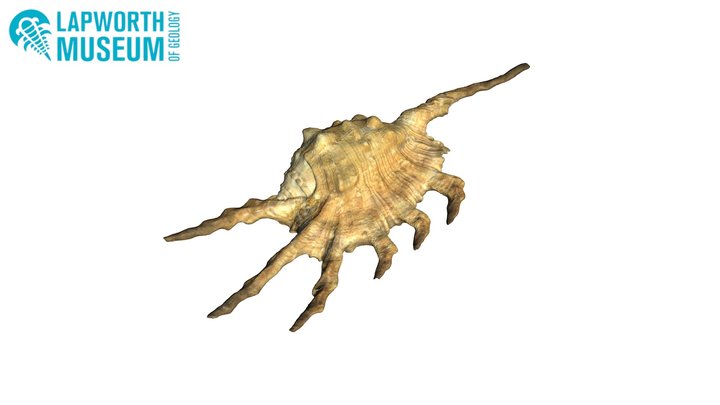
3D model
- Source
- Sketchfab
- Licence
- CC Attribution-NonCommercial
- Commercial use
- the licence does not allow it
Smithsonian Open Access and MorphoSource were not reached for this taxon, so this list is what the others held rather than everything there is.
The description on this site
- Source
- Wikipedia, “Lambis”
- Licence
- CC BY-SA 4.0
This is what the site found, which is not the same as what exists.
Keep going
What may have been alongside itStrombus through timeFormations of the PleistoceneThe world it lived on
Occurrence data from the Paleobiology Database, CC BY 4.0. Röding 1798