Hybodontidae
Hybodontiformes, commonly called hybodonts, are an extinct group of shark-like cartilaginous fish (chondrichthyans) which existed from the late Devonian to the Late Cretaceous. Hybodonts share a close common ancestry with modern sharks and rays (Neoselachii) as part of the clade Euselachii. They are distinguished from other chondrichthyans by their distinctive fin spines and cephalic spines present on the heads of males. An ecologically diverse group, they were abundant in marine and freshwater environments during the late Paleozoic and early Mesozoic, but were rare in open marine environments by the end of the Jurassic, having been largely replaced by modern sharks, though they were still common in freshwater and marginal marine habitats. They survived until the end of the Cretaceous, before going extinct.

Sebastian Stumpf Faviel A. López‐Romero René Kindlimann Frederic Lacombat Burkhard Pohl Jürgen Kriwet · CC BY 4.0 · via Wikipedia/Commons. May be a photograph of a specimen, or an artist’s reconstruction — an interpretation of a skeleton, since colour and soft tissue are almost never preserved.
On record
Recorded, not inferred- Sits inside
- HybodontiformesPBDB
- Diet
- carnivorePBDB, for Chondrichthyes
- Life habit
- nektonicPBDB, for Chondrichthyes
- Motility
- actively mobilePBDB, for Chondrichthyes
Time the record covers
At least 356 million years on record.
The record covers at least 372.15 Mya to 15.98 Mya. No occurrence read is dated outside 382.31 Mya to 13.82 Mya.
671 occurrences of Hybodontidae on record, most of them in the Late Cretaceous. Bar height is expected occurrences, not a count: each fossil is spread across the span it is dated to, so a tall narrow bar means tight dating and a low wide one means loose.
When
671 occurrences- Devonianunder 1%
- Carboniferousunder 1%
- Permian2%
- Early Triassic4%
- Middle Triassic9%
- Late Triassic9%
- Early Jurassic10%
- Middle Jurassic4%
- Late Jurassic5%
- Early Cretaceous26%
- Late Cretaceous31%
- Mioceneunder 1%
These are dates about fossils, not the animal: the record can only begin after it arose and end before it died out, so either end may reach further. Shares are expected occurrences: a fossil dated to a span is counted partly in each period it straddles. More on what this infers.
Found in
211 formations
- Durlston Formation · Purbeck Group24
- Dinosaur Park Formation · Belly River Group18
- Mesaverde Formation18
- Cañete Formation13
- Judith River Formation · Montana Group12
- Sao Khua Formation · Khorat Group10
Loading coastlines…
The named rock units Hybodontidae has been recovered from, largest first. Drawn where the rock is now, not where it formed. 187 further formations hold fewer occurrences each and are not listed. 158 occurrences have no formation on record, which is common for older literature.
Hybodontidae and its relatives
Late CretaceousWhere Hybodontidae and its relatives were recorded in the Late Cretaceous.
Found in the same rock
1,820 taxa- Hybodus99 sites
- Crocodylia42 sites
- Theropoda40 sites
- Myledaphus bipartitus38 sites
- Meristodonoides montanensis37 sites
- Testudines34 sites
- Ischyrhiza mira31 sites
- Lepidotes31 sites
- Archaeolamna kopingensis28 sites
- Anura24 sites
- Amiidae23 sites
- Egertonodus basanus23 sites
- Paralbula casei23 sites
- Scapanorhynchus texanus23 sites
- Teleostei23 sites
- Hybodontiformes22 sites
- Parvodus parvidens21 sites
- Odontaspis aculeatus20 sites
- Squalicorax kaupi20 sites
- Protoplatyrhina renae19 sites
- Trionychidae19 sites
- Osteichthyes18 sites
- Squamata18 sites
- Belonostomus longirostris17 sites
The Paleobiology Database records 544 sites for Hybodontidae, and this reads 240 of them. The number is how many of those sites it was catalogued from too. The 24 sharing the most are listed.
This is not a list of everything alive at the time. It is only what has come out of the same ground as this animal and been written down.
Entered from
342 references- Selachian faunas from the lowermost Purbeck Group of Dorset, southern England28
- Catalogue of the Fossil Fishes in the British Museum (Natural History) Part 120
- The dentition of Hybodus hauffianus Fraas, 1895 (Toarcian, Early Jurassic)18
- A new selachian fauna from the late Campanian of Wyoming (Teapot Sandstone Member, Mesaverde Formation, Big Horn Basin)16
- The Chondrichthyan Fauna from the Middle Triassic (Ladinian)of the Iberian Range (Spain)13
- Paleoecology of an estuarine, incised-valley fill in the Dinosaur Park Formation (Judith River Group, Upper Cretaceous) of southern Alberta, Canada12
- Ergebnisse der Forschungsreisen Prof. E. Stromers in den Wüsten Ägyptens II. Wirbeltier-Reste der Baharîje-Stufe (unterstes Cenoman) 9. Die Plagiostomen, mit einem Anhang über käno- und mesozoische Rückenflossenstacheln von Elasmobranchiern9
- Position stratigraphique des niveaux à vertébrés du Mésozoïque Sud-Est de la Tunisie [Stratigraphic position of beds with Mesozoic vertebrates from southeastern Tunisia]8
- Cartilaginous fishes of the Trinity Group and related rocks (Lower Cretaceous) of north central Texas8
- L'Infralias dans la Franche-Comté [The Lower Lias of Franche-Comté]8
- Contribution à l'étude des Sélaciens du Crétacé du Bassin de Paris. Découverte de quelques nouvelles espèces associées à une faune de type wealdien dans le Barrémien supérieur (Crétacé inférieur) des environs de Troyes (Aube)7
- A new selachian fauna from the Judith River Formation (Campanian) of Montana7
Each of the 671 occurrences read was entered from one of these publications, ordered by how many each accounts for. This is not a search for papers mentioning the name. 330 further references are not listed. Entries link to doi.org where the Paleobiology Database holds an identifier, and to its own record where it does not. Relayed as the Paleobiology Database holds them, not checked against what they resolve to.
Media and terms
Media content3

Picture of Hybodontidae
- Source
- Wikipedia/Commons
- Credit
- Sebastian Stumpf Faviel A. López‐Romero René Kindlimann Frederic Lacombat Burkhard Pohl Jürgen Kriwet
- Licence
- CC BY 4.0
- Commercial use
- the licence allows it
CT scan
- Source
- MorphoSource
- Licence
- not stated by the source
- Commercial use
- cannot be read from the licence given — check the record
- Specimen
- Hybodontidae indet. · pefo:53779
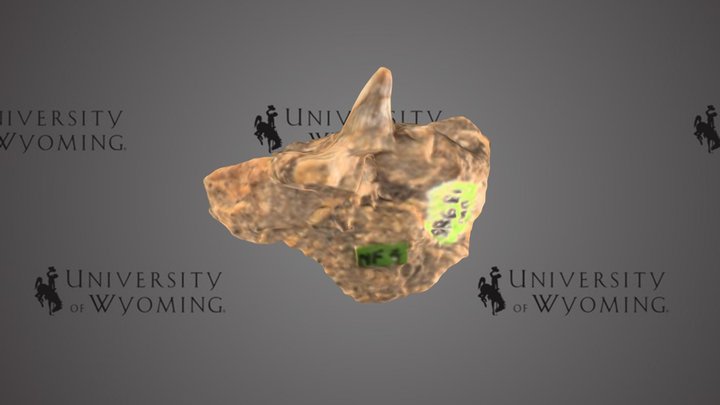
3D model
- Source
- Sketchfab
- Licence
- CC Attribution-NonCommercial
- Commercial use
- the licence does not allow it
Smithsonian Open Access was not reached for this taxon, so this list is what the others held rather than everything there is.
The description on this site
- Licence
- CC BY-SA 4.0
This is what the site found, which is not the same as what exists.
Keep going
What may have been alongside itHybodontiformes through timeFormations of the Late CretaceousThe world it lived on
Occurrence data from the Paleobiology Database, CC BY 4.0. Agassiz 1834