Histrionicus histrionicus
The harlequin duck is a small sea duck. It takes its name from Harlequin, a colourfully dressed character in the commedia dell'arte theatre of Italy. The species name comes from the Latin word histrio, meaning "actor". Other names include painted duck, totem pole duck, rock duck, glacier duck, mountain duck, white-eyed diver, squeaker, lords and ladies and blue streak.

Chuck Homler d/b/a Focus On Wildlife · CC BY-SA 4.0 · via Wikipedia/Commons. May be a photograph of a specimen, or an artist’s reconstruction — an interpretation of a skeleton, since colour and soft tissue are almost never preserved.
On record
Recorded, not inferred- Also called
- harlequin duckPBDB
- Sits inside
- HistrionicusPBDB
- Diet
- herbivorePBDB, for Anseriformes
- Life habit
- volantPBDB, for Anseriformes
- Motility
- actively mobilePBDB, for Theropoda
- Environment
- terrestrialPBDB, for Theropoda
Time the record covers
At least 3.4 million years on record.
The record covers at least 3.6 Mya to 129 ka. No occurrence read is dated outside 5.333 Mya to 11.7 ka.
6 occurrences of Histrionicus histrionicus on record, most of them in the Pleistocene. The Paleobiology Database records this as a living group. Bar height is expected occurrences, not a count: each fossil is spread across the span it is dated to, so a tall narrow bar means tight dating and a low wide one means loose.
When
6 occurrences- Pliocene17%
- Pleistocene83%
These are dates about fossils, not the animal: the record can only begin after it arose and end before it died out, so either end may reach further. Shares are expected occurrences: a fossil dated to a span is counted partly in each period it straddles. More on what this infers.
Found in
2 formations
- Yorktown Formation · Chesapeake Group1
- San Pedro Formation1
Loading coastlines…
The named rock units Histrionicus histrionicus has been recovered from, largest first. Drawn where the rock is now, not where it formed. 4 occurrences have no formation on record, which is common for older literature.
Histrionicus histrionicus and its relatives
PleistoceneWhere Histrionicus histrionicus and its relatives were recorded in the Pleistocene.
Found in the same rock
596 taxa- Anas platyrhynchos5 sites
- Ardenna grisea4 sites
- Aethia cristatella3 sites
- Ardenna tenuirostris3 sites
- Cetacea3 sites
- Clangula hyemalis3 sites
- Fraterculini3 sites
- Phalacrocorax pelagicus3 sites
- Phoebastria albatrus3 sites
- Podiceps3 sites
- Shiriyanetta hasegawai3 sites
- Synthliboramphus antiquus3 sites
- Uria onoi3 sites
- Zalophus californianus3 sites
- Accipitridae2 sites
- Aethia pusilla2 sites
- Anatidae2 sites
- Apodemus2 sites
- Bison2 sites
- Bucephala albeola2 sites
- Bufo2 sites
- Callorhinus ursinus2 sites
- Canis lupus2 sites
- Capricornis crispus2 sites
The Paleobiology Database records 6 sites for Histrionicus histrionicus, and this reads all of them. The number is how many of those sites it was catalogued from too. The 24 sharing the most are listed.
This is not a list of everything alive at the time. It is only what has come out of the same ground as this animal and been written down.
Entered from
4 references- Pleistocene seabirds from Shiriya, northeast Japan: systematics and oceanographic context3
- The presence of Harlequin duck Histrionicus histrionicus (Linnaeus 1758) in the Middle Pleistocene of Italy1
- Miocene and Pliocene birds from the Lee Creek Mine, North Carolina1
- Marine studies of San Pedro Bay, California1
Each of the 6 occurrences read was entered from one of these publications, ordered by how many each accounts for. This is not a search for papers mentioning the name. Entries link to doi.org where the Paleobiology Database holds an identifier, and to its own record where it does not. Relayed as the Paleobiology Database holds them, not checked against what they resolve to.
Media and terms
Media content3

Picture of Histrionicus histrionicus
- Source
- Wikipedia/Commons
- Credit
- Chuck Homler d/b/a Focus On Wildlife
- Licence
- CC BY-SA 4.0
- Commercial use
- the licence allows it
CT scan
- Source
- MorphoSource
- Credit
- MCZ Ornithology
- Licence
- In Copyright
- Commercial use
- cannot be read from the licence given — check the record
- Specimen
- Histrionicus histrionicus · MCZ:Orn:336960
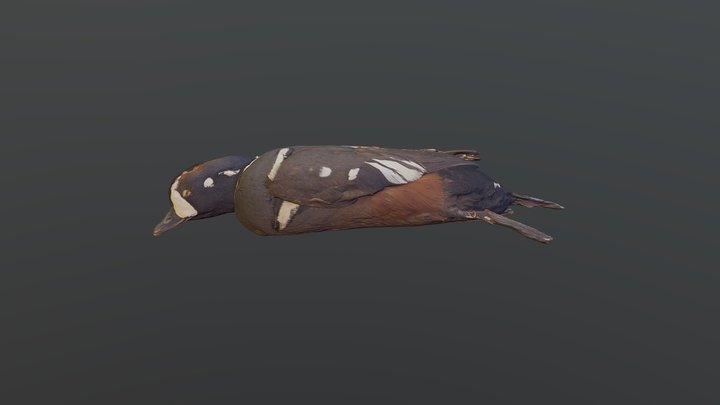
Smithsonian Open Access was not reached for this taxon, so this list is what the others held rather than everything there is.
The description on this site
- Licence
- CC BY-SA 4.0
This is what the site found, which is not the same as what exists.
Keep going
What may have been alongside itHistrionicus through timeFormations of the PleistoceneThe world it lived on
Occurrence data from the Paleobiology Database, CC BY 4.0. (Linnaeus 1758)