Heterocentrotus
Heterocentrotus is a genus of the family Echinometridae. They are mainly found in the Indo-Pacific basin, especially in Reunion or Hawaii. This genus appeared in the Miocene and spread throughout the warm Indo-Pacific.

David Burdick · Public Domain · via Wikipedia/Commons. May be a photograph of a specimen, or an artist’s reconstruction — an interpretation of a skeleton, since colour and soft tissue are almost never preserved.
On record
Recorded, not inferred- Sits inside
- EchinometridaePBDB
- Diet
- grazer, deposit feederPBDB, for Echinoidea
- Life habit
- epifaunalPBDB, for Echinoidea
- Motility
- actively mobilePBDB, for Echinoidea
- Vision
- limitedPBDB, for Echinoidea
- Environment
- marinePBDB, for Echinodermata
Time the record covers
At least 15 million years on record.
The record covers at least 15.98 Mya to 11.7 ka. No occurrence read is dated outside 23.04 Mya to 0 Mya.
15 occurrences of Heterocentrotus on record, most of them in the Pleistocene. The Paleobiology Database records this as a living group. Bar height is expected occurrences, not a count: each fossil is spread across the span it is dated to, so a tall narrow bar means tight dating and a low wide one means loose.
When
15 occurrences- Miocene13%
- Pliocene29%
- Pleistocene45%
- Holocene13%
These are dates about fossils, not the animal: the record can only begin after it arose and end before it died out, so either end may reach further. Shares are expected occurrences: a fossil dated to a span is counted partly in each period it straddles. More on what this infers.
Found in
6 formations
- Ndalithoni Limestone Formation3
- "Old Reef Limestone" Formation1
- Tagpochau Formation1
- Futuna Limestone Formation1
- Shagra Formation1
- Samadai Formation1
Loading coastlines…
The named rock units Heterocentrotus has been recovered from, largest first. Drawn where the rock is now, not where it formed. 7 occurrences have no formation on record, which is common for older literature.
Heterocentrotus and its relatives
PleistoceneWhere Heterocentrotus and its relatives were recorded in the Pleistocene.
Found in the same rock
91 taxa- Clypeaster3 sites
- Echinopora gemmacea3 sites
- Goniastrea retiformis3 sites
- Laganum depressum3 sites
- Platygyra daedalea3 sites
- Pocillopora eydouxi3 sites
- Pocillopora verrucosa3 sites
- Acropora abrotanoides2 sites
- Acropora humilis2 sites
- Acropora robusta2 sites
- Cardium2 sites
- Clypeaster reticulatus2 sites
- Cyphastrea serailia2 sites
- Favites complanata2 sites
- Gloripallium pallium2 sites
- Goniastrea stelligera2 sites
- Hydrolithon onkodes2 sites
- Hyotissa virleti2 sites
- Leptastrea2 sites
- Lithophaga2 sites
- Lopha2 sites
- Lucina2 sites
- Millepora platyphylla2 sites
- Pecten vasseli2 sites
The Paleobiology Database records 8 sites for Heterocentrotus, and this reads all of them. The number is how many of those sites it was catalogued from too. The 24 sharing the most are listed.
This is not a list of everything alive at the time. It is only what has come out of the same ground as this animal and been written down.
Entered from
11 references- Geology of Lau, Fiji4
- Pliocene and Plio-Pleistocene macrofauna from the Red Sea coastal plain (Egypt): biostratigraphy and biogeography2
- Biofacies and diagenetic alterations of the Pleistocene coral reefs, northwest Red Sea coast, Saudi Arabia1
- Pleistocene Coral Reef Terraces on the Saudi Arabian Side of the Gulf of Aqaba, Red Sea1
- Sea-level and reef accretion history of Marine Oxygen Isotope Stage 7 and late Stage 5 based on age and facies of submerged late Pleistocene reefs, Oahu, Hawaii1
- Contributions to the Pleistocene coral reefs of the Red Sea coast, Egypt1
- Personal data1
- Postglacial growth history of a French Polynesian barrier reef tract, Tahiti, central Pacific1
- Response of reef coral communities to sea-level rise: a Holocene model from Mauritius (western Indian Ocean)1
- Geology of Saipan, Mariana Islands: Part 1. General Geology1
- Fossiles Néogénes et Quaternaires des Nouvelles-Hébrides1
Each of the 15 occurrences read was entered from one of these publications, ordered by how many each accounts for. This is not a search for papers mentioning the name. Entries link to doi.org where the Paleobiology Database holds an identifier, and to its own record where it does not. Relayed as the Paleobiology Database holds them, not checked against what they resolve to.
Media and terms
Media content2

Picture of Heterocentrotus
- Source
- Wikipedia/Commons
- Credit
- David Burdick
- Licence
- Public Domain
- Commercial use
- the licence allows it
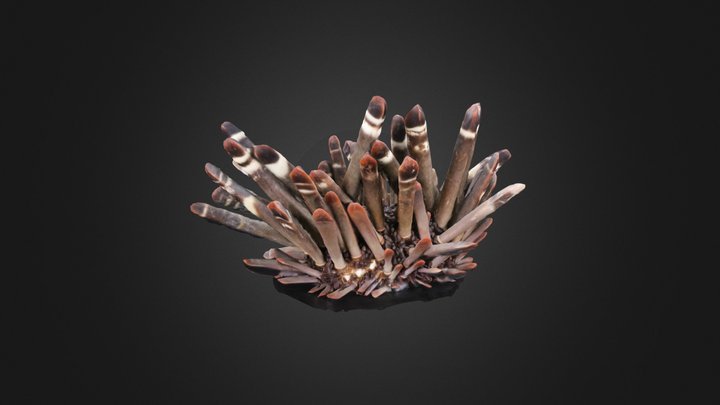
3D model
- Source
- Sketchfab
- Licence
- CC0 Public Domain
- Commercial use
- the licence allows it
Smithsonian Open Access was not reached for this taxon, so this list is what the others held rather than everything there is.
The description on this site
- Licence
- CC BY-SA 4.0
This is what the site found, which is not the same as what exists.
Keep going
What may have been alongside itEchinometridae through timeFormations of the PleistoceneThe world it lived on
Occurrence data from the Paleobiology Database, CC BY 4.0. Brandt 1835