Platygyra daedalea
Platygyra daedalea, sometimes known as the lesser valley coral, is a colonial species of stony coral in the family Merulinidae. It occurs on reefs in shallow water in the Indo-Pacific region. It is a common species and the International Union for Conservation of Nature has assessed its conservation status as being of "least concern".

Diego Delso · CC BY-SA 4.0 · via Wikipedia/Commons. May be a photograph of a specimen, or an artist’s reconstruction — an interpretation of a skeleton, since colour and soft tissue are almost never preserved.
On record
Recorded, not inferred- Sits inside
- PlatygyraPBDB
- Diet
- microcarnivore, photosymbioticPBDB, for Scleractinia
- Life habit
- intermediate-level epifaunal, colonial, clonalPBDB, for Scleractinia
- Motility
- stationary, attachedPBDB, for Scleractinia
- Vision
- blindPBDB, for Anthozoa
- Environment
- marinePBDB, for Scleractinia
Time the record covers
At least 15 million years on record.
The record covers at least 15.98 Mya to 11.7 ka. No occurrence read is dated outside 20.45 Mya to 0 Mya.
82 occurrences of Platygyra daedalea on record, most of them in the Pleistocene. The Paleobiology Database records this as a living group. Bar height is expected occurrences, not a count: each fossil is spread across the span it is dated to, so a tall narrow bar means tight dating and a low wide one means loose.
When
82 occurrences- Miocene4%
- Pliocene14%
- Pleistocene70%
- Holocene12%
These are dates about fossils, not the animal: the record can only begin after it arose and end before it died out, so either end may reach further. Shares are expected occurrences: a fossil dated to a span is counted partly in each period it straddles. More on what this infers.
Found in
15 formations
- Samadai Formation5
- Upper Kalibeng Formation2
- Sobe Formation · Ryukyu Group2
- Naha Formation · Ryukyu Group2
- Farasan Formation2
- Chaya Formation2
Loading coastlines…
The named rock units Platygyra daedalea has been recovered from, largest first. Drawn where the rock is now, not where it formed. 58 occurrences have no formation on record, which is common for older literature.
Platygyra daedalea and its relatives
PleistoceneWhere Platygyra daedalea and its relatives were recorded in the Pleistocene.
Found in the same rock
474 taxa- Goniastrea retiformis19 sites
- Leptoria phrygia13 sites
- Acropora11 sites
- Galaxea fascicularis11 sites
- Cyphastrea serailia10 sites
- Goniastrea stelligera9 sites
- Porites9 sites
- Stylophora pistillata9 sites
- Cyphastrea microphthalma8 sites
- Dipsastraea speciosa8 sites
- Fungia8 sites
- Goniastrea pectinata8 sites
- Diploastrea heliopora7 sites
- Echinopora gemmacea7 sites
- Favites7 sites
- Galaxea astreata7 sites
- Leptastrea purpurea7 sites
- Lobophyllia corymbosa7 sites
- Pocillopora verrucosa7 sites
- Porites lutea7 sites
- Acropora humilis6 sites
- Dipsastraea laxa6 sites
- Dipsastraea pallida6 sites
- Favites abdita6 sites
The Paleobiology Database records 31 sites for Platygyra daedalea, and this reads all of them. The number is how many of those sites it was catalogued from too. The 24 sharing the most are listed.
This is not a list of everything alive at the time. It is only what has come out of the same ground as this animal and been written down.
Entered from
42 references- Limited membership in Pleistocene reef coral assemblages from the Huon Peninsula, Papua New Guinea: constancy during global change11
- Variations in Pleistocene coral assemblages in space and time in southern and northern central Ryukyu Islands, Japan7
- Quaternary corals (Scleractinia: Merulinidae) from the Egyptian and Saudi Arabian Red Sea Coast6
- Taxonomic vetting of Pleistocene coral occurrence data6
- Geological and geographical distribution of reef-corals in Japan4
- Taxonomic Study of Faviidae Family- Quaternary Corals of Okha-Mandal Taluka, Saurashtra Coast, Gujarat2
- Palaeoecology of well-preserved coral communities in a siliciclastic environment from the Late Pleistocene (MIS 7), Kish Island, Persian Gulf (Iran): the development of low-relief reef frameworks (biostromes) in increasingly restricted environments2
- Symbiosis in the Fossil Record: Eocene Nummulites and Pleistocene Reefs of Egypt2
- Field work Sinai2
- Contributions to the Pleistocene coral reefs of the Red Sea coast, Egypt2
- A 300000-yr coral reef record of sea level changes, Mururoa atoll (Tuamotu archipelago, French Polynesia)2
- Pliocene and Plio-Pleistocene macrofauna from the Red Sea coastal plain (Egypt): biostratigraphy and biogeography2
Each of the 82 occurrences read was entered from one of these publications, ordered by how many each accounts for. This is not a search for papers mentioning the name. 30 further references are not listed. Entries link to doi.org where the Paleobiology Database holds an identifier, and to its own record where it does not. Relayed as the Paleobiology Database holds them, not checked against what they resolve to.
Media and terms
Media content2

Picture of Platygyra daedalea
- Source
- Wikipedia/Commons
- Credit
- Diego Delso
- Licence
- CC BY-SA 4.0
- Commercial use
- the licence allows it
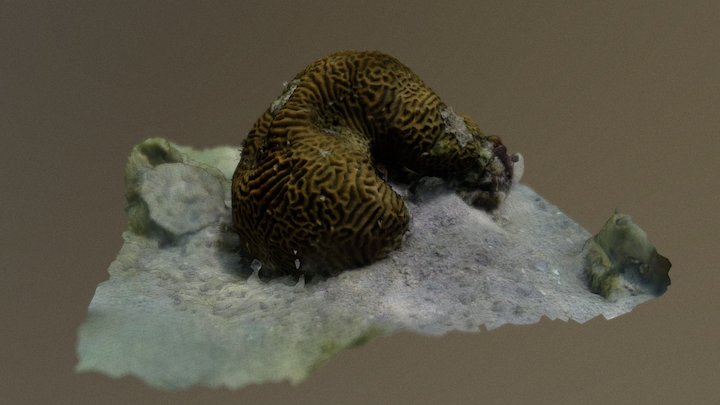
3D model
- Source
- Sketchfab
- Credit
- jordanmakesmaps
- Licence
- CC Attribution
- Commercial use
- cannot be read from the licence given — check the record
Smithsonian Open Access was not reached for this taxon, so this list is what the others held rather than everything there is.
The description on this site
- Licence
- CC BY-SA 4.0
This is what the site found, which is not the same as what exists.
Keep going
What may have been alongside itPlatygyra through timeFormations of the PleistoceneThe world it lived on
Occurrence data from the Paleobiology Database, CC BY 4.0. (Ellis and Solander 1786)