Goniopora
Goniopora, commonly referred to as flowerpot coral or daisy coral, is a genus of colonial stony coral found in lagoons and turbid water conditions. Goniopora have numerous daisy-like polyps that extend outward from the base, each tipped with 24 stinging tentacles which surrounds a mouth.

Peter Young Cho, MD · CC BY-SA 3.0 · via Wikipedia/Commons. May be a photograph of a specimen, or an artist’s reconstruction — an interpretation of a skeleton, since colour and soft tissue are almost never preserved.
On record
Recorded, not inferred- Sits inside
- PoritidaePBDB
- Diet
- photosymbiotic, suspension feederPBDB, for Poritidae
- Life habit
- colonial, clonalPBDB, for Poritidae
- Motility
- stationary, attachedPBDB, for Poritidae
- Vision
- blindPBDB, for Anthozoa
- Environment
- marinePBDB, for Poritidae
Time the record covers
At least 85 million years on record.
The record covers at least 85.7 Mya to 11.7 ka. No occurrence read is dated outside 143.1 Mya to 0 Mya.
428 occurrences of Goniopora on record, most of them in the Miocene. The Paleobiology Database records this as a living group. Bar height is expected occurrences, not a count: each fossil is spread across the span it is dated to, so a tall narrow bar means tight dating and a low wide one means loose.
When
428 occurrences- Early Cretaceousunder 1%
- Late Cretaceous5%
- Paleocene7%
- Eocene15%
- Oligocene19%
- Miocene32%
- Pliocene6%
- Pleistocene12%
- Holocene4%
These are dates about fossils, not the animal: the record can only begin after it arose and end before it died out, so either end may reach further. Shares are expected occurrences: a fossil dated to a span is counted partly in each period it straddles. More on what this infers.
Found in
109 formations
- Salayar Formation14
- Anguilla Formation13
- Tokelau Formation12
- Castro Limestone Formation9
- Qom Formation9
- Yalam Formation8
Loading coastlines…
The named rock units Goniopora has been recovered from, largest first. Drawn where the rock is now, not where it formed. 85 further formations hold fewer occurrences each and are not listed. 183 occurrences have no formation on record, which is common for older literature.
Goniopora and its relatives
MioceneWhere Goniopora and its relatives were recorded in the Miocene.
Found in the same rock
1,858 taxa- Porites61 sites
- Favites28 sites
- Stylophora28 sites
- Montastraea27 sites
- Astreopora25 sites
- Acropora23 sites
- Favia23 sites
- Alveopora19 sites
- Actinacis18 sites
- Porites portoricensis17 sites
- Porites waylandi17 sites
- Montastraea endothecata16 sites
- Porites baracoaensis16 sites
- Siderastrea16 sites
- Corallinaceae15 sites
- Pavona15 sites
- Stylophora pistillata15 sites
- Caulastrea14 sites
- Hydnophora14 sites
- Leptoseris14 sites
- Antiguastrea13 sites
- Lithothamnion13 sites
- Solenastrea bournoni13 sites
- Fungia12 sites
The Paleobiology Database records 171 sites for Goniopora, and this reads all of them. The number is how many of those sites it was catalogued from too. The 24 sharing the most are listed.
This is not a list of everything alive at the time. It is only what has come out of the same ground as this animal and been written down.
Entered from
164 references- Evolutionary dynamics of Indo-Pacific reef corals throughout the Neogene34
- Neogene paleontology in the northern Dominican Republic, 3. The family Poritidae (Anthozoa, Scleractinia)19
- Fossil corals from central America, Cuba, and Porto Rico, with an account of the American Tertiary, Pleistocene, and Recent coral reefs16
- A Bükkhegyseg Eocen Koralljai [Eocene corals from the Bükk Mountains]13
- Corals of the KT-boundary: Scleractinian corals of the suborders Dendrophylliina, Caryophylliina, Fungiina, Microsolenina, and Stylinina9
- Les faunes coralliennes de l’Oligocène de Malte : biodiversité et paléoenvironnement8
- Les faunes de coraux (Anthozoaires Scléractiniaires) de la façade atlantique française au Chattien et au Miocène8
- Recherches sur les Madreporaires et les formations recifales Miocenes de la Mediterranee occidentale [Miocene corals and reefs from the western Mediterranean]7
- Caribbean reef coral diversity during the Early to Middle Miocene: an Example from the Anguilla Formation6
- Die Anthozoenfauna des Jungtertiärs von Borneo [Anthozoa from the Upper Tertiary of Borneo]6
- Paläontologische Studien über die älteren Tertiärschichten der Alpen, 1: Die fossilen Anthozoen der Schichten von Castelgomberto [Paleontological studies about the older Tertiary beds in the Alps, 1: The fossil Anthozoa from the Castelcomberto Formation]6
- High coral diversity is coupled with reef-building capacity during the Late Oligocene warming event (Castro Limestone, Salento Peninsula, S Italy)5
Each of the 428 occurrences read was entered from one of these publications, ordered by how many each accounts for. This is not a search for papers mentioning the name. 152 further references are not listed. Entries link to doi.org where the Paleobiology Database holds an identifier, and to its own record where it does not. Relayed as the Paleobiology Database holds them, not checked against what they resolve to.
Media and terms
Media content3

Picture of Goniopora
- Source
- Wikipedia/Commons
- Credit
- Peter Young Cho, MD
- Licence
- CC BY-SA 3.0
- Commercial use
- the licence allows it
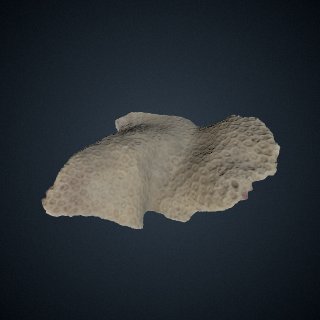
3D scan
- Source
- Smithsonian
- Licence
- CC0 — this site’s default, not the record’s
- Commercial use
- the licence allows it
- Specimen
- Goniopora somaliensis
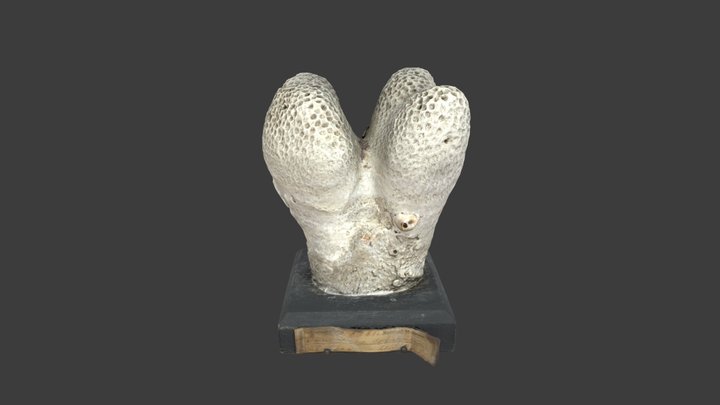
3D model
- Source
- Sketchfab
- Licence
- CC0 Public Domain
- Commercial use
- the licence allows it
The description on this site
- Source
- Wikipedia, “Goniopora”
- Licence
- CC BY-SA 4.0
This is what the site found, which is not the same as what exists.
Keep going
What may have been alongside itPoritidae through timeFormations of the MioceneThe world it lived on
Occurrence data from the Paleobiology Database, CC BY 4.0. Blainville 1830