Geodia
Geodia is a genus of sea sponge belonging to the family Geodiidae. It is the type genus of its taxonomic family.

Paco Cárdenas · CC BY-SA 3.0 · via Wikipedia/Commons. May be a photograph of a specimen, or an artist’s reconstruction — an interpretation of a skeleton, since colour and soft tissue are almost never preserved.
On record
Recorded, not inferred- Sits inside
- GeodiinaePBDB
- Diet
- suspension feederPBDB, for Demospongiae
- Life habit
- intermediate-level epifaunalPBDB, for Demospongiae
- Motility
- stationary, attachedPBDB, for Demospongiae
- Vision
- blindPBDB, for Porifera
Time the record covers
At least 318 million years on record.
The record covers at least 330.3 Mya to 11.63 Mya. No occurrence read is dated outside 335.9 Mya to 7.246 Mya.
30 occurrences of Geodia on record, most of them in the Eocene. The Paleobiology Database records this as a living group, and the chart stops with its fossils rather than at the present. Bar height is expected occurrences, not a count: each fossil is spread across the span it is dated to, so a tall narrow bar means tight dating and a low wide one means loose.
When
30 occurrences- Carboniferous3%
- Late Jurassic3%
- Early Cretaceous7%
- Late Cretaceous13%
- Paleocene3%
- Eocene43%
- Oligocene13%
- Miocene13%
These are dates about fossils, not the animal: the record can only begin after it arose and end before it died out, so either end may reach further. Shares are expected occurrences: a fossil dated to a span is counted partly in each period it straddles. More on what this infers.
Found in
8 formations
- Elmore Formation · Bracklesham Group11
- Upper Chalk Formation3
- Porters Creek Formation1
- Lagos-Portimao Formation1
- Castle Hayne Formation1
- Obukhov Formation1
Loading coastlines…
The named rock units Geodia has been recovered from, largest first. Drawn where the rock is now, not where it formed. 10 occurrences have no formation on record, which is common for older literature.
Geodia and its relatives
EoceneWhere Geodia and its relatives were recorded in the Eocene.
Found in the same rock
148 taxa- Coscinodiscus11 sites
- Cribrostomoides11 sites
- Ammodiscus10 sites
- Ammobaculites9 sites
- Bivalvia7 sites
- Gastropoda6 sites
- Triceratium5 sites
- Gaudryina4 sites
- Ochrophyta4 sites
- Echinodermata3 sites
- Alectona2 sites
- Cibicides2 sites
- Erylus2 sites
- Globulina gibba2 sites
- Nodellum2 sites
- Pachastrellidae2 sites
- Plantae2 sites
- Plinthosella squamosa2 sites
- Samus2 sites
- Theonellidae2 sites
- Tintinnida2 sites
- Acanthactinella bennei1 site
- Acrochordonia bifurcata1 site
- Acrochordonia ramosa1 site
The Paleobiology Database records 19 sites for Geodia, and this reads all of them. The number is how many of those sites it was catalogued from too. The 24 sharing the most are listed.
This is not a list of everything alive at the time. It is only what has come out of the same ground as this animal and been written down.
Entered from
11 references- Stratigraphy and Biota of the Elmore Formation (Huntingbridge division, Bracklesham Group) at Lee-on-the-Solent, Gosport, Hampshire11
- Catalogue of the fossil sponges in the Geological Department of the British Museum (Natural History)5
- Post-Eocene strata of the southern Viking Graben, northern North Sea; integrated biostratigraphic, strontium isotopic and lithostratigraphic study4
- Les spongiaires siliceux du Tortonien des Betiques (Miocene de l'Espagne du Sud): especes nouvelles ou peu connues, I: Choristides et Lithistides [Tortonian siliceous sponges from the Betics (Miocene of southern Spain): new or little known species, I: Choristida and Lithistida]3
- Hi diversity of siliceous sponges in Western Tethyan areas during the Eocene: Palaeobiogeographical, ecological and taxonomic significance1
- Late Valanginian sponge spicules from north-eastern Sardinia (Italy)1
- A major Eocene sponge fauna (Castle Hayne Formation, North Carolina)1
- Siliceous sponge spicules from the Miocene Mem Moniz Marls (Portugal) and their environmental significance1
- Microscleres of a Paleocene Geodia from western Alabama1
- Spongiofaunes du Jurassique Superieur du Portugal1
- Siliceous sponges from the Upper Cretaceous of Poland, part 1: Tetraxonia1
Each of the 30 occurrences read was entered from one of these publications, ordered by how many each accounts for. This is not a search for papers mentioning the name. Entries link to doi.org where the Paleobiology Database holds an identifier, and to its own record where it does not. Relayed as the Paleobiology Database holds them, not checked against what they resolve to.
Media and terms
Media content2

Picture of Geodia
- Source
- Wikipedia/Commons
- Credit
- Paco Cárdenas
- Licence
- CC BY-SA 3.0
- Commercial use
- the licence allows it
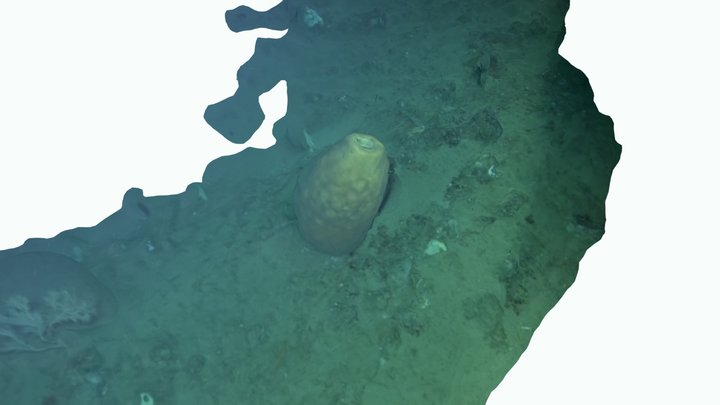
3D model
- Source
- Sketchfab
- Credit
- elena.prado
- Licence
- CC Attribution
- Commercial use
- cannot be read from the licence given — check the record
Smithsonian Open Access and MorphoSource were not reached for this taxon, so this list is what the others held rather than everything there is.
The description on this site
- Source
- Wikipedia, “Geodia”
- Licence
- CC BY-SA 4.0
This is what the site found, which is not the same as what exists.
Keep going
What may have been alongside itGeodiinae through timeFormations of the EoceneThe world it lived on
Occurrence data from the Paleobiology Database, CC BY 4.0. Lamarck 1815